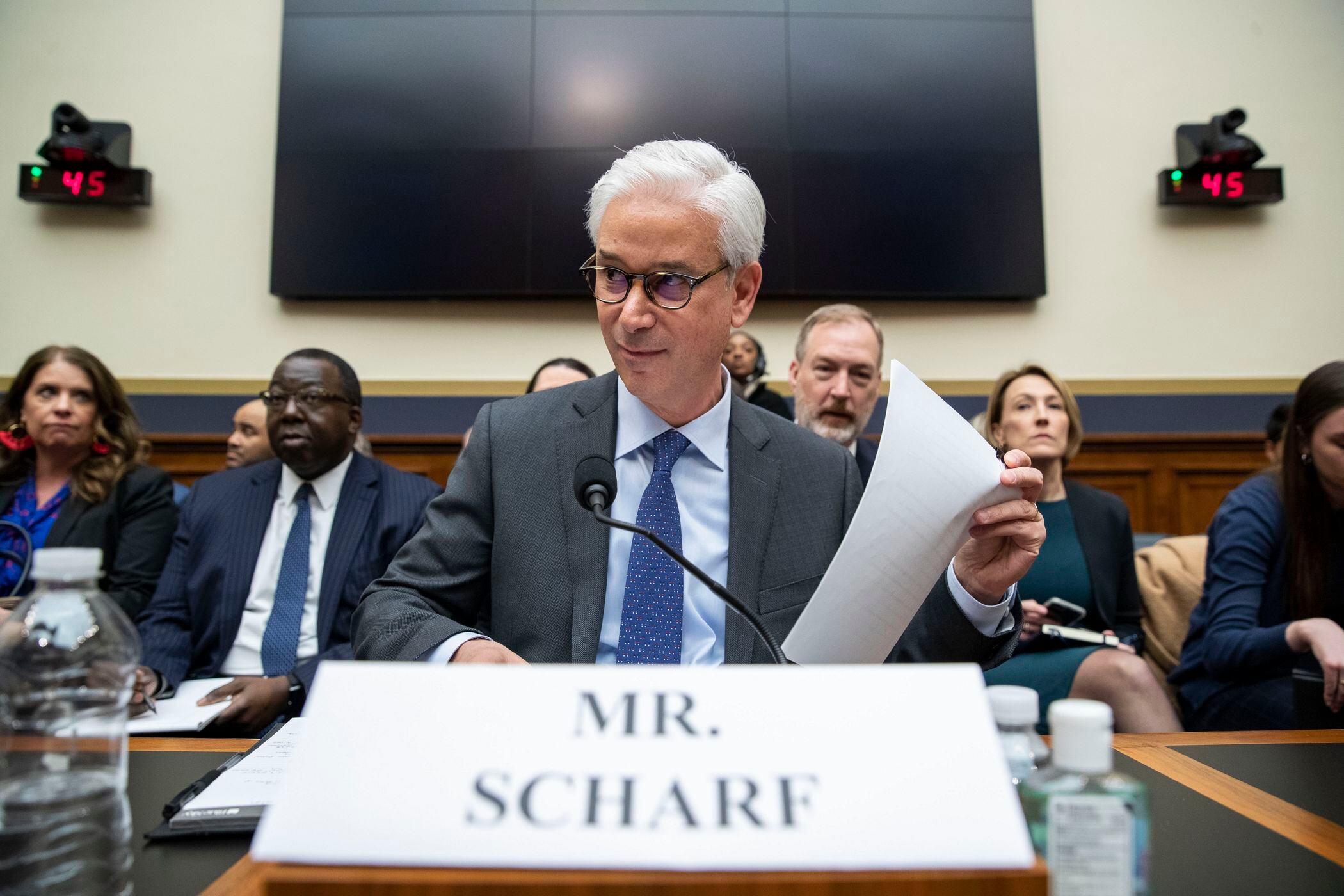
In this March 10, 2020 file photo, Wells Fargo CEO and President Charles Scharf is seated before he testifies during a hearing of the House Financial Services Committee, on Capitol Hill, in Washington. Scharf apologized Wednesday, Sept. 23 for comments he made that dismissed concerns that the banking industry, which has a long history of racist behavior, wasn’t doing enough to promote and retain diverse talent. (AP Photo/Alex Brandon, File)
By Ken Sweet
Wells Fargo CEO Charles Scharf apologized Wednesday for comments he made about the difficulty of finding qualified Black executives.
Scharf said that "there is a very limited pool of black talent to recruit from" in corporate America. The memo to employees was written in June but became public this week.
The comments and similar statements made in a Zoom meeting, reported by Reuters, led to an intense backlash in Washington and on social media.
"Perhaps it is the CEO of Wells Fargo who lacks the talent to recruit Black workers," said Rep. Alexandra Ocasio-Cortez of New York, on Twitter.
Scharf on Wednesday said in a prepared statement that his comments reflected "my own unconscious bias."
"There is no question Wells Fargo has to make meaningful progress to increase diverse representation," he wrote. Wells has pledged to increase the hiring of minority candidates, particularly through Black colleges and universities, as well as new anti-racism training programs at the bank.
American banking is dominated by leadership that is largely white and male. None of the six big Wall Street banks have ever had a Black or female CEO. Citigroup a few weeks ago announced it would promote a woman to CEO next year, the first on Wall Street to do so.
The last prominent African American to serve as CEO at a large financial services company was Kenneth Chenault, the former CEO of American Express. He retired in 2018. In an interview with The Associated Press at the time, Chenault called the lack of a pipeline to recruit and retain diverse talent "embarrassing" to the financial services industry.
Stanley O'Neal, the former CEO Merrill Lynch while it was still an independent company, is also Black. He resigned in 2007 during the firm's collapse.
Americans stepped up their spending in December more than expected, closing out the holiday season and the year on an upbeat tone. The Commerce Department said retail sales rose 0.6% in December compared with a November’s 0.3% increase.
Christine Short, VP of Research at Wall Street Horizon, shares insights on small and big banks earnings, a fresh round of layoffs in the tech world, and what to expect from upcoming rate decisions.
More executives are feeling better about the global economy. But a growing number don’t think their companies will survive the coming decade without a major overhaul because of pressure from climate change and technology like artificial intelligence.
The International Olympic Committee has signed the first beer brand in the 40-year history of a sponsorship program that earns billions of dollars for the organization and international sports.
The latest calculations from several science agencies showing Earth obliterated global heat records last year may seem scary. But scientists worry that what’s behind those numbers could be even worse.
Along with the $122 million from delinquent millionaires in October, nearly half a billion dollars in back taxes from rich tax cheats has been collected.
Greg Moran, CEO of Zoomcar, joined Cheddar to talk about the growth of the car-sharing platform, the company's recent debut on the NASDAQ, and its continued work in emerging markets.