In an intensely visual news world, a seismic week of politics was transformed again in an instant on Sunday by something almost old-fashioned: a printed statement.
President Joe Biden's announcement that he would not run for a second term was dropped into his social media feed at 1:46 p.m. Eastern, followed 33 minutes later by an endorsement of his vice president, Kamala Harris. Still recovering from COVID, the president did not appear on camera. Which meant, for news outlets, scant to no visuals.
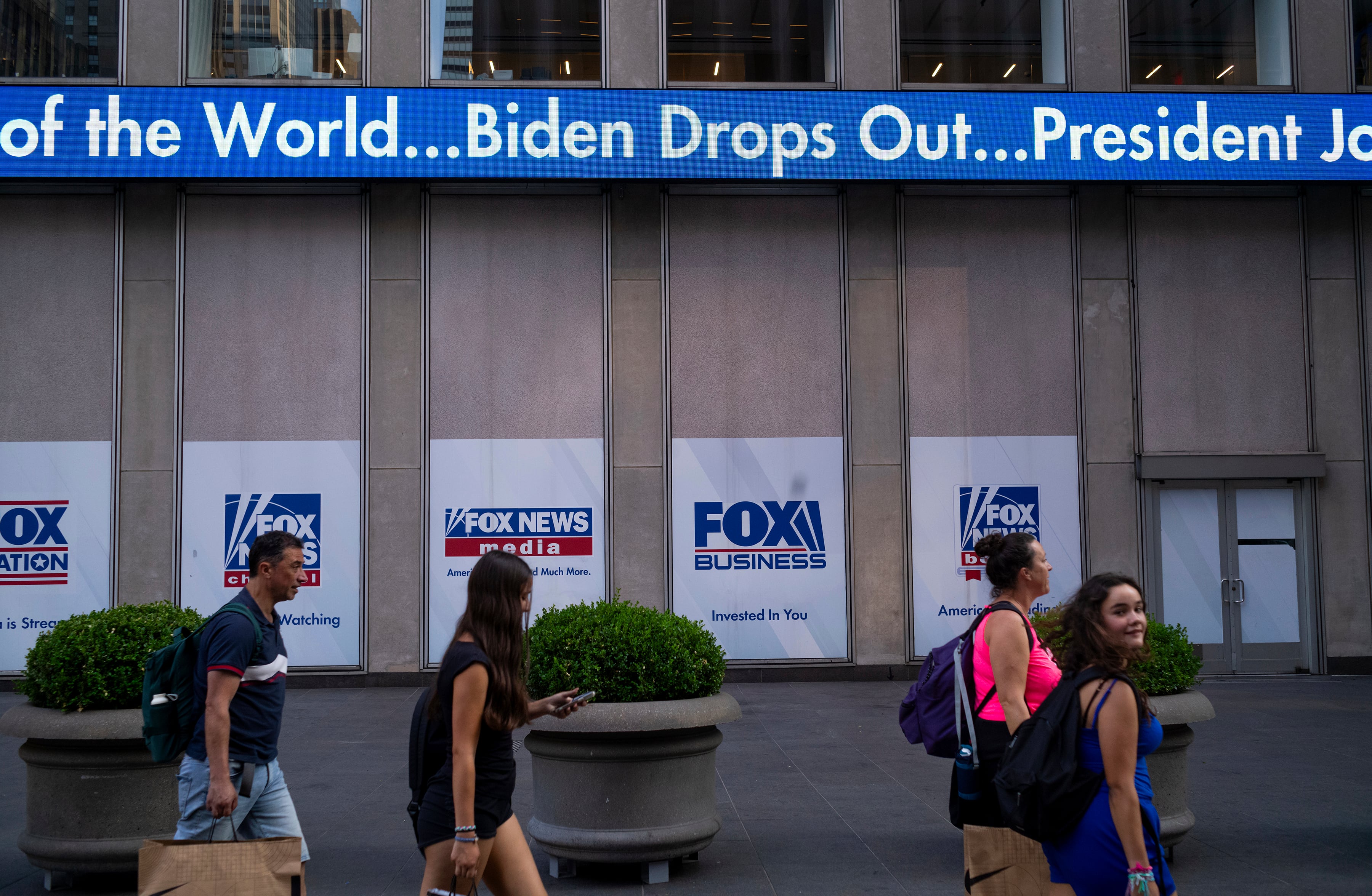
There was also virtually no warning, leading to initial concerns that the president's X feed had been hacked. The Associated Press filed a “flash” alert at 1:54 p.m. Eastern. Television networks broke into programming between 1:50 (Fox News Channel) and 2:04 p.m. (ABC).
It was, the Associated Press wrote, “a late-season campaign thunderstrike unlike any in American history.” CBS News analyst Ashley Etienne called it “an incredible day in American history.”
Hungry for visuals, and not finding them
After a week saturated with the endlessly repeated and parsed video of former President Donald Trump being shot at a Pennsylvania campaign rally, and the carefully choreographed four-day television show of the Republican National Convention that followed it, here was a dramatic news story that lacked the visual element in almost every way.
News shows on cable, particularly when covering live events or breaking news, rely on video from a scene and its aftermath to provide the all-important connecting thread between talking heads and anchor updates. With no video Sunday other than “b-roll,” or old footage of Biden, news channels had to turn elsewhere.
But they even had to scramble to find people who could talk about it at all. CBS' White House correspondent, Ed Keefe, sounded out of breath when he was reached on the phone. Because it was a summer Sunday afternoon, TV news' first string wasn't immediately available, giving opportunities to ABC's Rachel Scott, CBS' Kristine Johnson and NBC's Hallie Jackson to anchor the initial reports.
As the news sunk in, others interrupted their weekends to rush into an office — Wolf Blitzer on CNN, John Roberts on Fox News Channel, Rachel Maddow on MSNBC. ABC and CBS spent more time on the story than NBC, which switched after a half hour for NASCAR coverage.
Biden's former White House press secretary, Jen Psaki, was in a studio after finishing her Sunday show, which put her in place to break the news about her former boss.
The networks quickly pivoted to talking about a Harris-Trump general election matchup, even before Harris announced — again, via a printed statement — about two hours after Biden's endorsement that she would be a candidate.
“Look how fast politics moves,” ABC's Terry Moran said by phone. “Joseph Biden, after 50 years in politics in which he reached the highest level, is now yesterday's news.”
Echoes of history
The day was reminiscent of March 31, 1968, when President Lyndon Johnson shocked the country at the end of a 40-minute televised address to the nation by saying, “I shall not seek, and I will not accept, the nomination of my party for another term as your president.”
That was a complete surprise, compared to the seemingly endless discussion that absorbed the political world during the past three weeks about whether the 81-year-old Biden could effectively continue as a candidate following his disastrous performance in a June 27 debate against Trump.
But Biden had repeatedly and emphatically insisted he was staying in the race, and the Sunday morning political talk shows featured surrogates pushing that line. “He's going to do what the American people need him to do, and that's to beat Donald Trump,” Cedric Richmond, a Biden campaign co-chairman, said on CBS' “Face the Nation.”
Several reporters spoke about how even Biden White House and campaign staff members were taken by surprise by the announcement. Biden is expected to address the nation later in the week.
The TV political junkies were nearly giddy at the prospect of the news that will be created up to and including the Democratic national convention, which is scheduled to begin Aug. 19 in Chicago.
“This is going to be a really amazing, historic sprint to the finish,” said ABC News White House correspondent Mary Bruce.
Said Fox News commentator Dana Perino: “The politics in the next four weeks is going to be absolutely insane."
___
David Bauder writes about media for the AP. Follow him at http://twitter.com/dbauder.