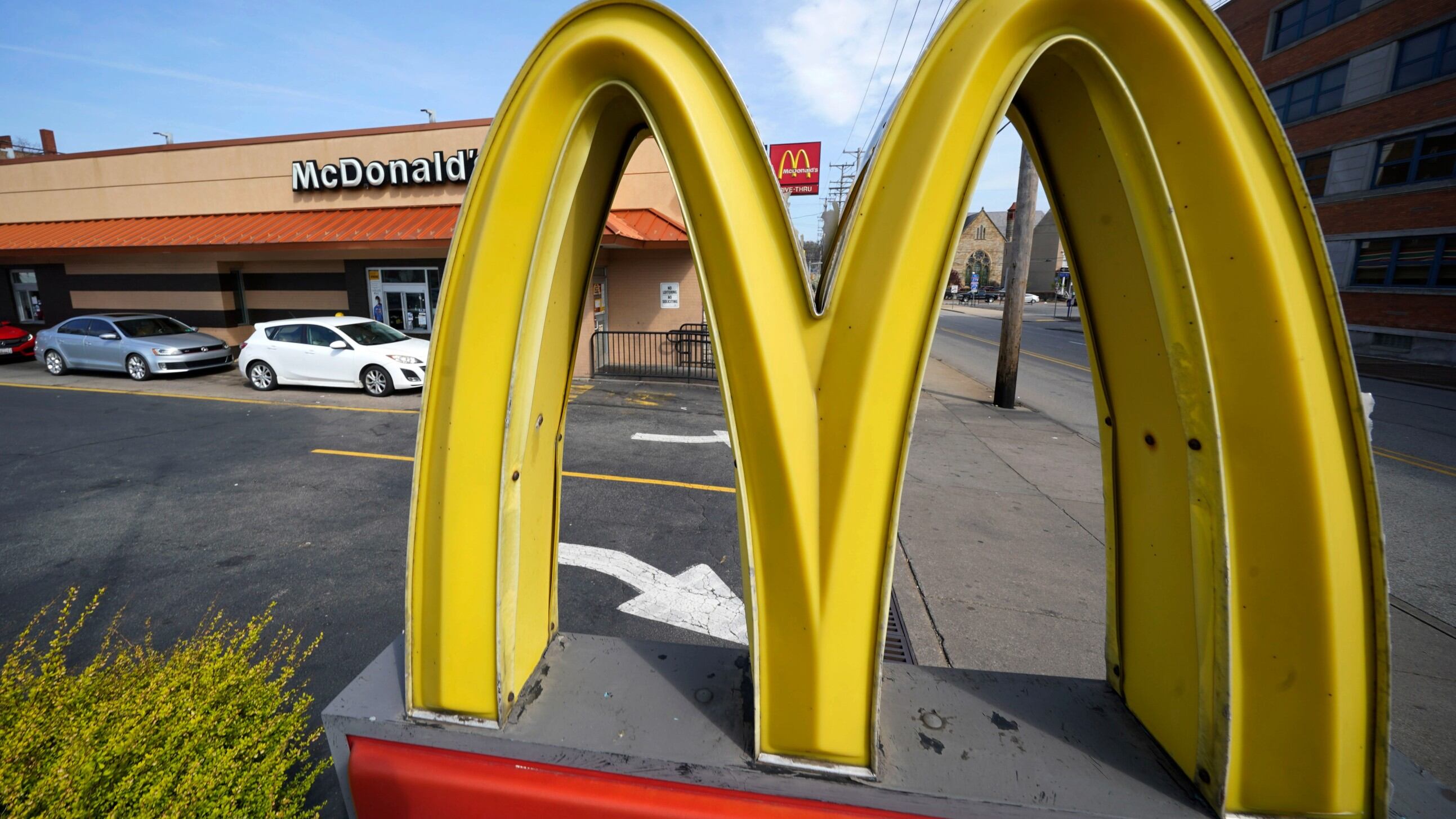
This is a McDonald's restaurant in Pittsburgh on Saturday, April 23, 2022. (AP Photo/Gene J. Puskar, File)
By Dee-Ann Durbin
A federal judge in New York has dismissed a lawsuit that accused McDonald’s and Wendy’s of misleading consumers with ads that show bigger, juicier burgers than their restaurants actually serve.
In an opinion released over the weekend, U.S. District Judge Hector Gonzalez said the images on the companies’ websites __ which the plaintiff was challenging __ note the weight of the meat and the calories each burger contains.
Gonzalez also said the plaintiff, Justin Chimienti, failed to prove that a reasonable customer would be misled by the ads. Gonzalez said the ads are considered “puffery,” akin to other companies' use of models to make their products more visually appealing.
Wendy's and McDonald's didn't immediately respond to messages left Tuesday seeking comment.
The suit was one of several false advertising lawsuits filed recently against fast food companies by New York attorney James Kelly. A message seeking comment from Kelly was left Tuesday by The Associated Press.
In August, a federal judge in Florida refused to dismiss a class action lawsuit Kelly filed against Burger King claiming that the company's ads overstate the amount of meat in its Whopper burger and other sandwiches. Kelly has also sued Taco Bell and Arby's.
Lawsuits accusing food and beverage companies of misleading customers __ for putting fewer chips than expected in a bag or advertising artificial flavors as real “vanilla," for example __ have grown more common in recent years.
Perkins Coie, a law firm that tracks class action suits, said 214 were filed against food and beverage companies in 2022 and 101 were filed in the first six months of this year. That’s a big increase from 2010, when just 45 were filed.
Orangetheory Fitness is redefining the future of workouts with smarter tech, strength-based programming, and community-driven studios built for what’s next.
Spain's government has fined Airbnb 64 million euros or $75 million for advertising unlicensed tourist rentals. The consumer rights ministry announced the fine on Monday. The ministry stated that many listings lacked proper license numbers or included incorrect information. The move is part of Spain's ongoing efforts to regulate short-term rental companies amid a housing affordability crisis especially in popular urban areas. The ministry ordered Airbnb in May to remove around 65,000 listings for similar violations. The government's consumer rights minister emphasized the impact on families struggling with housing. Airbnb said it plans to challenge the fine in court.
Roomba maker iRobot has filed for Chapter 11 bankruptcy protection, but says that it doesn’t expect any disruptions to devices as the more than 30-year-old company is taken private under a restructuring process. iRobot said that it is being acquired by Picea through a court-supervised process. Picea is the company's primary contract manufacturer. The Bedford, Massachusetts-based anticipates completing the prepackaged chapter 11 process by February.
Serbia’s prosecutor for organized crime has charged a government minister and three others with abuse of position and falsifying of documents related to a luxury real estate project linked to U.S. President Donald Trump’s son-in-law Jared Kushner. The charges came on Monday. The investigation centers on a controversy over a a bombed-out military complex in central Belgrade that was a protected cultural heritage zone but that is facing redevelopment as a luxury compound by a company linked to Kushner. The $500 million proposal to build a high-rise hotel, offices and shops at the site has met fierce opposition from experts at home and abroad. Selakovic and others allegedly illegally lifted the protection status for the site by falsifying documentation.
Wealthfront’s CFO Alan Iberman talks the $2.05B IPO and the major moment for robo banking as the company bets on AI, automation, and “self-driving money."


