U.S. markets had a strong open Monday morning on President Trump's announcement that U.S. and Chinese officials are willing to continue talks in an effort to de-escalate mounting trade tensions.
Speaking from the G7 summit in Biarritz, France, Trump said that Chinese negotiators had called U.S. officials and requested a new round of talks. "We'll be getting back to the table. And I think they want to do something," he said. "This is a very positive development for the world."
China's Foreign Ministry spokesperson Geng Shuang, however, said at a press conference Monday that he was not aware of any calls, but that the trade feud should be solved "through dialogue and consultation."
Meanwhile, Chinese Vice Premier Liu He said at an economics conference in Chongqing that China favored "calm negotiations" to resolve trade tension. "We resolutely oppose the escalation of the trade war, which is not beneficial for the U.S. or China. It is also not beneficial to the world," Liu said, according to multiple reports citing government transcripts.
By midday, the Dow was up more than 250 points, while the S&P 500 and Nasdaq Composite were up more than one percent. Yet the news came too late for Asian markets, which had plummeted by close Monday local time.
The Hang Seng Index in Hong Kong and the Shanghai Composite Index ended the day down 1.91 percent and 1.17 percent respectively. The Nikkei in Tokyo closed down 2.17 percent and South Korea's Kospi Index fell 1.6 percent.
On Monday, Trump also repeatedly lauded Chinese President Xi Jinping as a "great leader" and a "brilliant man" — a far cry from the "enemy" characterization that Trump gave Xi last week.
The enduring trade dispute between the U.S. and China, which has both ebbed and surged in recent months, significantly escalated last week. China announced on Friday that it would hit $75 billion worth of U.S. goods with new retaliatory tariffs and proceed with a steep tariff levied on U.S. vehicles and car parts.
In response, Trump announced that the U.S. would hike its 25 percent tariff on $250 billion worth of Chinese imports to 30 percent, and increase the forthcoming 10 percent tariff on $300 billion worth of goods to 15 percent. Friday's culmination sent U.S. stocks into a nosedive and led to an outcry from industry against the escalation.
Trump added he was confident that Liu's remarks on calm negotiations were sincere and were not a bid to quell market woes. "I think they want to make a deal. I think they should make a deal, and I think if they don't make a deal it will be very bad for China," he said during a press conference with President Emmanuel Macron of France.
At a separate event, Treasury Secretary Steven Mnuchin said Liu's remarks were "very significant statements" and that the U.S. was communicating with the vice premier, who is China's chief negotiator, through intermediaries.
China, nonetheless, urged the U.S. on Monday not to "miscalculate the situation" and to cease its "erroneous ways."
"China firmly opposes and rejects such stark trade bullying and maximum pressuring tactics," Shuang said. "I would like to remind the U.S. once again that threats and intimidation will never work on China."
In response to a question on the trade uncertainty fueling market volatility, Trump said "Sorry, it's the way I negotiate ... and it has done very well for me over the years."
Several Silicon Valley insiders are being accused of contorting a 1990s-era tax break to avoid taxes on millions of dollars of investment profits. The tax break is known as the qualified small business stock exemption, and it allows early investors in certain companies to avoid half of the taxes on up to $10 million in capital gains. A piece recently published in the New York Times says venture capital firms like Andreessen Horowitz replicated the tax exemption by giving shares of companies to friends and family, who would otherwise face a 23.8% capital gains bill. The CEO of Roblox is also accused of replicating the tax break for his family members at least 12 times. Although the loophole known as 'stacking' is considered to be legal, the Times piece implies that the exemption has been manipulated for the ultra-wealthy to become more wealthy. Greycroft co-founder and Chairman Emeritus Alan Patricof joins Cheddar News' Closing Bell to discuss.
There is a new player in the mobile app stock trading space.
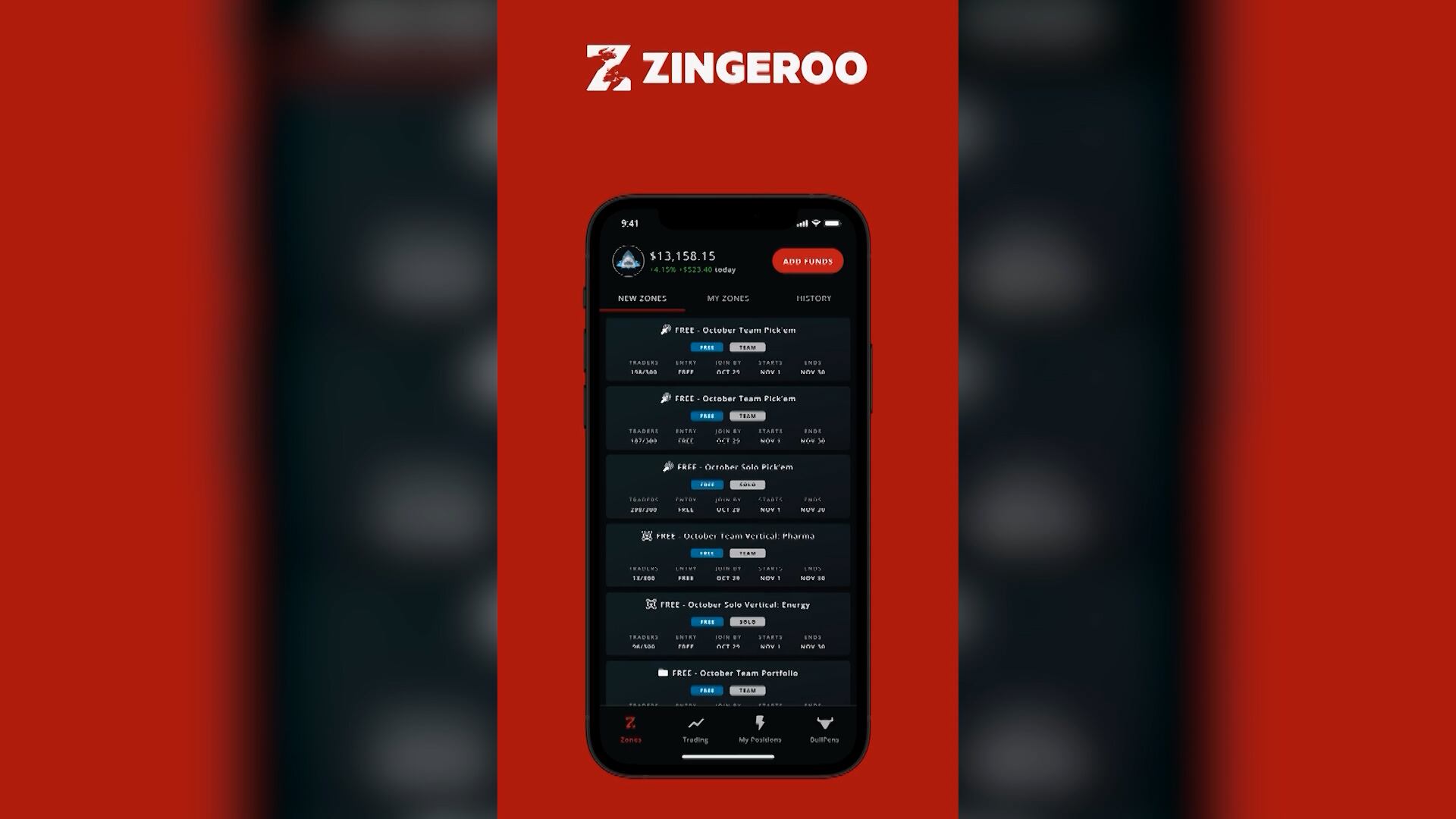
Zingeroo recently announced a funding round of $8.5 million. The company says it aims to bring 'friendly competition' to stock trading, by literally breaking trading down into daily and weekly competitions between friends. Zingeroo also says it hopes its new approach can make trading more accessible, educational, and social than ever before. Zingeroo co-founder and CEO Zoe Barry joins Cheddar News' Closing Bell for more.
Stocks closed higher on the first trading day of 2022, with both the Dow and the S&P 500 hitting record closes. Apple and Tesla created momentum, with the tech giant hitting a $3 trillion market cap, and the EV maker reporting over 300,000 deliveries in the fourth quarter of 2021. Investors are taking an optimistic approach to start the year even as COVID-19 continues to linger and omicron cases soar. Rebecca Walser, President at Walser Wealth Management, joins Cheddar News' Closing Bell to discuss today's market movement, her broad predictions for the year, and more.
As cell carriers AT&T and Verizon planned to roll out nationwide 5G service this week, the FAA and U.S. DOT are asking the companies to pause their plans so more research can be done on the impact 5G has on aircraft technology. The companies are refusing, citing French regulations that limit wireless signals around airports while allowing research to continue. This week's launch wasn't the first time concerns have delayed 5G — last year, Airbus and Boeing express concerns, pushing the deadline into November, December, and then into this year. So what happens now — and what happens next? Will 5G roll out this year as expected? Jon Swartz, Senior Reporter at MarketWatch, joins Cheddar News' Closing Bell to discuss the state of the planned 5G rollout, why the FAA and U.S. Department of Transportation are asking carriers to stall the launch, and more.
Tyrone Ross, CEO of Onramp Invest, joins Cheddar News' Closing Bell, where he explains why he believes the current crypto slump is expected to persist and says that investors should be focusing more on Bitcoin's hashrate when it comes to metrics.
As the COVID-19 omicron variant continues to spread, thousands of flights have been canceled, restaurants and bars have been forced to re-adapt to outdoor and take-out dining, and consumers are canceling their travel and other plans. This all comes as the CDC recently updated its quarantine guidelines for people who test positive, slashing the isolation period from 10 days to five. That change was pushed by the airline industry as it continues to struggle with labor shortages. How will the variant continue to impact businesses large and small? Laura Reathaford, Partner at Lathrop GPM, and Tom Sacco, CEO, President, and Chief Happiness Officer of Iowa-based Happy Joe's Pizza and Ice Cream, join Cheddar News' Closing Bell to discuss employment law issues related to worker safety during COVID-19 outbreaks, and how small businesses are dealing with the latest wave, respectively.