By Audrey McAvoy, Jennifer Sinco Kelleher and Christopher Weber
Several thousand Hawaii residents raced to escape homes on Maui as the Lahaina fire swept across the island, killing at least 36 people and burning parts of a centuries-old town.
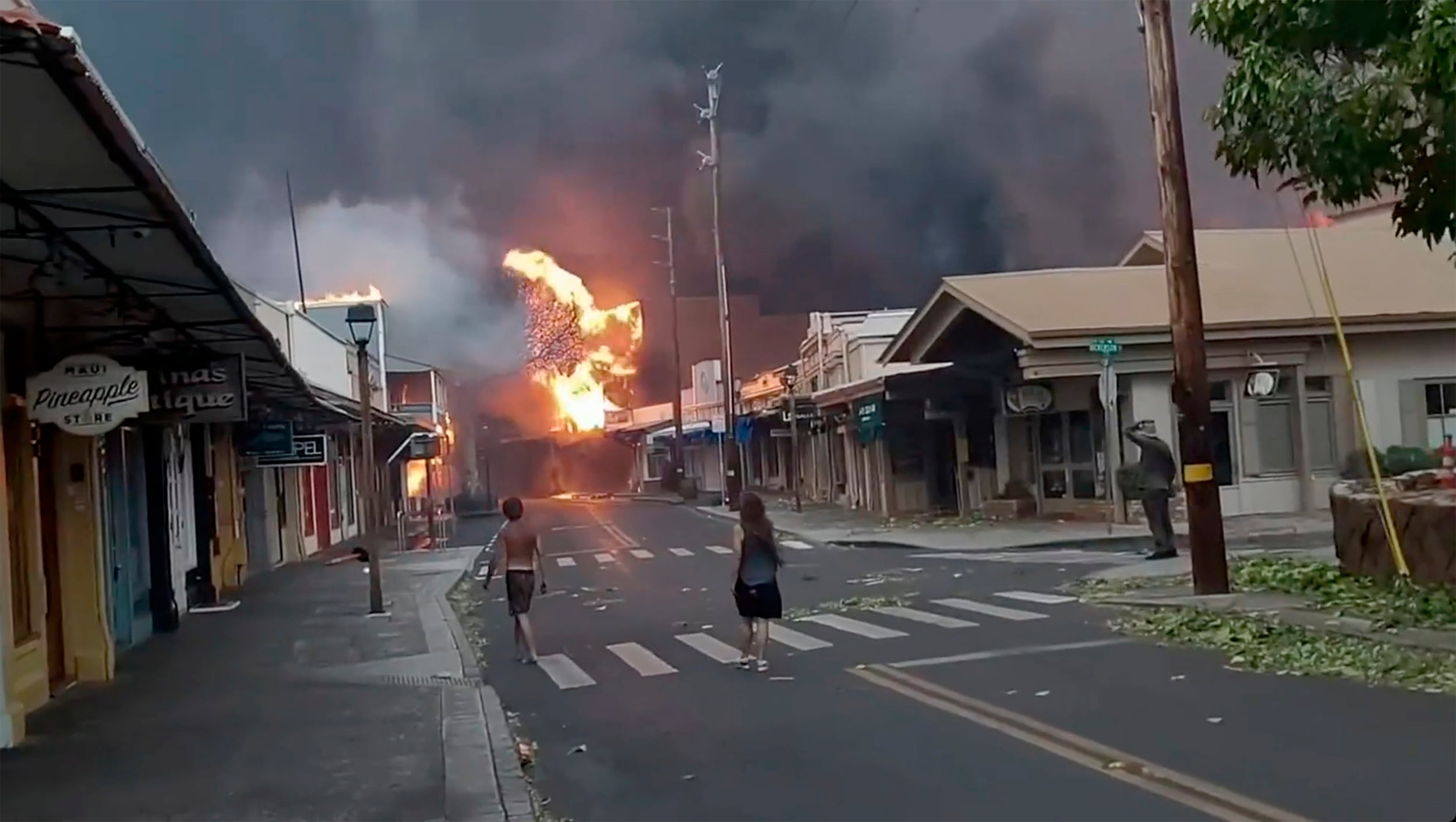
The fire took the island of Maui by surprise, leaving behind burned-out cars on once busy streets and smoking piles of rubble where historic buildings had stood. Flames roared throughout the night, forcing adults and children to dive into the ocean for safety.
Maui county announced the updated death toll on its website late Wednesday, writing that no other details were currently available on the deaths. Officials said earlier that 271 structures were damaged or destroyed and dozens of people injured.
On Wednesday, Maui crews continued to battle blazes in several places on the island. Authorities urged visitors to stay away.
Lahaina residents Kamuela Kawaakoa and Iiulia Yasso described a harrowing escape under smoke-filled skies Tuesday afternoon. The couple and their 6-year-old son got back to their apartment after a quick dash to the supermarket for water, and only had time to grab a change of clothes and run as the bushes around them caught fire.
“We barely made it out,” Kawaakoa said at an evacuation shelter on Wednesday, still unsure if anything was left of their apartment.
As the family fled, a senior center across the road erupted in flames. They called 911, but didn't know if the people got out. Fire alarms blared. As they drove away, downed utility poles and fleeing cars slowed their progress.
Kawaakoa, 34, grew up in the apartment building, called Lahaina Surf, where his dad and grandmother also lived. Lahaina Town dates back to the 1700s and has long been a favorite destination for tourists.
“It was so hard to sit there and just watch my town burn to ashes and not be able to do anything," Kawaakoa said. “I was helpless.”
The Hawaiian fires were whipped by strong winds from Hurricane Dora passing far to the south. It's the latest in a series of disasters caused by extreme weather around the globe this summer. Experts say climate change is increasing the likelihood of such events.
As winds eased somewhat on Maui, some flights resumed Wednesday, allowing pilots to view the full scope of the devastation. Aerial video from Lahaina showed dozens of homes and businesses razed, including on Front Street, where tourists once gathered to shop and dine. Smoking heaps of rubble lay piled high next to the waterfront, boats in the harbor were scorched, and gray smoke hovered over the leafless skeletons of charred trees.
“It’s horrifying. I’ve flown here 52 years and I’ve never seen anything come close to that,” said Richard Olsten, a helicopter pilot for a tour company. “We had tears in our eyes."
About 14,500 customers in Maui were without power early Wednesday. With cell service and phone lines down in some areas, many people were struggling to check in with friends and family members living near the wildfires. Some were posting messages on social media.
Tiare Lawrence was frantically trying to reach her siblings who live near where a gas station exploded in Lahaina.
“There’s no service, so we can’t get ahold of anyone,” she said from the Maui community of Pukalani.
Maj. Gen. Kenneth Hara, from the Hawaii State Dept. of Defense, told reporters Wednesday night that officials were working to get communications restored, to distribute water, and possibly adding law enforcement personnel. He said National Guard helicopters had dropped 150,000 gallons of water on the Maui fires.
State Department of Education Superintendent Keith Hayashi said in a statement that a team was working on contingency plans and preparing for the possible loss of the King Kamehameha III elementary school that had been in Lahaina for more than a century.
“The department is striving to maintain regular school schedules to provide a sense of normalcy, but will keep most Maui schools closed for the remainder of this week,” he said.
The Coast Guard said it rescued 14 people who jumped into the water to escape flames and smoke, including two children.
Among those injured were three people with critical burns who were flown to Straub Medical Center’s burn unit on the island of Oahu, officials said. At least 20 patients were taken to Maui Memorial Medical Center, officials said, and a firefighter was hospitalized in stable condition after inhaling smoke.
Richard Bissen Jr., the mayor of Maui County, said at a Wednesday morning news conference that he didn't have details on how or where on the island the six deaths occurred. He said officials hadn't yet begun investigating the immediate cause of the fires, but officials did point to the combination of dry conditions, low humidity and high winds.
More than 2,100 people spent Tuesday night in evacuation centers. Another 2,000 travelers sheltered at Kahului Airport after many flights were canceled. Officials were preparing the Hawaii Convention Center in Honolulu to take in thousands of displaced tourists and locals.
Mauro Farinelli, of Lahaina, said the winds had started blowing hard on Tuesday, and then somehow a fire had started up on a hillside.
“It just ripped through everything with amazing speed,” he said, adding it was “like a blowtorch.”
The winds were so strong they blew his garage door off its hinges and trapped his car in the garage, Farinelli said. So a friend drove him, along with his wife Judit and dog Susi, to an evacuation shelter. He had no idea what had happened to their home.
“We’re hoping for the best,” he said, “but we’re pretty sure it’s gone.”
President Joe Biden said he'd ordered all available federal assets to help with the response. He said the Hawaii National Guard had mobilized Chinook helicopters to help with fire suppression as well as search and rescue efforts on Maui.
“Our prayers are with those who have seen their homes, businesses and communities destroyed," Biden said in a statement.
Former President Barack Obama, who was born in Hawaii, said on social media that it’s tough to see some of the images coming out of a place that is so special to many.
Alan Dickar, who owns a poster gallery and three houses in Lahaina, said most tourists who come to Maui visit Front Street.
“The central two blocks is the economic heart of this island, and I don’t know what’s left," he said.
Dickar took video of flames engulfing the main strip before escaping with three friends and two cats.
“Every significant thing I owned burned down today,” he said. “I’ll be OK. I got out safely.”
Wildfires were also burning on Hawaii’s Big Island, Mayor Mitch Roth said, although there had been no reports of injuries or destroyed homes there. Roth said firefighters had needed to extinguish some roof fires and there were continuing flareups of one fire near the Mauna Kea Resorts.
Acting Gov. Sylvia Luke said the flames had wiped out communities and urged travelers to stay away.
“This is not a safe place to be,” she said.
Luke issued an emergency proclamation on behalf of Gov. Josh Green, who was traveling. Green's office said he'd cut short his trip and was returning Wednesday evening.
Fires in Hawaii are unlike many of those burning in the U.S. West. They tend to break out in large grasslands on the dry sides of the islands and are generally much smaller than mainland fires. A major fire on the Big Island in 2021 burned homes and forced thousands to evacuate.
The 2018 Camp Fire in the Sierra Nevada foothills of California killed at least 85 people and destroyed nearly 19,000 homes.
Yasso, who fled her home with boyfriend Kawaakoa, said residents are going to need time to regroup and that people shouldn't plan to visit right now.
“It’s everybody losing their memories of growing up,” she said. “It’s the memories for everybody. We all lost our homes with this.”
Sinco Kelleher reported from Honolulu and Perry from Wellington, New Zealand. Associated Press writers Christopher Weber in Los Angeles and Beatrice Dupuy in New York contributed to this report.
This article has been significantly updated.