By Aamer Madhani, Kevin Freking and Ricardo Alonso-Zaldivar
President Donald Trump on Tuesday warned Americans to brace for a “rough two-week period” ahead as the White House released new projections that there could be 100,000 to 240,000 deaths in the U.S. from the coronavirus pandemic even if current social distancing guidelines are maintained.
Public health officials stressed that the number could be less if people change their behavior.
“We really believe we can do a lot better than that,” said Dr. Deborah Birx, the coordinator of the White House coronavirus task force. That would require all Americans to take seriously their role in preventing the spread of disease, she said.
Trump called American efforts to slow the spread of the coronavirus “a matter of life and death” and urged the public to heed his administration’s guidelines. He predicted the country would soon see a “light at the end of the tunnel” in the pandemic that has killed more than 3,500 Americans and infected 170,000 more.
"I want every American to be prepared for the hard days that lie ahead,” Trump said. “We're going to go through a very tough two weeks."
Dr. Anthony Fauci, the government’s top infectious disease expert, said the numbers are “sobering” and called on Americans to “step on the accelerator” with their collective mitigation efforts.
“We are [continuing] to see things go up,” Fauci said. “We cannot be discouraged by that because the mitigation is actually working and will work."
Birx said pandemic forecasts initially predicted 1.5 million to 2.2 million deaths in the U.S. But that was a worst-case scenario, without efforts to slow the spread of the coronavirus through social distancing.
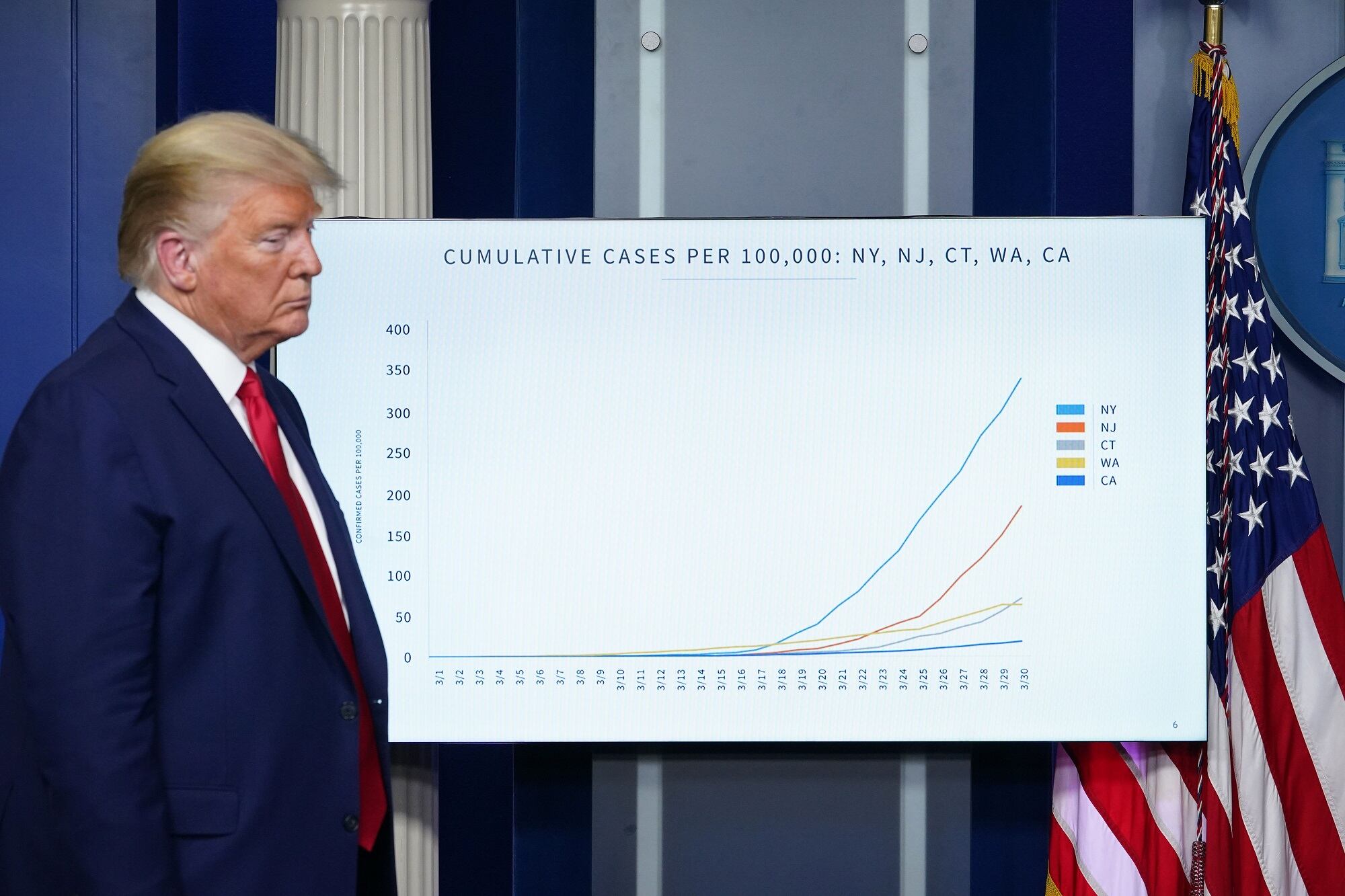
Birx said states that have not yet seen a spike in cases as New York has could take action to flatten the curve of rising hospitalizations and deaths.
As for the projection of 100,000-240,000 deaths, Fauci of the National Institutes of Health said: “We don’t accept that number, that that's what it's going to be...We want to do much better than that.”
The comments came after Trump announced Sunday that he was extending to April 30 the social distancing guidelines that urged Americans to cease social gatherings, work from home, suspend onsite learning at schools and more in a nationwide effort to stem the spread of the virus.
It was an abrupt reversal for Trump, who spent much of last week targeting April 12 as the day he wanted to see Americans “pack the pews” for Easter Sunday services.
Trump called the data “very sobering” saying it was his understanding that the 100,000 deaths was a minimum that would be difficult to avoid. He also sought to rewrite his past minimization of the outbreak, saying he rejected those who compared the new coronavirus to the flu — when in fact he repeatedly did so publicly.
“This could be helluva bad two weeks,'” Trump said.
Many states and local governments already have stiffer controls in place on mobility and gatherings.
Birx said the experiences of Washington state and California give her hope that other states can keep the coronavirus under control through social distancing. That’s because they moved quickly to contain the early clusters of coronavirus by closing schools, urging people to work from home, banning large gatherings and taking other measures now familiar to most Americans, she noted.
“I am reassured by looking at the Seattle line,” she added. “California and Washington state reacted very early to this.”
Trump spoke after another troubling day for the stock market, which has been in a free fall as the cononavirus ground the economy to a near-halt and left millions unemployed. The Dow Jones Industrial Average plunged more than 400 points, or roughly 1.9%, to seal the worst first-quarter finish of its 135-year history.