WASHINGTON (AP) — As the United States rapidly builds massive data centers for the development of artificial intelligence, many Americans are concerned about the environmental impact.
Worries about how AI will affect the environment surpass concerns about other industries that worsen climate change, according to a new poll from The Associated Press-NORC Center for Public Affairs Research and the Energy Policy Institute at the University of Chicago.
The results of the poll, conducted in September, suggest that as AI reshapes work, communication and culture, it’s also sparking anxieties about how the growing energy demands could further harm the environment.
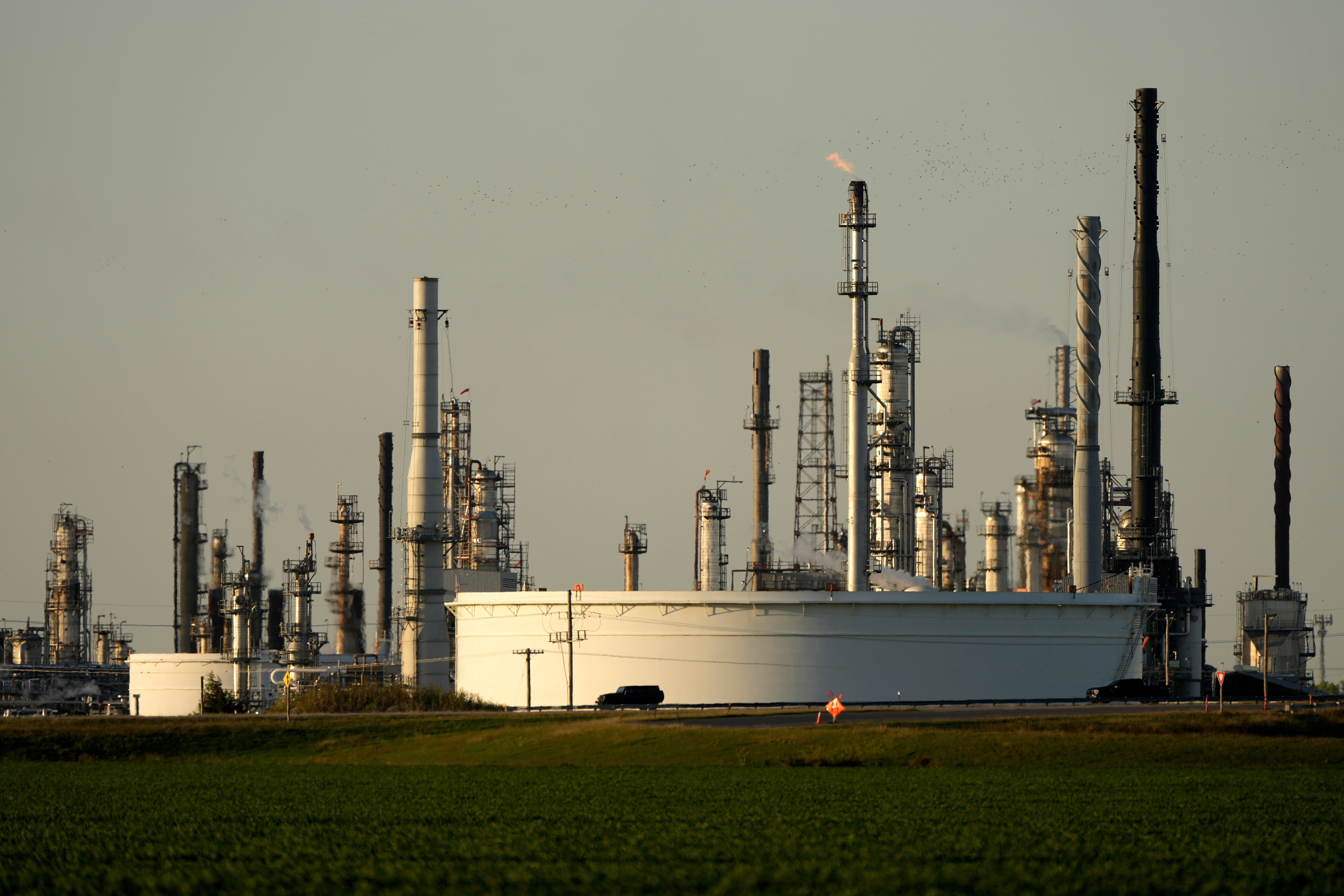
It takes massive amounts of electricity to power AI. Electricity consumption from data centers is set to more than double globally by 2030, according to the International Energy Agency. The United States accounts for by far the largest share of the projected increase, followed by China. In many places, the electricity for data centers will come from power plants that burn coal, oil and natural gas. Burning these fossil fuels for electricity emits carbon dioxide, trapping heat in the atmosphere and warming the planet.
The energy needs are so large that major technology companies are investing in next-generation nuclear technology, which can produce electricity without emissions, and quietly scaling back their own goals to cut carbon pollution.
Aidan Collins, a 26-year-old Democrat in New York, said in his view, AI uses an “absurd amount” of energy.
“Using all this energy and contributing to climate change in a bad way, it all just seems very awful to me,” he said.
More worries about AI’s environmental impact than meat and aviation
President Donald Trump unveiled a plan this summer for America’s “global dominance” in artificial intelligence, which included cutting back environmental regulations to speed up the construction of AI supercomputers. The U.S. Department of Energy has identified federal sites where tech companies could build data centers to power AI. Trump, a Republican, has made sweeping strides to prioritize fossil fuels for electricity generation and hinder renewable energy projects.
About 4 in 10 U.S. adults say they are “extremely” or “very” concerned about the environmental impacts of AI. That’s higher than the share of Americans who are highly concerned about the environmental impact of the cryptocurrency, meat production and air travel industries, all of which contribute to climate change and cause environmental harm. Bitcoin mining uses enormous amounts of electricity. Livestock produce methane, a powerful greenhouse gas. And when airplanes burn jet fuel, it releases carbon dioxide.
Like Collins, several Americans said in follow-up interviews that they are worried about the energy and water required to power AI. Data centers need a tremendous amount of water to keep cool. Some communities strongly oppose data centers because they demand so much energy and water.
Aaron Gunnoe, a 29-year-old independent in Ohio, said he’s very concerned about the increasing electricity demand, when much of it is supplied by fossil fuels.
“They haven’t done anything in the way of offsetting it cleanly,” he said. “They just keep building more and more.”
Democrats are more likely than Republicans to be highly worried
Democrats are particularly likely to be concerned about the environmental impacts of AI.
“I feel like it’s going to be a greater and greater burden,” said Amy Fennewald, a 61-year-old Democrat in Minnesota.
But while about half of Democrats are “extremely” or “very” concerned, so are about one-third of independents and Republicans. Raymond Suarez, a 60-year-old living in Florida, considers himself a “strong” Republican. He fears data centers will be built on land that should be preserved or used for other things, such as farming, and he worries AI is becoming too pervasive.
“For them to uptick it and for them to think it’s a great thing, no, it’s not,” he said.
On the other hand, James Horner said he’s not at all concerned about the environmental impacts. The 52-year-old Republican living in South Carolina said he thinks artificial intelligence will be the solution to its own energy problem — it will show how clean energy can be built in an efficient, profitable way, and clean energy will be used to power AI.
“It’s going to help everybody,” he said. “I think it’s going to be able to figure out these processes happening in our body that scientists, as smart as they are, haven’t figured out yet. With supercomputers taking all that data, I think it will help everything, health care, the environment. If it’s used correctly, it will do good.”
The expected legacy of AI is more negative than positive
Americans are more likely to think that over the next decade, artificial intelligence will do more to hurt than help the environment, the economy and society as a whole.
Doug Bowen, a 79-year-old moderate Republican living in Kansas, said he thinks artificial intelligence will do more to hurt. The demand on the planet’s resources will be greater as AI and the number of companies involved in the field grow, he said.
Americans are divided on whether AI will do more to help or hurt them personally. About one-quarter say AI will do more to help them, and about the same share say it will do more to hurt them. About half say that it won’t make a difference in their lives or that they are unsure.
Amanda Hernandez, a 24-year-old Democrat in California, said she grew concerned after watching TikTok videos about the immense energy and water demands. Hernandez said she thinks she will be personally hurt by AI because she works as a cashier at a fast food restaurant.
“I’m more concerned, as AI continues to grow and advance, that we’re just not going to need any cashiers or customer service people altogether,” she said.
Fennewald, in Minnesota, said she doesn’t know whether she will be personally helped or hurt by AI in the future.
“I think it’s a black box. I don’t know how we can know,” she said. “We really have no idea what’s ahead.”
___
McDermott reported from Providence, R.I.
___
The AP-NORC poll of 3,154 adults was conducted Sept. 2-18, 2025, using a combined sample of interviews from NORC’s probability-based AmeriSpeak Panel, which is designed to be representative of the U.S. population, and interviews from opt-in online panels. The margin of sampling error for all respondents is plus or minus 2.4 percentage points. The AmeriSpeak panel is recruited randomly using address-based sampling methods, and respondents later were interviewed online or by phone. To incorporate the nonprobability sample, NORC used TrueNorth calibration, an innovative hybrid calibration approach developed at NORC to explicitly account for potential bias associated with the nonprobability sample.
___
The Associated Press’ climate and environmental coverage receives financial support from multiple private foundations. The AP is solely responsible for all content. Find the AP’s standards for working with philanthropies, a list of supporters and funded coverage areas at AP.org.
___
Follow the AP’s coverage of artificial intelligence at https://apnews.com/hub/artificial-intelligence.