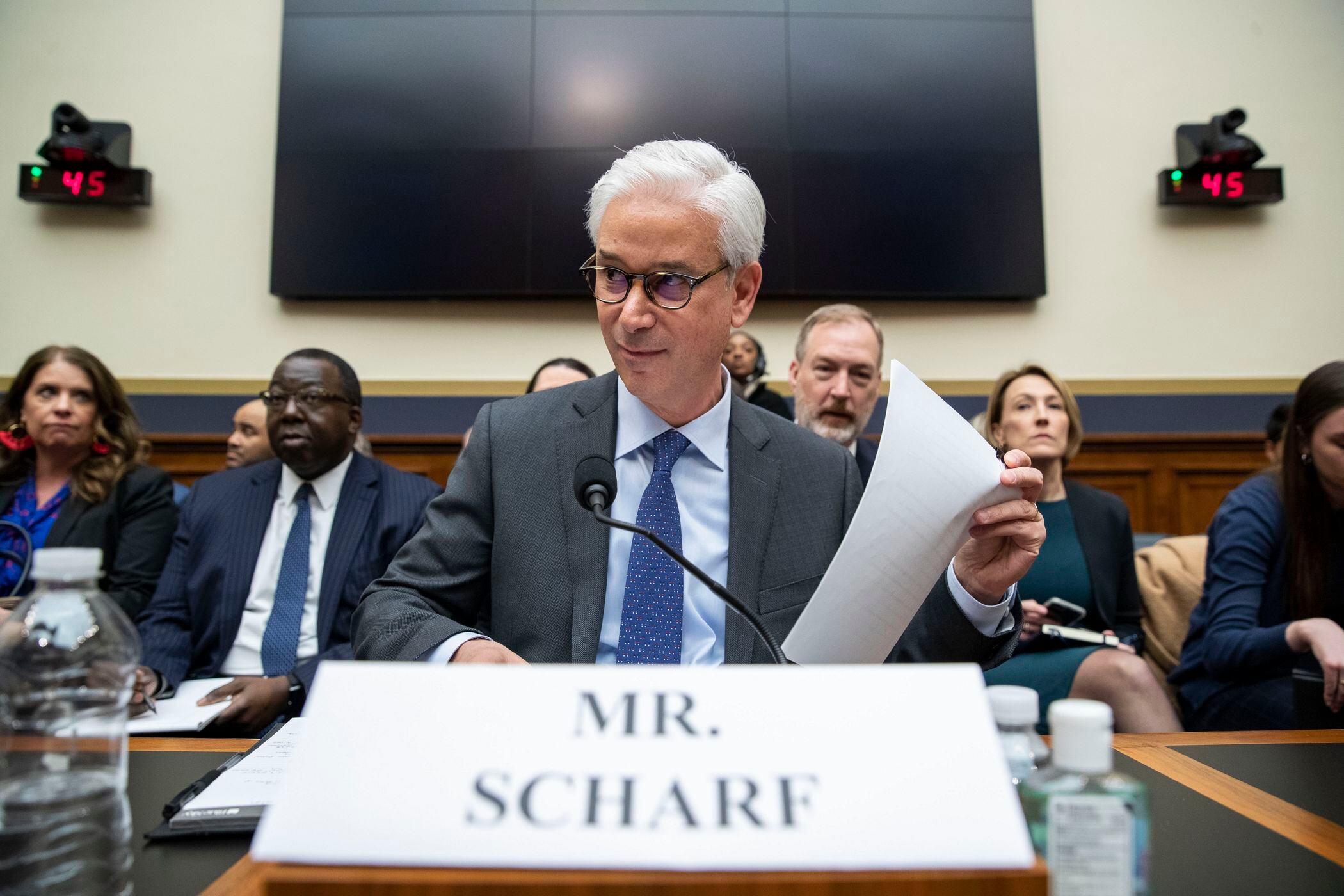
In this March 10, 2020 file photo, Wells Fargo CEO and President Charles Scharf is seated before he testifies during a hearing of the House Financial Services Committee, on Capitol Hill, in Washington. Scharf apologized Wednesday, Sept. 23 for comments he made that dismissed concerns that the banking industry, which has a long history of racist behavior, wasn’t doing enough to promote and retain diverse talent. (AP Photo/Alex Brandon, File)
By Ken Sweet
Wells Fargo CEO Charles Scharf apologized Wednesday for comments he made about the difficulty of finding qualified Black executives.
Scharf said that "there is a very limited pool of black talent to recruit from" in corporate America. The memo to employees was written in June but became public this week.
The comments and similar statements made in a Zoom meeting, reported by Reuters, led to an intense backlash in Washington and on social media.
"Perhaps it is the CEO of Wells Fargo who lacks the talent to recruit Black workers," said Rep. Alexandra Ocasio-Cortez of New York, on Twitter.
Scharf on Wednesday said in a prepared statement that his comments reflected "my own unconscious bias."
"There is no question Wells Fargo has to make meaningful progress to increase diverse representation," he wrote. Wells has pledged to increase the hiring of minority candidates, particularly through Black colleges and universities, as well as new anti-racism training programs at the bank.
American banking is dominated by leadership that is largely white and male. None of the six big Wall Street banks have ever had a Black or female CEO. Citigroup a few weeks ago announced it would promote a woman to CEO next year, the first on Wall Street to do so.
The last prominent African American to serve as CEO at a large financial services company was Kenneth Chenault, the former CEO of American Express. He retired in 2018. In an interview with The Associated Press at the time, Chenault called the lack of a pipeline to recruit and retain diverse talent "embarrassing" to the financial services industry.
Stanley O'Neal, the former CEO Merrill Lynch while it was still an independent company, is also Black. He resigned in 2007 during the firm's collapse.
According to data from Dealogic, the Nasdaq is on track to beat the NYSE in IPOs this year, raising $191 billion so far, compared with the NYSE's $109 billion. Louis Cordone, senior president of Data Strategy at AST, discusses why 2021 was so successful for IPOs, and what differentiates the two exchanges.
Jeffrey Small, President of Arbor Financial, breaks down the Omicron variants' impact on markets going forward and where investors should pay attention to for growth potential.
Rich Weiss, Multi-Asset Strategies CIO at American Century Investments, talks about economic growth amid COVID-19 concerns and how retail spending is being impacted by inflation.
Markets opened higher as investors shrugged off weaker-than-expected job growth and Omicron fears. George Seay, CEO, Annandale Capital joined Cheddar's Opening Bell to discuss.
Michele Schneider, Partner and Director of Trading Research & Education for MarketGauge, breaks down the major risks to the markets and discusses why tech and Agriculture are the best sectors to hedge inflation concerns.
Bitcoin took a nosedive over the weekend, falling to its lowest price level in nearly two months. According to data from Coindesk, the crypto dropped more than 20% to $42,000 on Saturday before rebounding some. Prices of Ether, Dogecoin and Shiba Inu dropped as well, with Ether tumbling by more than 15%at one point. Lance Ippolito, head trader at the Future of Wealth, joined Cheddar to discuss why crypto plummeted and what to expect next.
Less than six months after making its public debut on the NYSE, Chinese ride-hailing giant Didi says it will delist in the U.S. and pivot to Hong Kong instead. Chinese regulators are citing cybersecurity and data concerns. Shehzad Qazi, Managing Director, China Beige Book International joined Cheddar's Opening Bell to discuss.