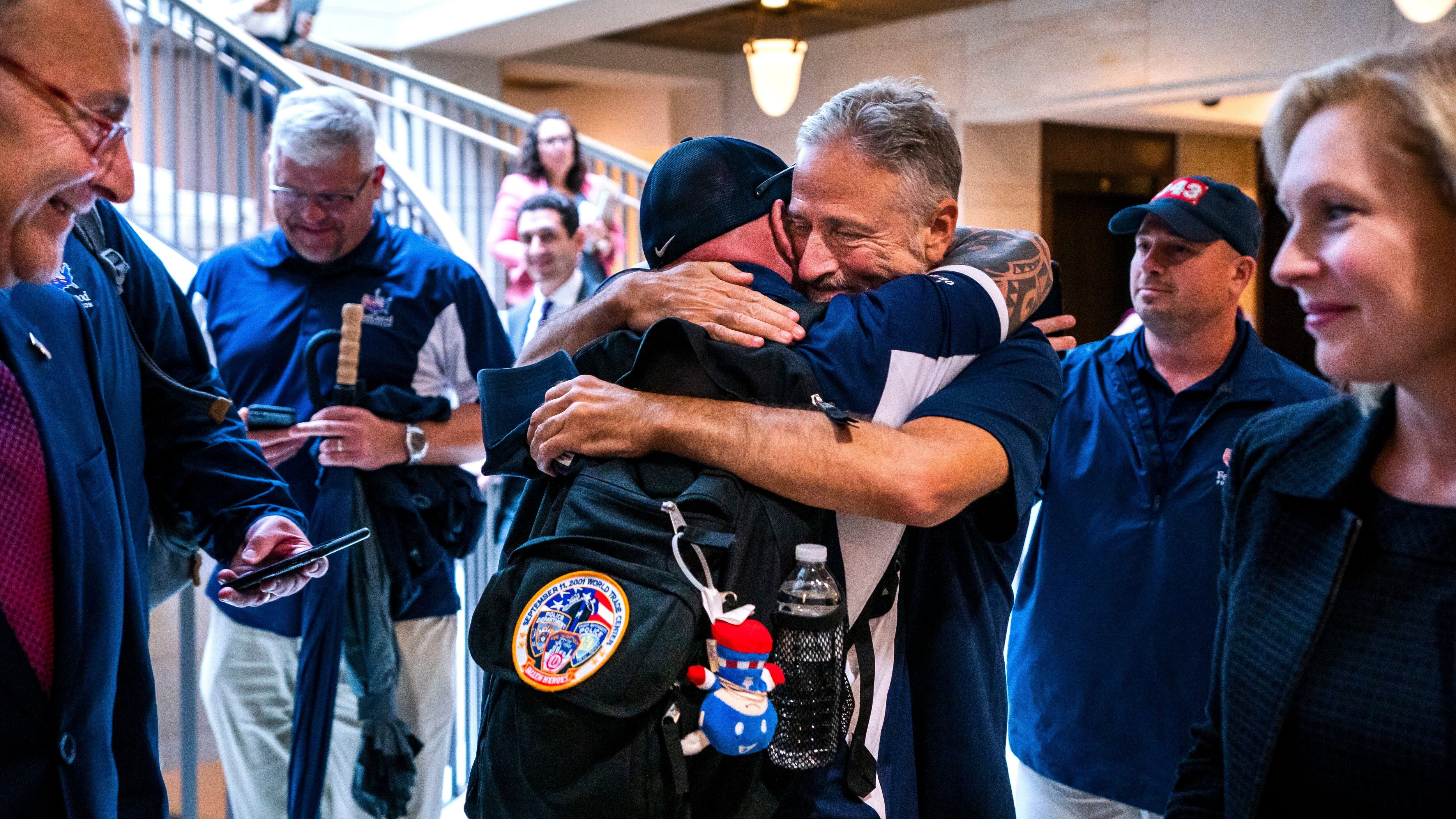
Tuesday’s 97-2 vote in the Senate to extend permanent protections for 9/11 first responders came after many years of visits to Capitol Hill — more than 280 for John Feal alone, a former demolition specialist and responder from Long Island whose advocacy has helped bring a national conversation to the issue.
And minutes after the lopsided vote, Feal made sure to alert lawmakers that his days of tirelessly knocking down their doors are thankfully coming to a close.
“We’ll put down our swords,” he said on Capitol Hill, acknowledging the good-faith efforts that Senate Majority Leader Mitch McConnell exhibited in recent months to get the bill a clean vote.
After all, during a recent trip to Washington, Feal came bearing a special memento for McConnell: the NYPD badge of Detective Luis Alvarez who died on June 29, a gesture that Jon Stewart recently told Cheddar he had hoped would secure passage of the measure.
McConnell’s commitment to Feal was widely noticed.
Jake Lemonda, the president of the Uniformed Fire Officers Association, told Cheddar, “When someone gives you their word, that’s their bond. I have so much respect. He stuck to his word. And I thank him.”
Republican Rep. Pete King added, “You have to give [McConnell] credit.” King was joined by his GOP colleague in the Senate Cory Gardner to gather support for the compensation fund from skeptical conservatives, although two Republicans — Senator Rand Paul of Kentucky and Senator Mike Lee of Utah — were on full blast Tuesday with their no votes.
“Trying to block this was inexcusable,” Rep. King told Cheddar about Paul and Lee.
There is a line that some New York Democrats like Rep. Carolyn Maloney and House Judiciary Chairman Jerry Nadler say about the immediate post-9/11 reality: that New Yorkers were told, as Maloney puts it, a “toxic lie” — that the air at Ground Zero was safe to breathe. (Former EPA Administrator Christine Todd Whitman apologized in 2016 for her role in government-led misinformation in the fall of 2001.)
“Government told them to go back,” Maloney told Cheddar Tuesday on Capitol Hill. History] will show it was a "horrible, horrible judgment and horrible decision.”
But Tuesday was not the day for the sharpest of barbs, nor the most accusatory of finger-pointing. It was, instead, a day of muted celebration: a victory of a hard-fought battle that has come — and continues to come — with devastating consequences (members of Congress have indicated that 18 people have died in the past month alone from 9/11-related illnesses). And while the bill got its final push over the goal line from McConnell, a simple credo has united the advocacy efforts for so many others along the way. As Maloney told Cheddar Tuesday, “We promised we would never forget.”
Markets were pointing to a higher open to kick off the third trading week in November. It comes as stocks come off a losing week in reaction to October's consumer price index--which showed inflation at its highest point in over 30 years.
Ryan Detrick, Chief Market Strategist for LPL Financial joined Wake Up with Cheddar to discuss.
Harvard Business School Professor Ranjay Gulati joined Wake Up With Cheddar to break down the massive challenge the Biden Administration faces in ensuring projects in the $1.2 trillion infrastructure bill are completed on time and on budget.
Jill is joined by Baker Machado to talk all things infrastructure: where will the money go and who’s in charge? Plus, Sesame Street has its first Asian-American muppet. And a trailer for the trailer for Spiderman. Huh?
In this week's Cheddar Changemakers, Megan Pratz spoke with a 16-year-old climate activist Sarah Goody. She is the founder of a youth-led climate action group 'Climate NOW.'
We toss around the term "democracy is under attack" quite often without thinking too much, but one organization is actually stepping up to do something about it. The Fairness Project is a group that funds and organizes state ballot measures across the country. It has used ballot initiatives on campaigns aimed at expanding Medicaid, adding more paid time off, and raising minimum wage. It recently launched a new direct democracy campaign to fight back against attempts to make ballot measures inaccessible.
Kelly Hall, executive director of The Fairness Project, joined Cheddar Politics to discuss more about the group's efforts to push for economic and social justice, avoiding partisan gridlock.
Doug Flynn, Certified Financial Planner and Co-Founder of Flynn Zito Capital Management, joins Cheddar News' Closing Bell, where he says he believes the news of the infrastructure bill was already priced into the market and that inflation continues to loom large on Wall Street.
President Joe Biden signed into law today his landmark $1.2 trillion infrastructure bill, and it includes approximately $550 billion in new funding for increased broadband access, improving the power grid, and more. But what does this mean for the American economy, and American workers? Eliza Collins, Politics Reporter at The Wall Street Journal joins Cheddar News' Closing Bell to discuss what's included in the bill, which former mayor has been tapped to oversee how the bill is implemented, and how these new infrastructure investments will impact the economy.
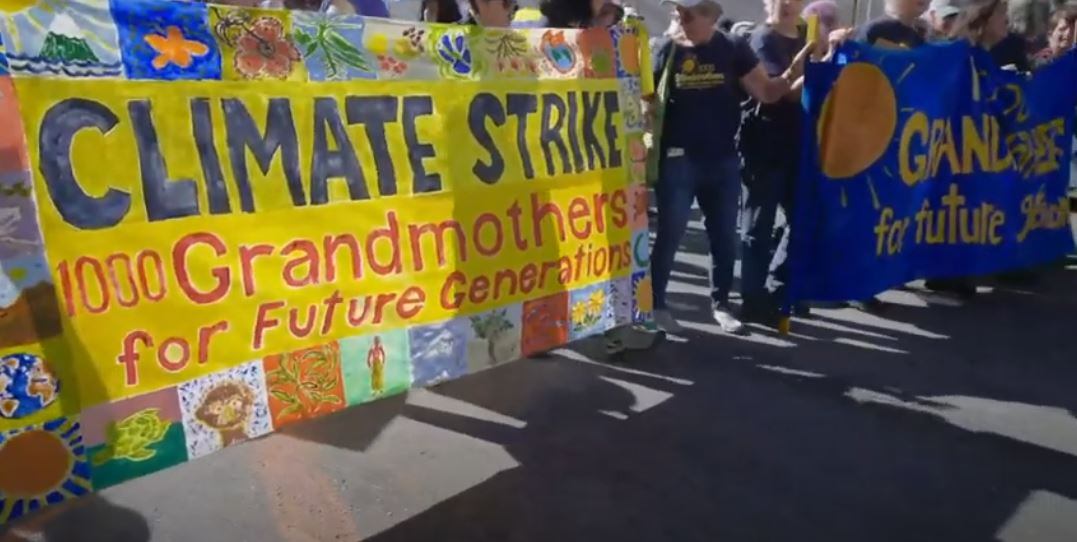
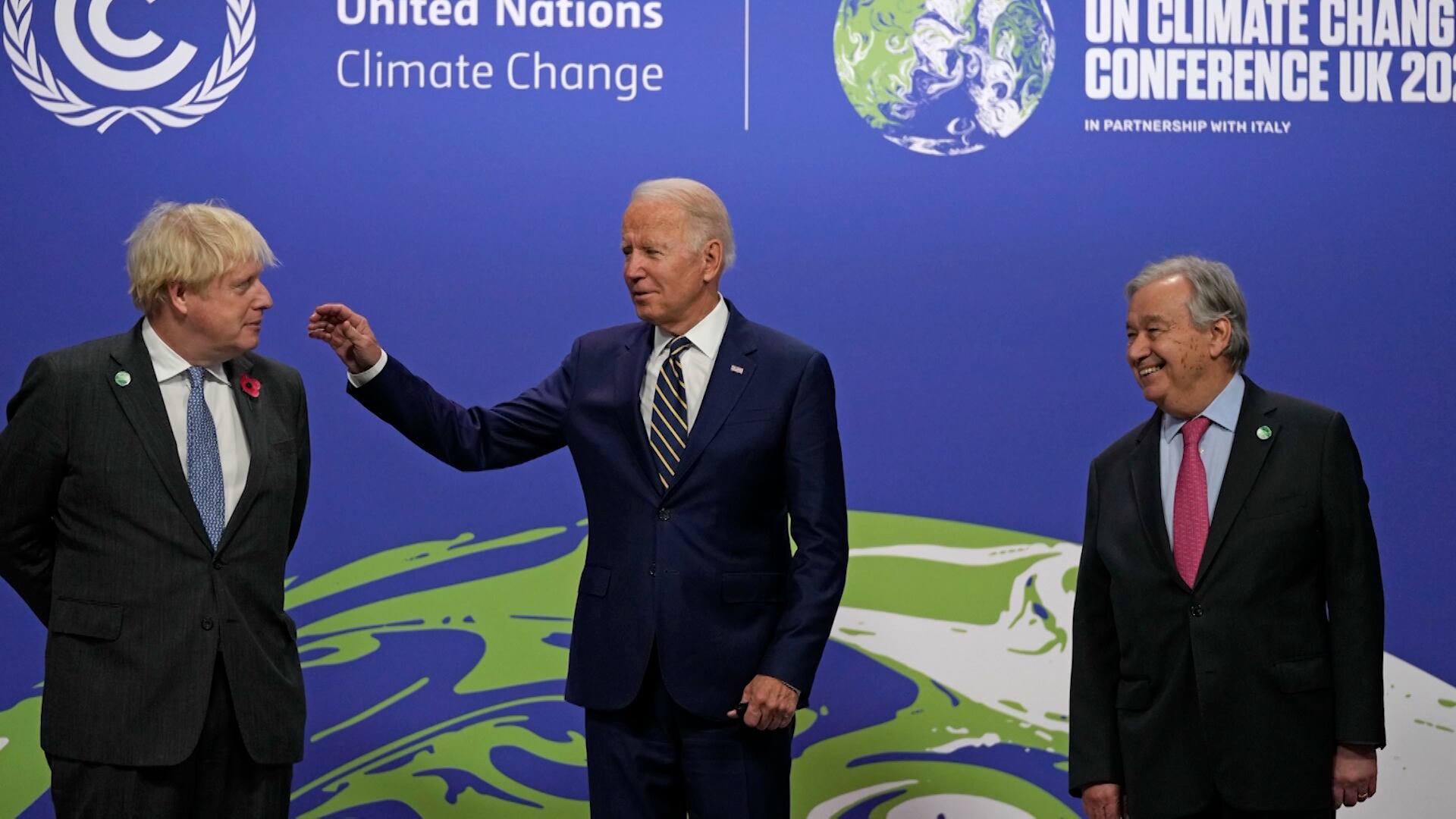
The two-week COP26 climate conference has now ended with leaders reaching a deal, but so far the deal is getting mixed reviews from climate experts across the globe. Chloe Demrovsky, president and CEO of Disaster Recovery Institute International, explains that while the agreement is a step forward in some ways, the world still has much more to work on in order to keep warming to below 2 degrees Celsius.
Jill and Carlo cover the latest with the infrastructure bill, the growing state rebellion over boosters, Trump's dereliction of duty on the pandemic, Taylor Swift's reign of cultural domination and more.