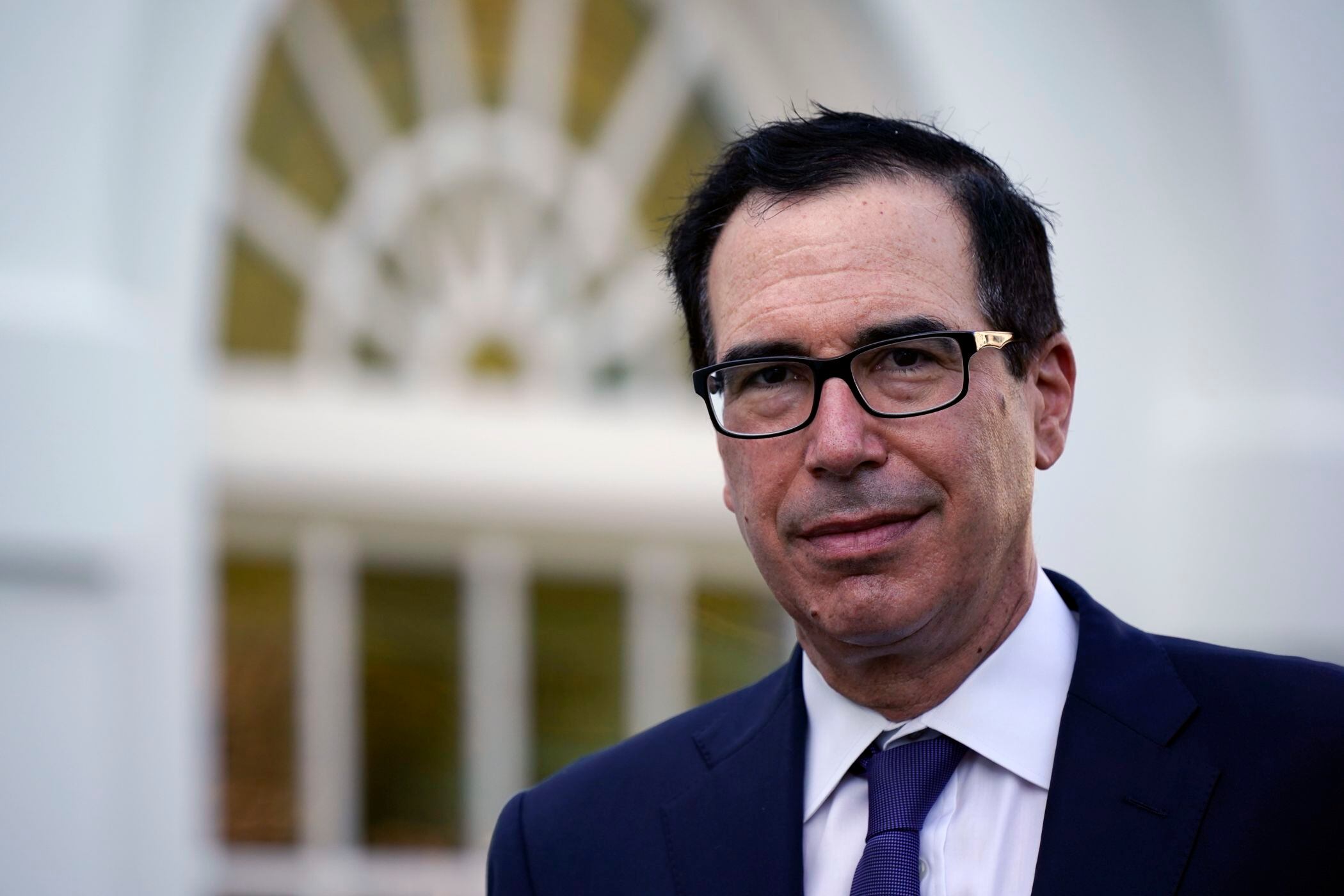
This Aug. 24, 2020 file photo shows Treasury Secretary Stephen Mnuchin at the White House in Washington. The U.S. government’s deficit in the first three months of the budget year was a record-breaking $572.9 billion. The Treasury Department reported Wednesday, Jan. 13, 2021 that with three months gone in the budget year, the deficit was $216.3 billion higher than the same October-December period a year ago. (AP Photo/J. Scott Applewhite, File)
By Martin Crutsinger
The U.S. government's deficit in the first three months of the budget year was a record-breaking $572.9 billion, 60.7% higher than the same period a year ago, as spending to deal with the COVID-19 pandemic surged while revenue declined.
The Treasury Department reported Wednesday that three months into the budget year, the deficit was $216.3 billion higher than the same October-December period a year ago.
The deficit reflects an 18.3% jump in outlays to $1.38 trillion, a record for the period, while revenues fell 0.4% to $803.37 billion. The red ink results from the difference between revenue collections and outlays.
For just the month of December, the deficit totaled a record $143.6 billion.
The shortfall for the 2020 budget year, which ended Sept. 30, climbed to an all-time high of $3.1 trillion. Beginning in the spring, Congress passed trillion-dollar-plus spending measures to combat the harm being done to the economy from a pandemic-induced downturn.
The recession, which has seen millions of Americans lose their jobs, has also meant a drop in tax revenues at a time when the demand on government support programs such as unemployment benefits and food stamps has risen.
The report showed that outlays in December were a record $489.7 billion, while receipts were $346.1 billion.
The spending figure did not include the $900 billion relief package Congress finally passed after months of wrangling because it was not signed into law until the end of the month. President Donald Trump delayed signing the bill, which he called a “disgrace,” because it included only $600 in direct payments to individuals.
President-elect Joe Biden has endorsed boosting the direct payments by another $1,400. He has said that higher amount will be included in another round of relief payments he will ask Congress to approve once he takes office on Jan. 20.
In addition to direct payments, the December relief bill extended two special unemployment benefit programs aimed at cushioning the pandemic’s blow. The unemployment benefits have totaled $80 billion from October through December, up from $5 billion during the same period in the last budget year.
The Congressional Budget Office has forecast that this year's deficit will total $1.8 trillion and the deficit will remain above $1 trillion each year though 2030. The CBO forecast for this year was made before the December relief package was passed and also does not take into account any extra spending that Congress may pass after Biden takes office.
Updated on January 13, 2021, at 3:28 p.m. ET with the latest information.
The airline industry says it is contending with staff shortages that threaten to hamper operations amid the COVID resurgence, andDelta Airlines CEO Ed Bastian called on the CDC to revise its guidance for vaccinated workers who test positive from a 10-day quarantine to just five. Chuck Liberman, chief investment officer and managing partner at Advisors Capital Management LLC, joined Cheddar to talk about the current guidance on isolation and why he believes the omicron variant calls for more relaxed guidance given its reportedly mild symptoms.
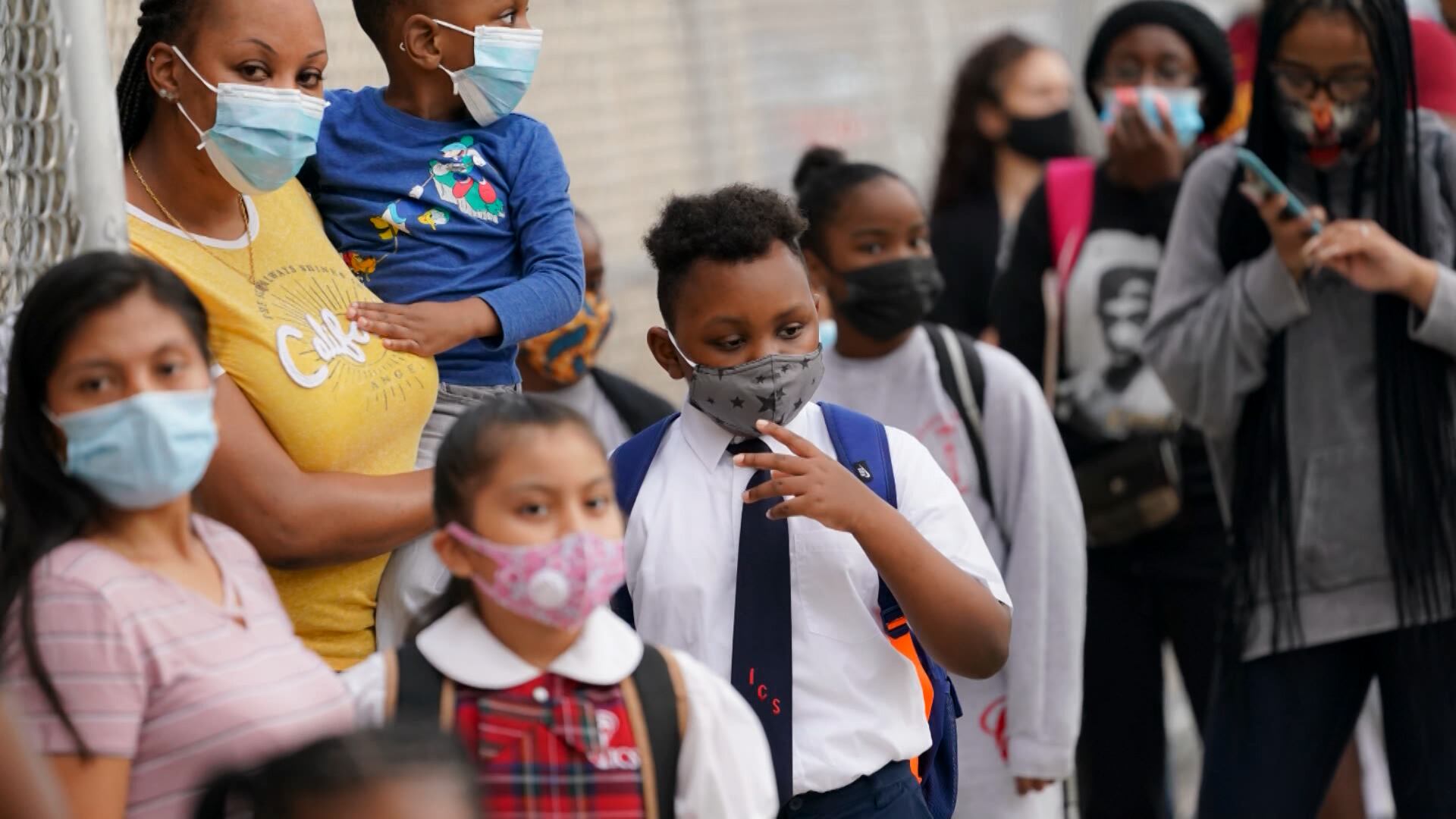
Schools are shutting down in droves as the highly contagious omicron variant surges across the country. Denisha Merriweather, director of public relations and content marketing at the American Federation for Children, an advocacy organization for vouchers and tax credits for school choice, joined Cheddar's "Opening Bell" to discuss the impact of remote learning on children. She argued that school districts have to be more proactive about the steps they are taking to engage students, and if they are unable to form better teaching methods, parents should be able to find alternative schools.
The boys discuss President Biden's plans to send out free rapid tests as the testing supply chain starts to buckle ahead of the holidays. Also, why aren't Americans having more babies, and The Matrix returns.
With the Build Back Better plan essentially out of the picture, economists are highlighting what the country might lose without the provisions designed to strengthen it. Among other things, this includes no more monthly payments for tens of millions of families, no universal Pre-K for 6 million children a year, and no billions of dollars in tax incentives for climate initiatives. Grace Segers, staff writer for The New Republic, joined Cheddar to discuss the various impacts on the economy without President Biden's spending bill.
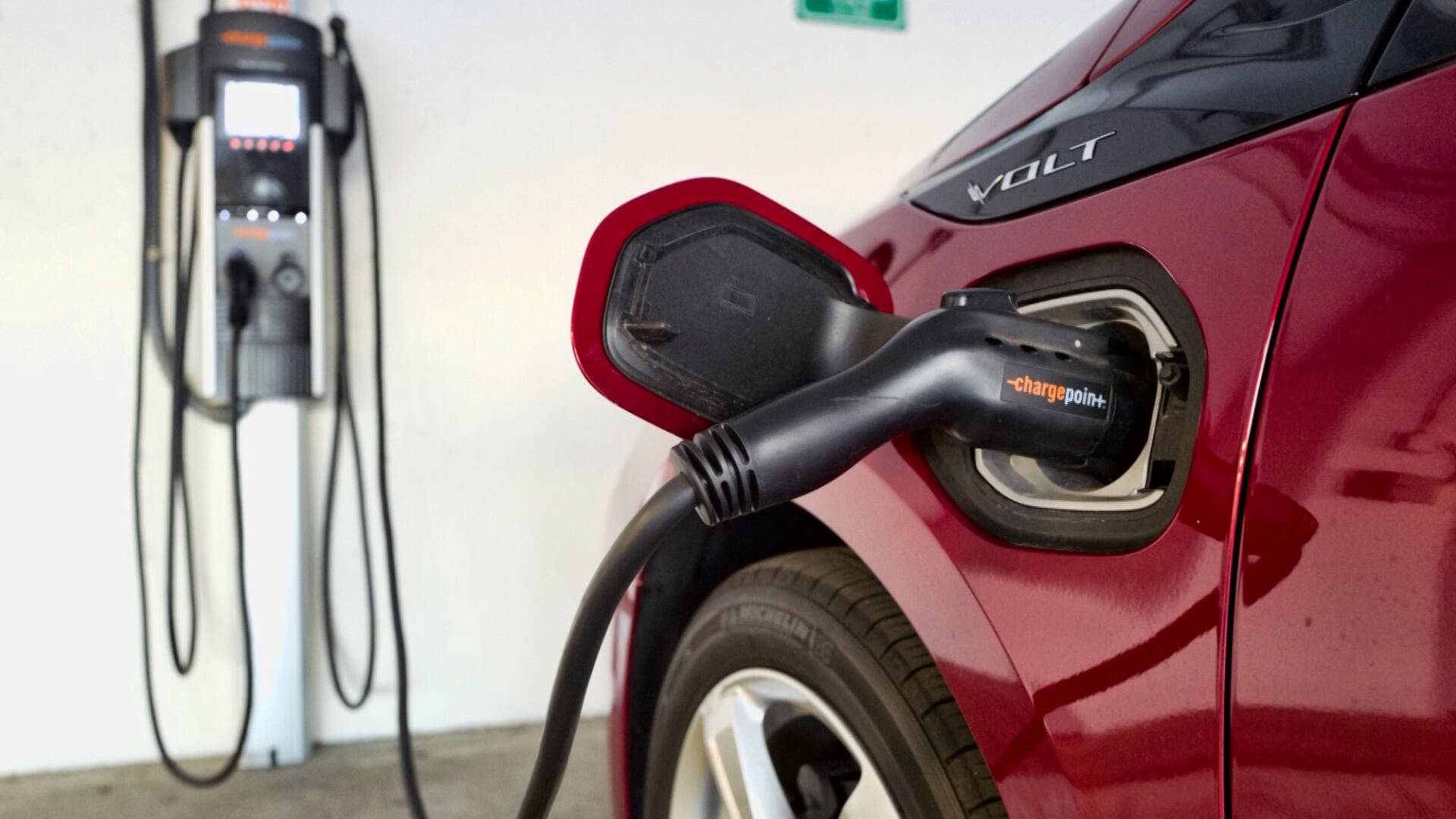
Electric vehicle companies took a tumble Monday after Senator Joe Manchin killed Biden's 'Build Back Better' plan. Shares of Tesla, Lucid, and Rivian all fell rapidly as the plan had included significant incentives for the growing EV sector. Rich Steinberg, former executive at Nissan, BMW and Electrify America joined Cheddar's Opening Bell to discuss.
Michael Robinson, Chief Technology Strategist at Money Map Press, joins Cheddar News' Closing Bell, where he explains why small and mid-cap stocks heating up during Tuesday's session is a very good sign for a stock market that ended the day's session sharply higher.
Coming off a 2021 campaign where the prices of Bitcoin, Ether, and other cryptocurrencies reached unpreceded levels, Bitwise Asset Management CIO Matt Hougan and OpenNode Co-Founder & CTO João Almeida join Cheddar News' Crypto Craze: The Year of the Token to discuss the ways the crypto market can soar even higher in 2022.