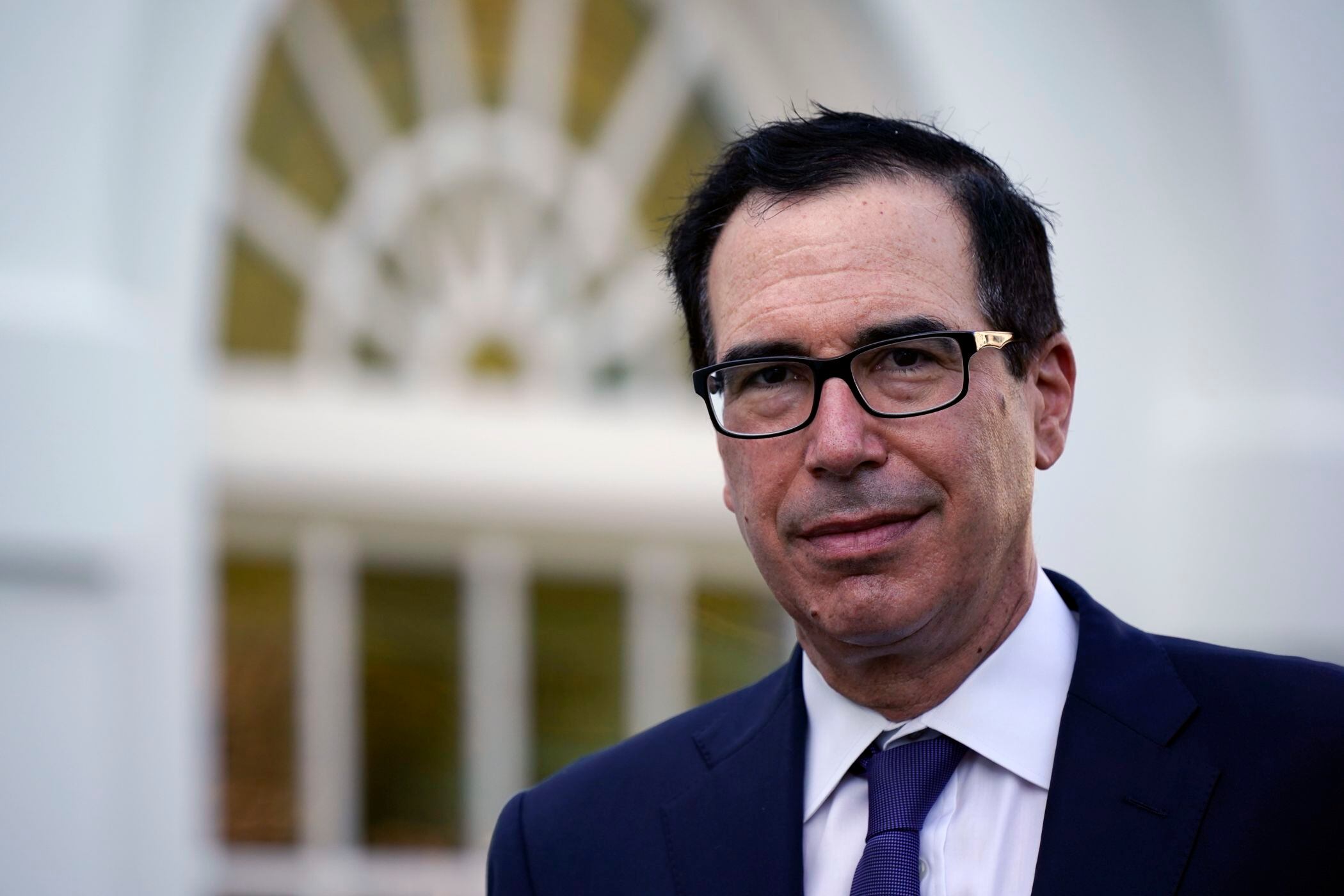
This Aug. 24, 2020 file photo shows Treasury Secretary Stephen Mnuchin at the White House in Washington. The U.S. government’s deficit in the first three months of the budget year was a record-breaking $572.9 billion. The Treasury Department reported Wednesday, Jan. 13, 2021 that with three months gone in the budget year, the deficit was $216.3 billion higher than the same October-December period a year ago. (AP Photo/J. Scott Applewhite, File)
By Martin Crutsinger
The U.S. government's deficit in the first three months of the budget year was a record-breaking $572.9 billion, 60.7% higher than the same period a year ago, as spending to deal with the COVID-19 pandemic surged while revenue declined.
The Treasury Department reported Wednesday that three months into the budget year, the deficit was $216.3 billion higher than the same October-December period a year ago.
The deficit reflects an 18.3% jump in outlays to $1.38 trillion, a record for the period, while revenues fell 0.4% to $803.37 billion. The red ink results from the difference between revenue collections and outlays.
For just the month of December, the deficit totaled a record $143.6 billion.
The shortfall for the 2020 budget year, which ended Sept. 30, climbed to an all-time high of $3.1 trillion. Beginning in the spring, Congress passed trillion-dollar-plus spending measures to combat the harm being done to the economy from a pandemic-induced downturn.
The recession, which has seen millions of Americans lose their jobs, has also meant a drop in tax revenues at a time when the demand on government support programs such as unemployment benefits and food stamps has risen.
The report showed that outlays in December were a record $489.7 billion, while receipts were $346.1 billion.
The spending figure did not include the $900 billion relief package Congress finally passed after months of wrangling because it was not signed into law until the end of the month. President Donald Trump delayed signing the bill, which he called a “disgrace,” because it included only $600 in direct payments to individuals.
President-elect Joe Biden has endorsed boosting the direct payments by another $1,400. He has said that higher amount will be included in another round of relief payments he will ask Congress to approve once he takes office on Jan. 20.
In addition to direct payments, the December relief bill extended two special unemployment benefit programs aimed at cushioning the pandemic’s blow. The unemployment benefits have totaled $80 billion from October through December, up from $5 billion during the same period in the last budget year.
The Congressional Budget Office has forecast that this year's deficit will total $1.8 trillion and the deficit will remain above $1 trillion each year though 2030. The CBO forecast for this year was made before the December relief package was passed and also does not take into account any extra spending that Congress may pass after Biden takes office.
Updated on January 13, 2021, at 3:28 p.m. ET with the latest information.
Mayor Ras Baraka of Newark, NJ and Ayana Morris, co-director of the documentary 'Why Is We Americans?,' join Cheddar News to discuss the new documentary highlighting the impact of the Baraka family.
Former New York City mayor and lawyer to Donald Trump Rudy Giuliani made his singing debut on a taping of Fox’s The Masked Singer. However, Ken Jeong and Robin Thicke, two judges on the competition show, reportedly left in protest when Giuliani was unmasked upon being eliminated.
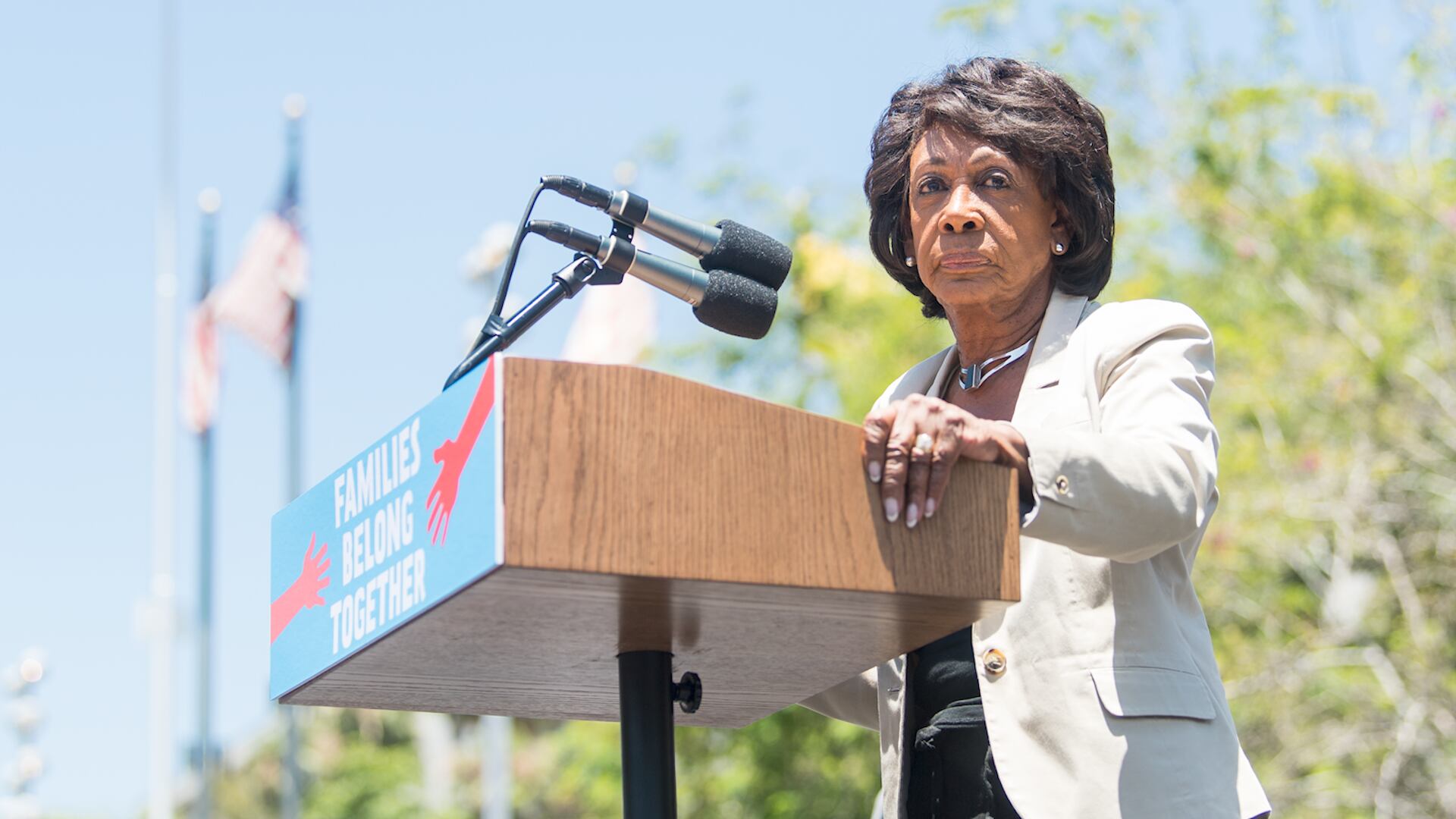
All Hands celebrates Black History Month by highlighting achievements in inclusivity and paying homage to those who have fought for equal rights. Rep. Maxine Waters (D-CA) joins Cheddar News to discuss voter suppression; Damali Peterman, CEO of Breakthrough ADR, elaborates on the biggest barriers for Black professionals; Andre Perry, senior fellow of Brookings Institution, dives into student loans and the racial wealth divide; and lastly, BET CEO Scott Mills discusses the company's initiatives for 2022.
All month long Cheddar News is celebrating Black History Month.
In our nation’s capital, Black history is being made right now.
cheddar's own Arielle Hixon puts the spotlight on three lawmakers making that happen, Rep. Lauren Underwood (D-IL), Rep. Cori Bush (D-MO), and Sen. Tim Scott (R-SC).
Representative Maxine Waters (D-Calif. 43rd District) joined Cheddar News to talk about the current political climate in America, including efforts to roll back voting rights in multiple states in light of Black History Month. "Why do we have to deal with those who still believe that somehow this country only belongs to the whites of the country and that somehow they have to do everything that they can to undermine our voting and do voters suppression to keep us from being influential and at the table by which to solve problems?" she asked. Waters chided "two Democrats" who she said were stymying attempts to rectify the issue and also spoke on President Biden’s promise to nominate a Black woman to the Supreme Court.
Wall Street saw another volatile day after the Federal Reserve left rates unchanged for now, with plans to raise rates in March at its next meeting in order to ease inflation. Fed Chair Jerome Powell said the Fed has not made decisions on the size of rate increases, adding that the Fed is not trying to get inflation below two-percent. Ken Johnson, CFA and Investment Strategy Analyst explains why Powell thinks that high inflation is a significant threat to the labor market.
Anu Gaggar, global investment strategist for Commonwealth Financial Network, joined Cheddar News to discuss how global supply chains could be disrupted even further by an armed conflict in Ukraine.
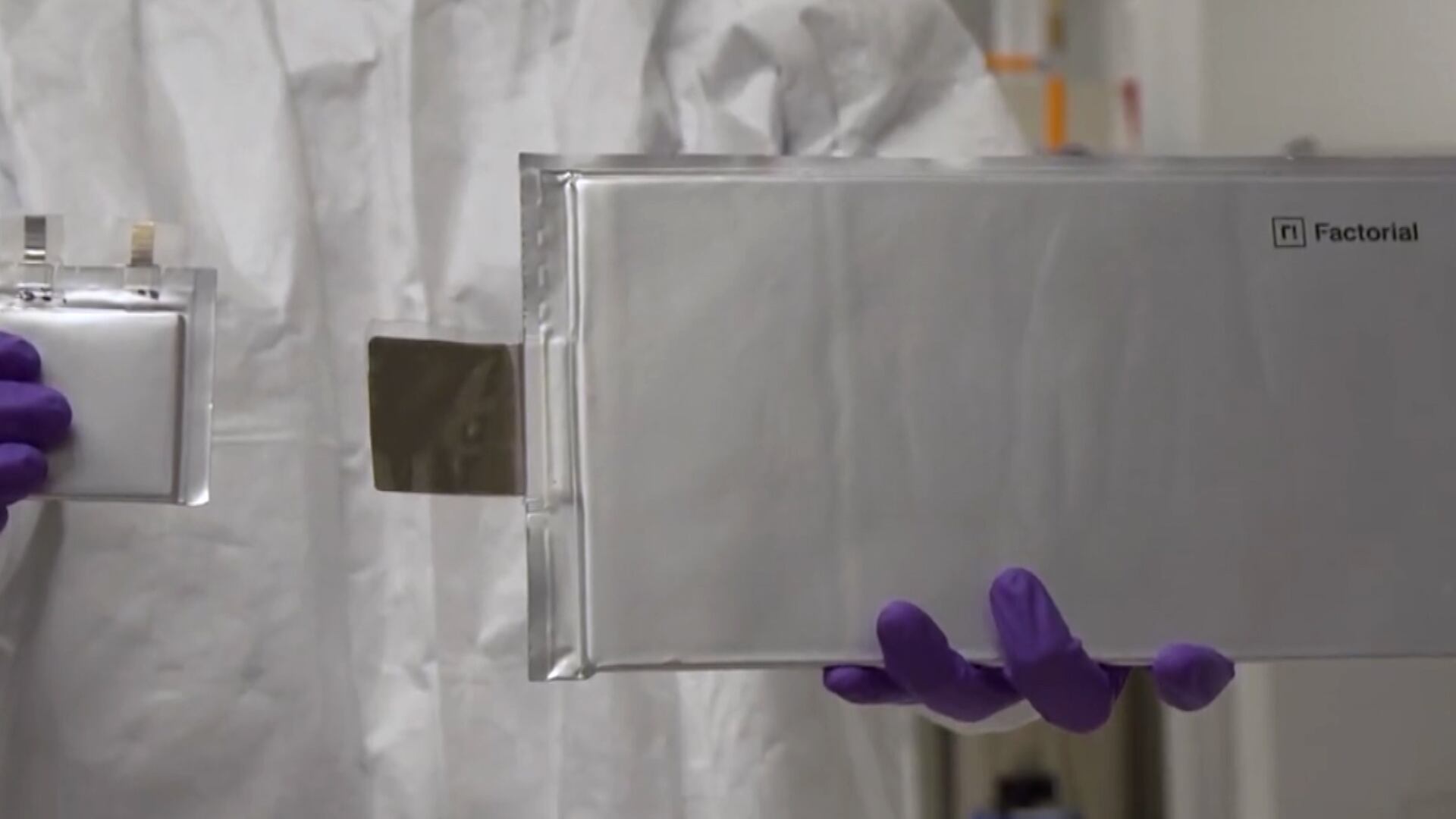
Solid-state battery maker Factorial Energy recently raised $200 million in a Series D round led by Mercedes-Benz and Stellantis. Factorial says the funding will be used to accelerate commercial production and deployment of its solid-state battery technology, which the company says is safer, and offers up to 50% more driving range than current lithium-ion technology. Factorial also has joint development agreements (announced in late 2021) with Mercedes-Benz, Stellantis, and Hyundai, three of the top 10 global automotive manufacturers, to commercialize its batteries. Factorial CEO Siyu Huang joined Cheddar News' Closing Bell to discuss.