That's the future communication imagined by the cellular satellite startup UbiquitiLink. The two-year old startup's plan is to build a constellation of orbital platforms that can send and receive calls to and from anywhere on Earth's surface.
"The fundamental problem we're solving is that you can't build cell towers everywhere. They're getting to about 10 percent of the planet, where you have cities and suburbs. It makes no economic sense to build them elsewhere. They're just really expensive," co-founder and CEO Charles Miller told Cheddar.
"In the future, [your call] will stay in the cell tower on the ground when you're connected, but whenever you roam outside to an area — which is 90 percent of the Earth — where there is no cell tower, you'll roam onto the cell tower in space. In the long-term, you won't even know it."
Miller's proposed model raised about $12 million back in July, but UbiquitiLink is hoping to attract even more after additional demonstration flights scheduled over the coming months. "After we prove this technology from space, we have a bunch of big money sitting on the sideline ready to invest," he said.
The technology is meant to be integrated into existing cellular telecoms infrastructure. UbiquitiLink has already partnered with 24 mobile network operations, representing about 1.5 billion wireless users.
While there are a few other startups focused on satellite constellations for the internet, namely OneWeb, Amazon, and SpaceX, UbiquitiLink differentiates itself by focusing exclusively on cellular communications.
The company plans to have 24 to 36 satellites in orbit which will serve as the foundation for its commercial service within the next two years. By 2023, Ubiquitlink expects to be able to provide continuous coverage.
Miller concedes that satellite-based cellular communication will be slower than terrestrial cell towers, predicting the connection will be about the speed of 2G. But, he argues, it's about providing connection where previously there was none, saying: "That's infinitely faster than No-G."
In February, the company launched its first test payload to space aboard a NASA-operated vehicle traveling to the International Space Station.
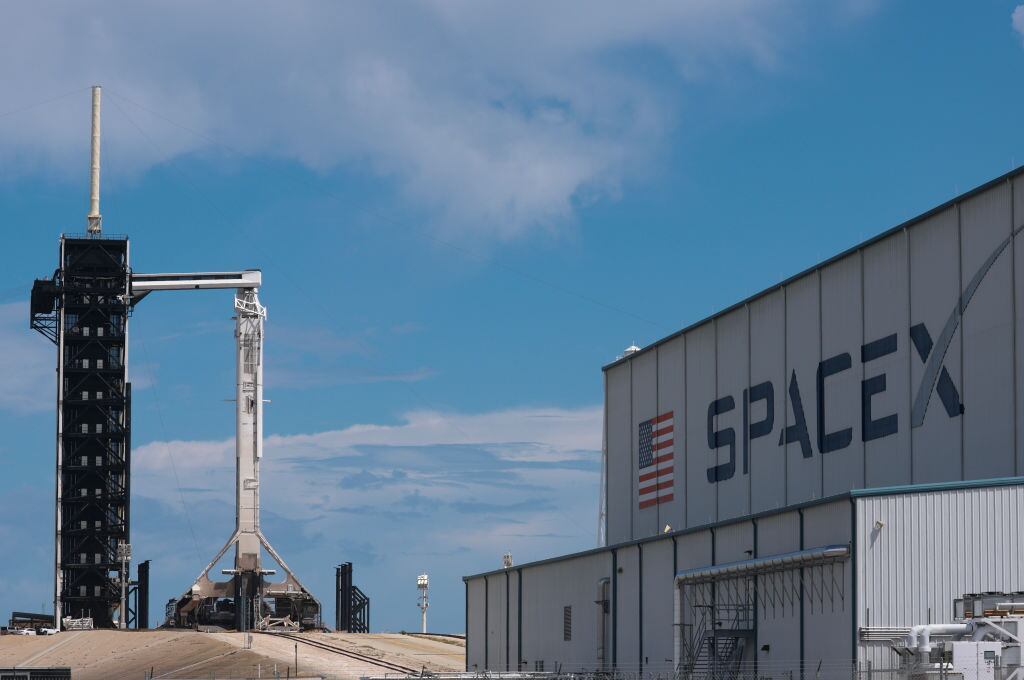
Last month, the second test payload launched on SpaceX's Falcon X. Miller says he ultimately expects that UbiquitiLink will rely on launches from SpaceX or Blue Origin, rather than small launch startups.
"Small launch vehicles just aren't affordable for serving our needs. They have a really difficult business model," he said.
A big-screen adaptation of the anime “Chainsaw Man” has topped the North American box office, beating a Springsteen biopic and “Black Phone 2.” The movie earned $17.25 million in the U.S. and Canada this weekend. “Black Phone 2” fell to second place with $13 million. Two new releases, the rom-com “Regretting You” and “Springsteen — Deliver Me From Nowhere,” earned $12.85 million and $9.1 million, respectively. “Chainsaw Man – The Movie: Reze Arc” is based on the manga series about a demon hunter. It's another win for Sony-owned Crunchyroll, which also released a “Demon Slayer” film last month that debuted to a record $70 million.
The Federal Aviation Administration says flights departing for Los Angeles International Airport were halted briefly due to a staffing shortage at a Southern California air traffic facility. The FAA issued a temporary ground stop at one of the world’s busiest airports on Sunday morning soon after U.S. Transportation Secretary Sean Duffy predicted that travelers would see more flights delayed as the nation’s air traffic controllers work without pay during the federal government shutdown. The hold on planes taking off for LAX lasted an hour and 45 minutes and didn't appear to cause continued problems. The FAA said staffing shortages also delayed planes headed to Washington, Chicago and Newark, New Jersey on Sunday.
Boeing workers at three Midwest plants where military aircraft and weapons are developed have voted to reject the company’s latest contract offer and to continue a strike that started almost three months ago. The strike by about 3,200 machinists at the plants in the Missouri cities of St. Louis and St. Charles, and in Mascoutah, Illinois, is smaller in scale than a walkout last year by 33,000 Boeing workers who assemble commercial jetliners. The president of the International Association of Machinists says Sunday's outcome shows Boeing hasn't adequately addressed wages and retirement benefits. Boeing says Sunday's vote was close with 51% of union members opposing the revised offer.
The stunning indictment that led to the arrest of more than 30 people — including Miami Heat guard Terry Rozier and other NBA figures — has drawn new scrutiny of the booming business of sports betting in the U.S. The multibillion-dollar industry has made it easy for sports fans — and even some players — to wager on everything from the outcome of games to that of a single play with just a few taps of a cellphone. But regulating the rapidly-growing industry has proven to be a challenge. Professional sports leagues’ own role in promoting gambling has also raised eyebrows.
Tesla, the car company run by Elon Musk, reported Wednesday that it sold more vehicles in the past three months after boycotts hit hard earlier this year, but profits still fell sharply. Third-quarter earnings fell to $1.4 billion, from $2.2 billion a year earlier. Excluding charges, per share profit of 50 cents came in below analysts' estimate. Tesla shares fell 3.5% in after-hours trading. Musk said the company's robotaxi service, which is available in Austin, Texas, and San Francisco, will roll out to as many as 10 other metro areas by the end of the year.
Starbucks’ AI barista aims to speed service and improve experience. Nick Lichtenberg, Fortune Business Editor, explains its impact on workers and customers.
As Big Tech reports Q3 earnings, investors await proof that massive AI and cloud investments from Meta, Apple, Microsoft, and Alphabet are driving real growth.
Eric Trump joins us to discuss American Bitcoin’s mission, market strategy, and why he believes the U.S. must lead the next era of digital currency innovation.