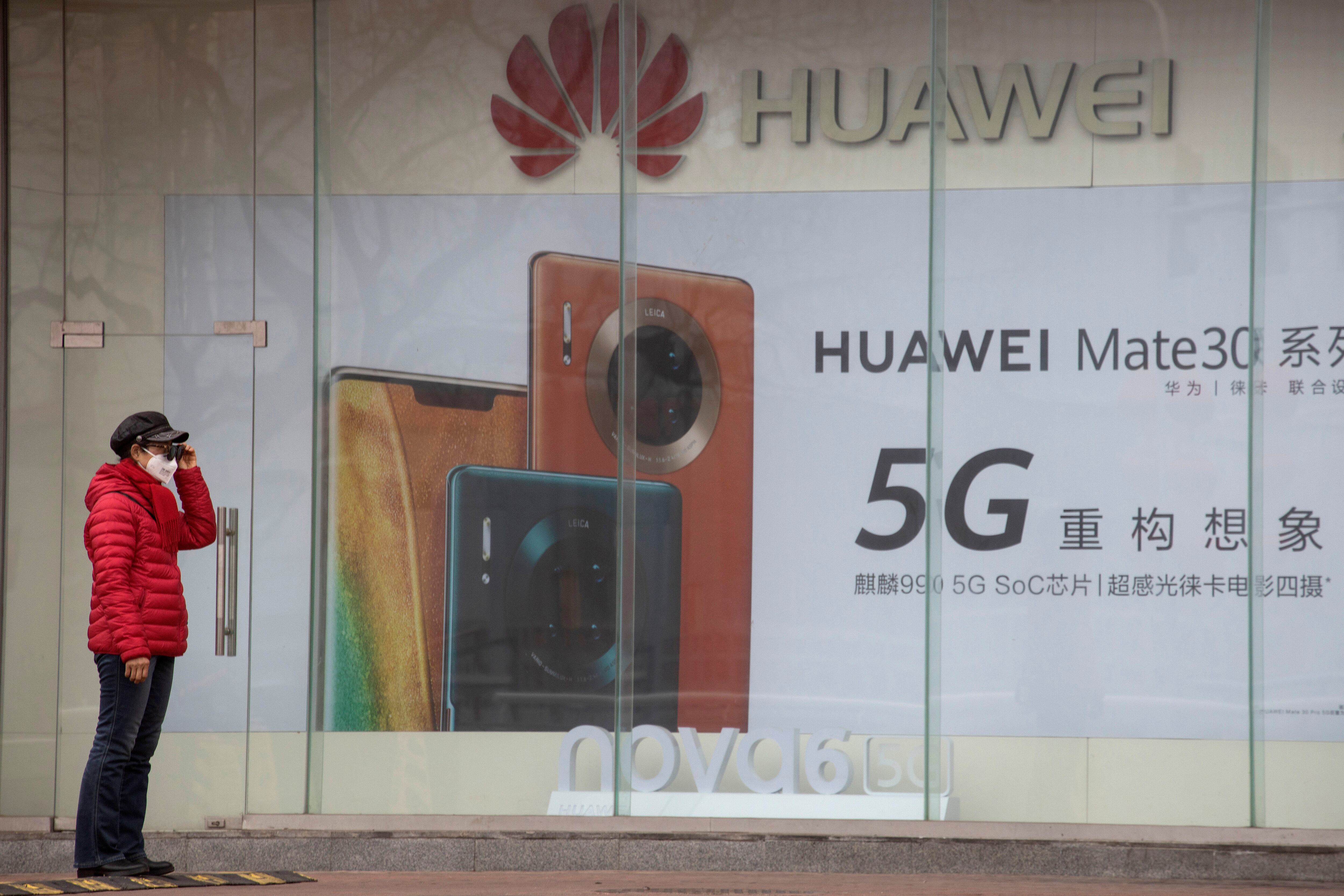
In this photo taken Sunday, March 8, 2020, a woman wearing a mask against COVID-19 stands near an advertisement for Huawei mobile phones in Beijing. (AP Photo/Ng Han Guan)
The U.S. government is imposing new restrictions on Chinese tech giant Huawei by limiting its ability to use American technology to build its semiconductors.
The Commerce Department said Friday the move aims to cut off Huawei's undermining of existing U.S. sanctions.
The new restriction is separate from an ongoing Trump administration reprieve on U.S. technology sales to Huawei. The U.S. government blacklisted the Chinese tech company a year ago, deeming it a national security risk, but the limited reprieve allows wireless companies to keep offering service in remote parts of the U.S.
The Commerce Department said this week that reprieve is being extended for another 90 days.
But numerous loopholes have been exploited, especially as U.S. companies continued to supply Huawei with chips made outside the United States. The Commerce Department said the new restriction will “narrowly and strategically" target Huawei’s acquisition of semiconductors built in overseas foundries but using U.S. software and technology.
The Gap is laying off 1,800 corporate workers, roughly three time the number of headquarters jobs it cut last fall, as the struggling chain cuts costs in a bid to become more nimble.
Tyson Foods is eliminating about 10 percent of corporate jobs and 15 percent senior leadership positions, according to a memo obtained by Reuters. The cuts are just the latest attempt to trim costs amid falling profits.
Verizon is taking steps to speed up its 5G network in rural areas. The company said it plans to extend its C-band 5G network across a larger suburban and rural footprint, meaning faster speeds for customers in those areas.
Facebook parent company Meta's first-quarter results surpassed Wall Street's modest expectations on both profit and revenue, sending its stock soaring in after-hours trading.
Another automaker is trying to cut its workforce to trim expenses and stay competitive as the industry makes the long and costly transition to electric vehicles.
The U.S. economy slowed sharply from January through March, decelerating to just a 1.1% annual pace as higher interest rates hammered the housing market and businesses reduced their inventories.