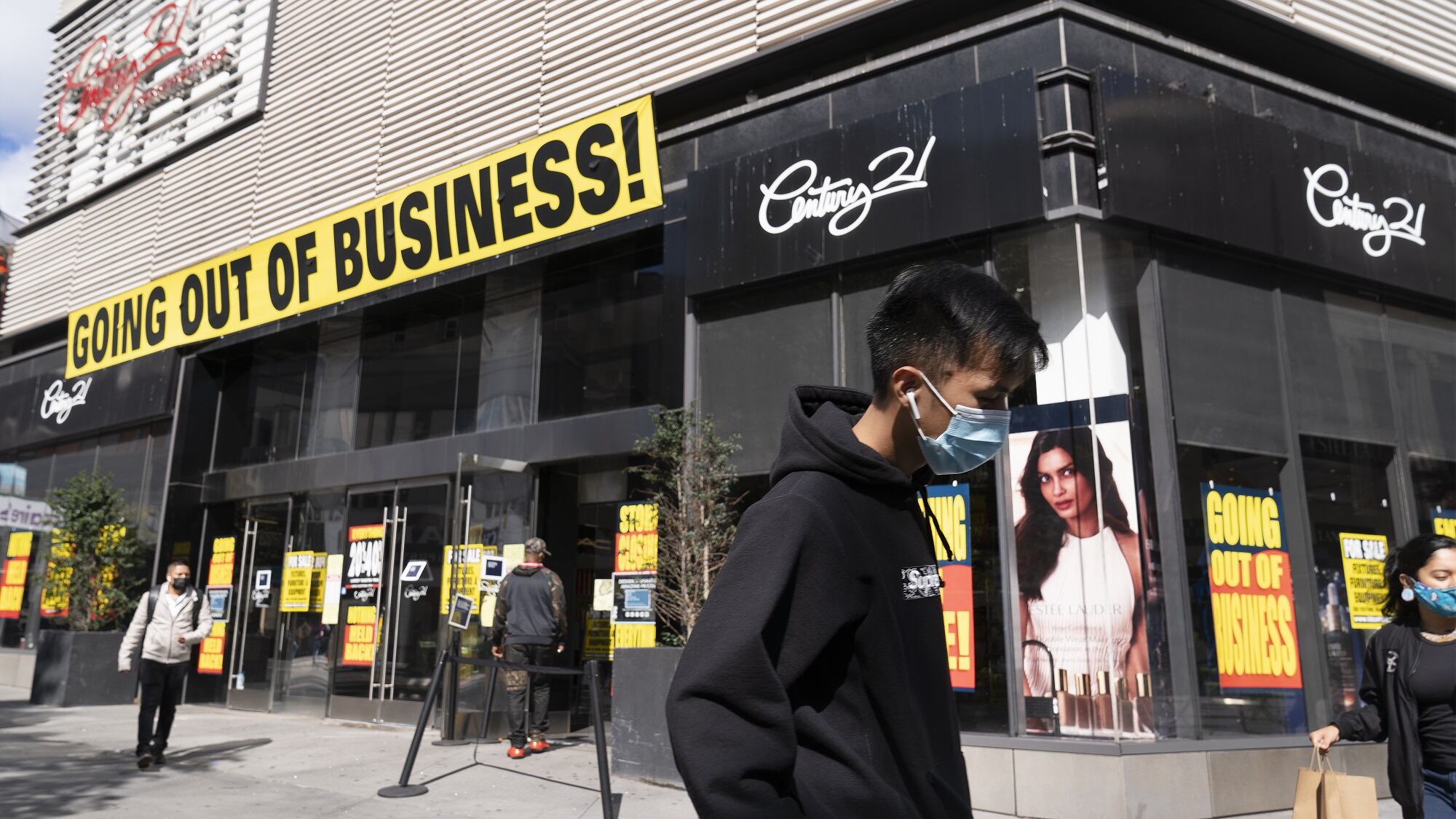
A man wearing a mask walks by Century 21 department store, Wednesday, Sept. 30, 2020 in the Brooklyn borough of New York. The discount department store chain has filed for Chapter 11 bankruptcy protection and is closing its 13 stores. (AP Photo/Mark Lennihan)
By Christopher Rugaber
The number of Americans seeking unemployment benefits declined last week to a still-high 837,000, evidence that the economy is struggling to sustain a tentative recovery that began this summer.
The Labor Department's report, released Thursday, suggests that companies are still cutting a historically high number of jobs, though the weekly numbers have become less reliable as states have increased their efforts to root out fraudulent claims and process earlier applications that have piled up.
For example, California, which accounts for more than one-quarter of aid applications, simply provided the same figure it submitted the previous week. The state had said it would stop accepting jobless claims online so it could tackle a backlog of 600,000 claims.
Measures of the U.S. economy have been sending mixed signals. Consumer confidence jumped in September, fueled by optimism among higher-income households, though it remains below pre-pandemic levels. And a measure of pending home sales rose in August to a record high, lifted by ultra-low mortgage rates.
Yet some real-time measures indicate that growth has lost momentum with the viral pandemic still squeezing many employers, especially small retailers, hotels, restaurants and airlines, nearly seven months after it paralyzed the economy. An economic index compiled by the Federal Reserve Bank of New York grew in September at a weaker pace than during the summer months.
In its report on jobless claims Thursday, the Labor Department said the number of people who are continuing to receive benefits fell to 11.8 million, extending a steady decline since spring. That suggests that many of the unemployed are being recalled to their old jobs.
But it also reflects the fact that tens of thousands of jobless Americans have exhausted their regular state unemployment benefits. Some of them are likely transitioning to an extended jobless aid program that provides benefits for an additional three months.
Weekly applications for unemployment benefits are typically watched as a proxy for layoffs, although the data has become muddied in recent months. The flood of laid-off workers during the pandemic recession overwhelmed state agencies.
Congress also made millions of contractors and self-employed people eligible for jobless aid for the first time through a new program that is managed by state agencies. This program has further burdened the states.
The states’ efforts to clear backlogs and uncover fraud in the new program have made it harder to interpret the government’s report on unemployment benefits. Many economists no longer consider it a clear sign of the pace of layoffs.
Initial jobless claims are stuck above the highest levels reached in the 2008-2009 Great Recession. But last week, economists at Goldman Sachs noted that according to other government data, layoffs have fallen below the peaks of a decade ago.
Still, many large companies are announcing further layoffs.
The Walt Disney Co. said this week that it’s cutting 28,000 jobs in California and Florida, a consequence of the damage it’s suffered from the viral outbreak and the shutdowns and attendance limits that were imposed in response.
Allstate said it will shed 3,800 jobs — 7.5% of its workforce. And tens of thousands of airline workers will lose their jobs this month as federal aid to the airlines expires. The airlines were barred from cutting jobs as long as they were receiving the government assistance.
Late Wednesday, two of them — American and United — announced that they would begin to furlough 32,000 employees after lawmakers and the White House failed to agree on a pandemic relief package that would extend the aid to airlines.
On Friday, the government will issue the jobs report for September, the final such report before Election Day, Nov. 3. Analysts have forecast that it will show a gain of 850,000, which would mark the third straight monthly slowdown in job growth. It would mean that the economy has regained just over half the 22 million jobs that were lost to the pandemic.
The unemployment rate is expected to decline from 8.4% to 8.2%, according to data provider FactSet.
Cloud data management company Informatica made its market debut on the New York Stock Exchange today under the ticker symbol INFA. Shares ending the day even after opening at $27.55. with shares priced at $29 apiece.
This is the second time the company has gone public after being founded back in 1993. Informatica then went private in a $5 billion deal in 2015. Now, the company is reentering public markets as a subscription business with a push to the cloud. Cheddar News welcomes CEO of Informatica, Amit Walia, to discuss.
If you plan on hosting family and friends this holiday season, you may want to start stocking up on gifts right now. That's because major retailers don't anticipate the national supply chain crisis to end anytime soon. President Biden even says he's considering deploying the National Guard to ease the supply chain crisis. Melissa Gonzalez, CEO and founder of The Lionesque Group, joins Cheddar News to breakdown what consumers should expect.
It's no doubt that the pandemic has been tough on the job market. According to the Labor Department, a record four million people quit their jobs in April. Now, a new survey from Oracle is touching on mental health and how employees are demanding more from their work lives. Juergen Lindner, SVP of global software for SaaS at Oracle, joins Cheddar Wellness to talk about the findings.
The new 2023 C8 Corvette Z06 is finally here. GM's Chevrolet is holding a livestream feature film to debut the car. A panel discussion will also take place to break down everything you need to know about the vehicle. Tadge Juechter, Corvette's executive chief engineer, joins Cheddar News to talk about the new model.
Anushka Salinas, president and COO of Rent the Runway, joined Cheddar's "Closing Bell" to talk about bringing the fashion rental company to the public market after debuting on Nasdaq. Salinas also talks about the future outlook for the company after the pandemic shifted the everyday lives of working women. "As of the end of September, we're at 97 percent of our ending 2019 subscriber count, which, I think, highlights that despite the pandemic, despite delta variant still kind of lingering around, limited marketing of our business, and women not fully being back in the office, we've already brought Rent the Runway back to pre-pandemic levels," she said.
The Roots' Questlove joined Cheddar's 'Between Bells' to talk about partnering with The Balvenie Scotch whisky on a new web series called 'Quest for Craft,' where he interviews big-name guests about their creative processes. He noted that he hopes the series can act as a guide for recent college grads who might be confused about their personal path to take toward success.
GM CFO Paul Jacobson joined Cheddar to talk about the automaker's Q3 earnings beat. Despite COVID concerns at some of its plants overseas as well as the ongoing global chip shortage, Jacobson said he expects the average sale price of GM's vehicles — around $50,000 — to remain the same going into 2022, even as inventory remains low. He also talked about plans to open more battery plants in coordination with the efforts to transform GM's fleet fully into electric vehicles.
Kevin Cohee, chairman and CEO of OneUnited Bank, joined Cheddar's "Opening Bell" to talk about the launch of its Greenwood debit card keeping alive the legacy of Tulsa, Oklahoma's historic Black Wall Street. Cohee also discussed the importance of shopping with Black businesses and investing in Black-led and owned financial institutions. "Our leaders have understood, since the end of slavery, the importance of us being organized in order to be effective in a capitalist society," he said.
Alex Wilhelm, a senior editor at TechCrunch, joined Cheddar to talk about the ups and downs of fashion rental company Rent the Runway as it went public on the Nasdaq. "In the case of Rent the Runway, the economics of its core business are a little bit suspect, I think, and the company's high debt load puts a pretty serious drag on its operations," he said. "And so when you consider it's going to spend a lot of its IPO paying down debt, you wonder what's going to be left over to fund future growth."