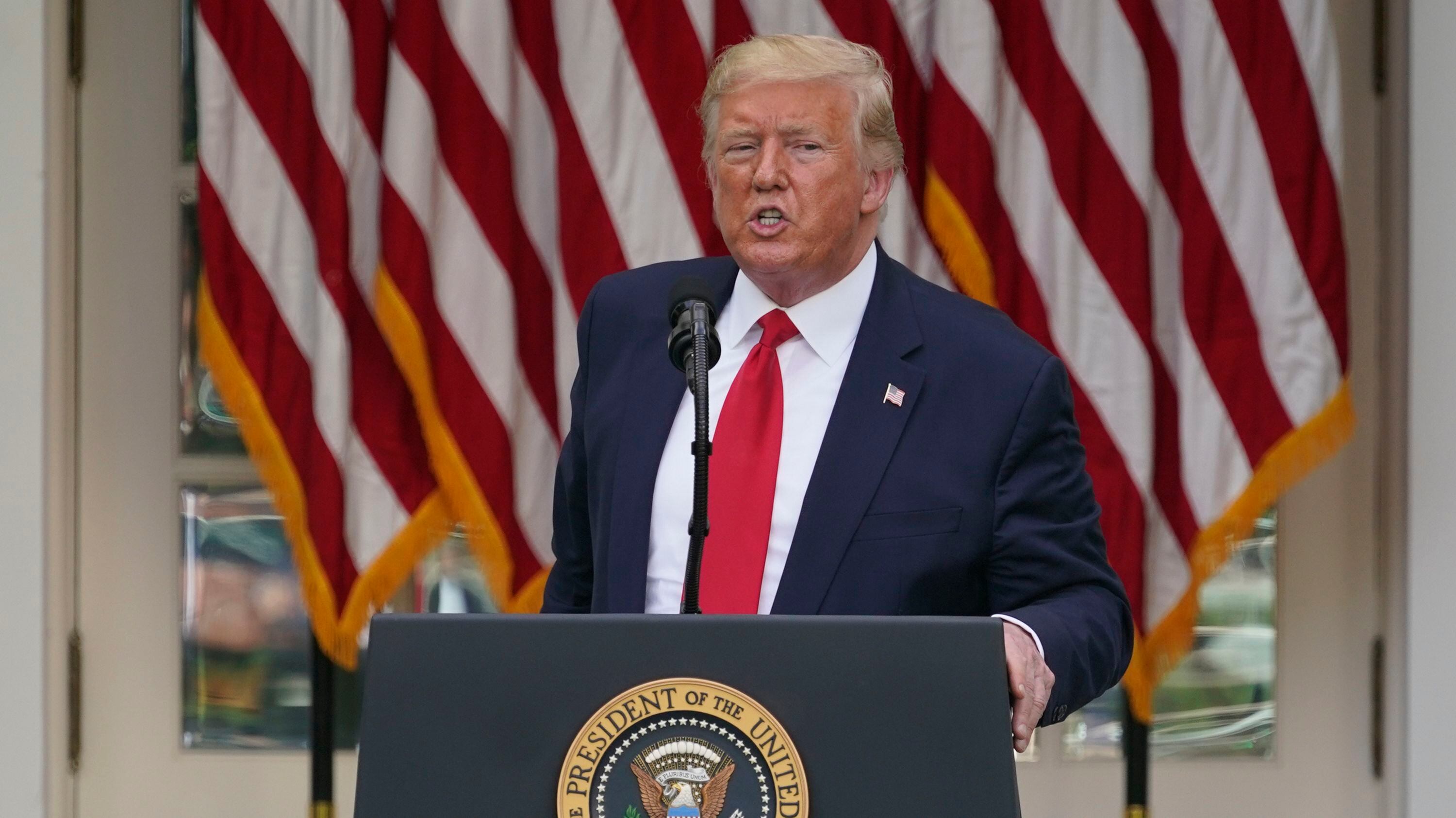
President Donald Trump answers questions from reporters during an event on protecting seniors with diabetes in the Rose Garden White House, Tuesday, May 26, 2020, in Washington. (AP Photo/Evan Vucci)
By Zeke Miller
President Donald Trump on Wednesday threatened social media companies with new regulations or even shuttering after Twitter added fact checks to two of his tweets.
The president can’t unilaterally regulate or close the companies, which would require action by Congress or the Federal Communications Commission. But that didn't stop Trump from angrily issuing strong warnings.
Claiming tech giants “silence conservative voices,” Trump tweeted early Wednesday, “We will strongly regulate, or close them down, before we can ever allow this to happen.” Later he tweeted without elaboration, “Big Action to follow.”
He repeated his unsubstantiated claim — which sparked his latest showdown with Silicon Valley — that expanding mail-in voting “would be a free for all on cheating, forgery and the theft of Ballots.”
There was no immediate reaction from Twitter or other social media companies to the president’s threats.
Trump and his campaign had lashed out Tuesday after Twitter added a warning phrase to two Trump tweets that called mail-in ballots “fraudulent” and predicted that “mail boxes will be robbed,” among other things. Under the tweets, there is now a link reading “Get the facts about mail-in ballots” that guides users to a Twitter “moments” page with fact checks and news stories about Trump’s unsubstantiated claims.
Trump replied on Twitter, accusing the platform of “interfering in the 2020 Presidential Election” and insisting that “as president, I will not allow this to happen.” His 2020 campaign manager, Brad Parscale, said Twitter’s “clear political bias” had led the campaign to pull “all our advertising from Twitter months ago.” Twitter has banned all political advertising since last November.
Trump did not explain his threat Wednesday, and the call to expand regulation appeared to fly in the face of long-held conservative principles on deregulation.
But some Trump allies, who have alleged bias on the part of tech companies, have questioned whether platforms like Twitter and Facebook should continue to enjoy liability protections as “platforms” under federal law — or be treated more like publishers, which can face lawsuits over content.
The protections have been credited with allowing the unfettered growth of the internet for more than two decades, but now some Trump allies are advocating that social media companies face more scrutiny.
“Big tech gets a huge handout from the federal government," Republican Sen. Josh Hawley told Fox News. “They get this special immunity, this special immunity from suits and from liability that’s worth billions of dollars to them every year. Why are they getting subsidized by federal taxpayers to censor conservatives, to censor people critical of China?”
There was no immediate reaction from Twitter or other social media companies to the president's threats.
As President Joe Biden heads to Europe for the G20 and the United Nations COP26 climate meeting, he has announced a new $1.75 trillion spending framework. Senate Democrats are reportedly close to agreeing on passing the legislation, but it hangs in the balance as President Biden and other world leaders will meet at COP26 and Biden looks to proclaim the U.S. a leader on climate issues. Vox Senior Reporter Rebecca Leber joins Cheddar News' Closing Bell to discuss the $555 billion worth of clean energy initiatives Biden included in the framework, and how Democrats' continuing negotiations undermine U.S. climate leadership.
Huntington Bancshares Inc. reported Q3 earnings today. The bank holding company delivered a record $1.7 billion in revenue, but saw some pressure on its bottom line. The company says results were driven by its recent acquisition of TCF bank, as well as positive trends in areas like wealth management, capital markets, and card and payments processing. Cheddar News welcomes the chairman, president and CEO of Huntington Bancshares, Steve Steinour, to discuss.
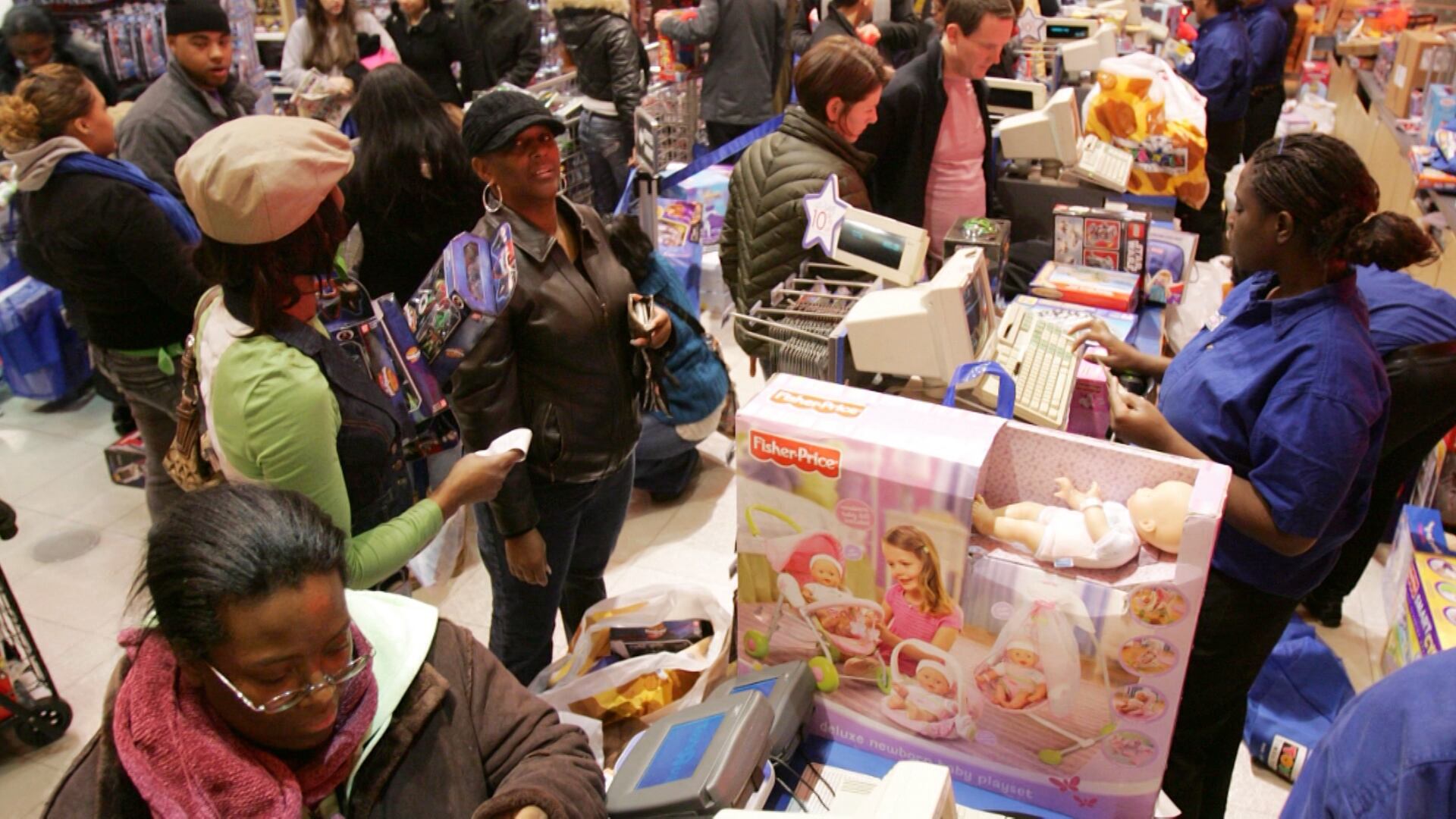
While the Q3 GDP report showed just 2 percent growth for the U.S. economy, the National Retail Federation said holiday shopping totals could shatter previous records, giving a much-needed boost. Katherine Cullen, senior director of industry and consumer insights for the National Retail Federation, joined Cheddar to discuss some of the potential drivers of a Q4 shopping boom, including a surge in holiday gatherings after the pandemic had forced people to stay away from family in 2020 and financial stability within American households.
Solo Brands ($DTC), maker of steel wood-burning stoves and other outdoor brands, made its NYSE debut on Thursday. CEO John Merris stopped by Cheddar's "Closing Bell" to talk about the decision behind the IPO and the company's experience in direct-to-consumer retail and e-commerce. Merris said that after going public the immediate goal for the company is to focus on overseas expansion. "Internationally, there's been a lot of demand and chatter from our customers of wanting us to launch there," he said.
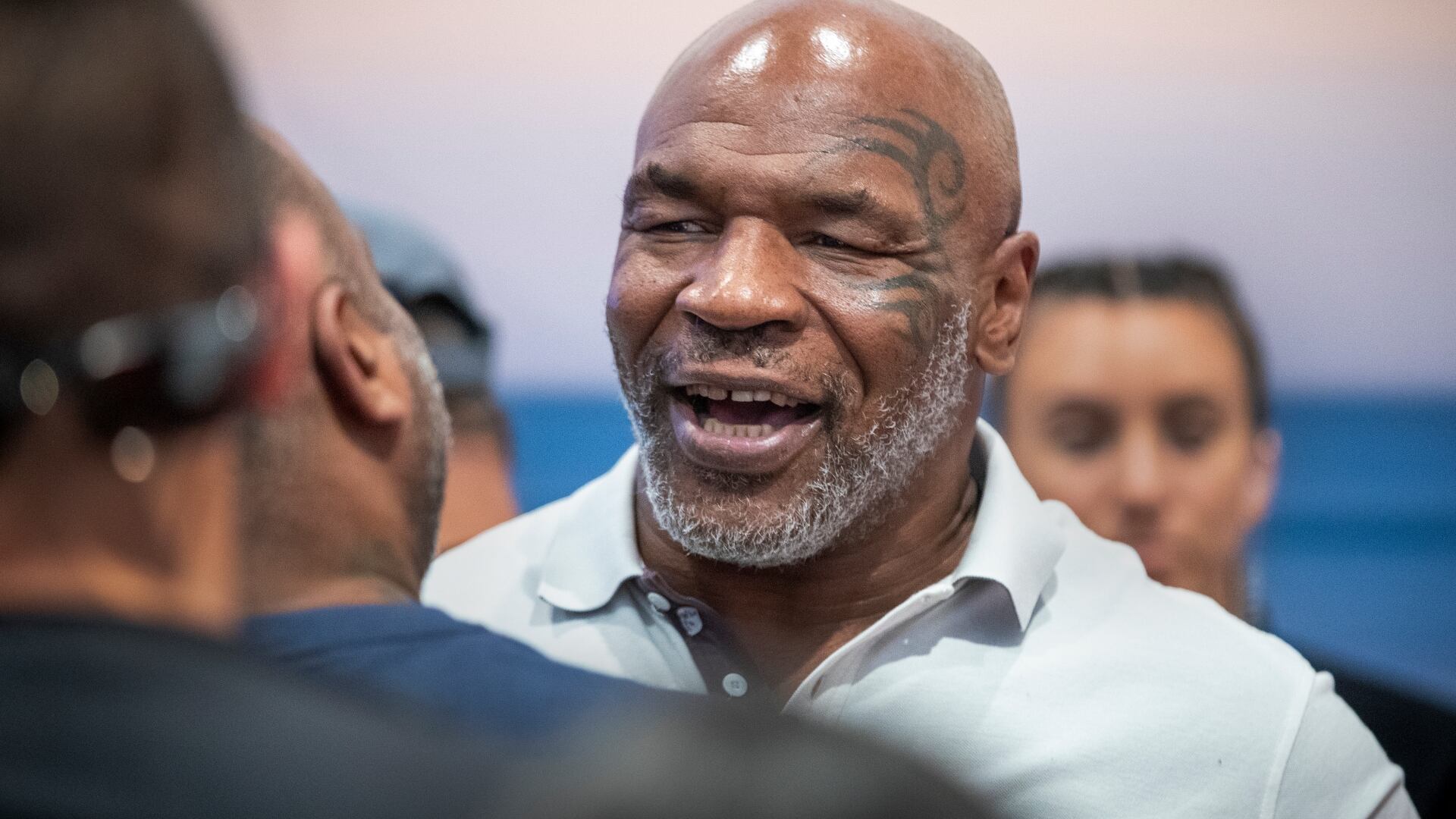
Boxing Legend Mike Tyson, Chief Brand Officer, of Tyson 2.0 and Chad Bronstein, Chairman of Tyson 2.0, joined Cheddar News to discuss venturing into the cannabis industry.
The CEO at Activision Blizzard Bobby Kotick apologized to employees after the company had been rocked by the public airing of sexual harassment claims that went unchecked. Kotick also asked that his compensation of more than $150 million be slashed to just over $62,000.
Cheddar's Ken Buffa took the Pixel 6 Pro for a test drive, highlighting some of the new features. The latest Google smartphone comes with an upgraded camera visor that holds three cameras in place as well as Gorilla Glass Victus covering the front and back protecting against drops and scratches. The device also contains Google's first homemade processor chip called Tensor and retails for about $899.
Overstock CEO Jonathan Johnson joined Cheddar's "Opening Bell" to talk about the company's Q3 earnings beat. While supply chain issues have plagued businesses across industries, Johnson noted that the company largely avoided constraints by not pressuring suppliers to fill Overstock's own distribution centers, encouraging them to use their own. "We have a higher in-stock percentage today than we did a year ago. Not quite as high as we did pre-pandemic but better than it was last year at this time," he said.