By Mark Sherman
As Democrat Joe Biden inched closer to the 270 Electoral College votes needed to win the White House, President Donald Trump's campaign put into action the legal strategy the president had signaled for weeks: attacking the integrity of the voting process in states where the result could mean his defeat.
Democrats scoffed at the legal challenges the president's campaign filed Wednesday in Pennsylvania, Michigan and Georgia. And the flurry of court action did not seem obviously destined to affect the election's outcome.
The new filings, joining existing Republican legal challenges in Pennsylvania and Nevada, demand better access for campaign observers to locations where ballots are being processed and counted, and raised absentee ballot concerns, the campaign said.
The Associated Press called Michigan for Biden on Wednesday. The AP has not called Nevada, Pennsylvania or Georgia.
The Trump campaign also is seeking to intervene in a Pennsylvania case at the Supreme Court that deals with whether ballots received up to three days after the election can be counted, deputy campaign manager Justin Clark said.
Trump's campaign also announced that it would ask for a recount in Wisconsin, also a state the AP called for Biden on Wednesday. Campaign manager Bill Stepien cited “irregularities in several Wisconsin counties,” without providing specifics.
Biden said Wednesday the count should continue in all states, adding, “No one’s going to take our democracy away from us — not now, not ever."
Campaign spokesman Andrew Bates said legal challenges were not the behavior of a winning campaign.
“What makes these charades especially pathetic is that while Trump is demanding recounts in places he has already lost, he’s simultaneously engaged in fruitless attempts to halt the counting of votes in other states in which he’s on the road to defeat,” Bates said in a statement.
Vote counting, meanwhile, stretched into Thursday. In every election, results reported on election night are unofficial and ballot counting extends past Election Day. But this year, states were contending with an avalanche of mail ballots driven by fears of voting in person during a pandemic.
Mail ballots normally take more time to verify and count. This year, because of the large numbers of mail ballots and a close race, results were expected to take longer.
The lawsuits the Trump campaign filed in Michigan and Pennsylvania on Wednesday called for a temporary halt in the counting until it is given “meaningful” access in numerous locations and allowed to review ballots that already have been opened and processed.
The AP's Michigan call for Biden came after the suit was filed. The president is ahead in Pennsylvania, but his margin is shrinking as more mailed ballots are counted. The state had 3.1 million mail ballots, and a court order allows them to be counted until Friday if they were postmarked by Nov. 3.
On Thursday, a state appellate court ordered a Philadelphia judge to ensure that party and candidate observers can get up close to election workers processing mail-in ballots in the city. The decision came after the Trump campaign complained Tuesday that its observer could not get close enough to election workers to see the writing on the mail-in ballot envelopes, to ensure that the envelope contains a signature and an eligible voter’s name and address. Ballots without that kind of information could be challenged or disqualified.
Pennsylvania Attorney General Josh Shapiro, a Democrat, said in a CNN interview the Trump campaign's lawsuit was “more a political document than a legal document.”
“There is transparency in this process. The counting has been going on. There are observers observing this counting, and the counting will continue,” he said.
The Michigan lawsuit claims Secretary of State Jocelyn Benson, a Democrat, was allowing absentee ballots to be counted without teams of bipartisan observers as well as challengers. Michigan Democrats said the suit was a longshot. Poll watchers from both sides were plentiful Wednesday at one major polling place in question, the TCF Center in Detroit, the AP observed.
The Georgia lawsuit filed in Chatham County essentially asks a judge to ensure the state laws are being followed on absentee ballots. Campaign officials said they were considering peppering a dozen other counties around the state with similar suits.
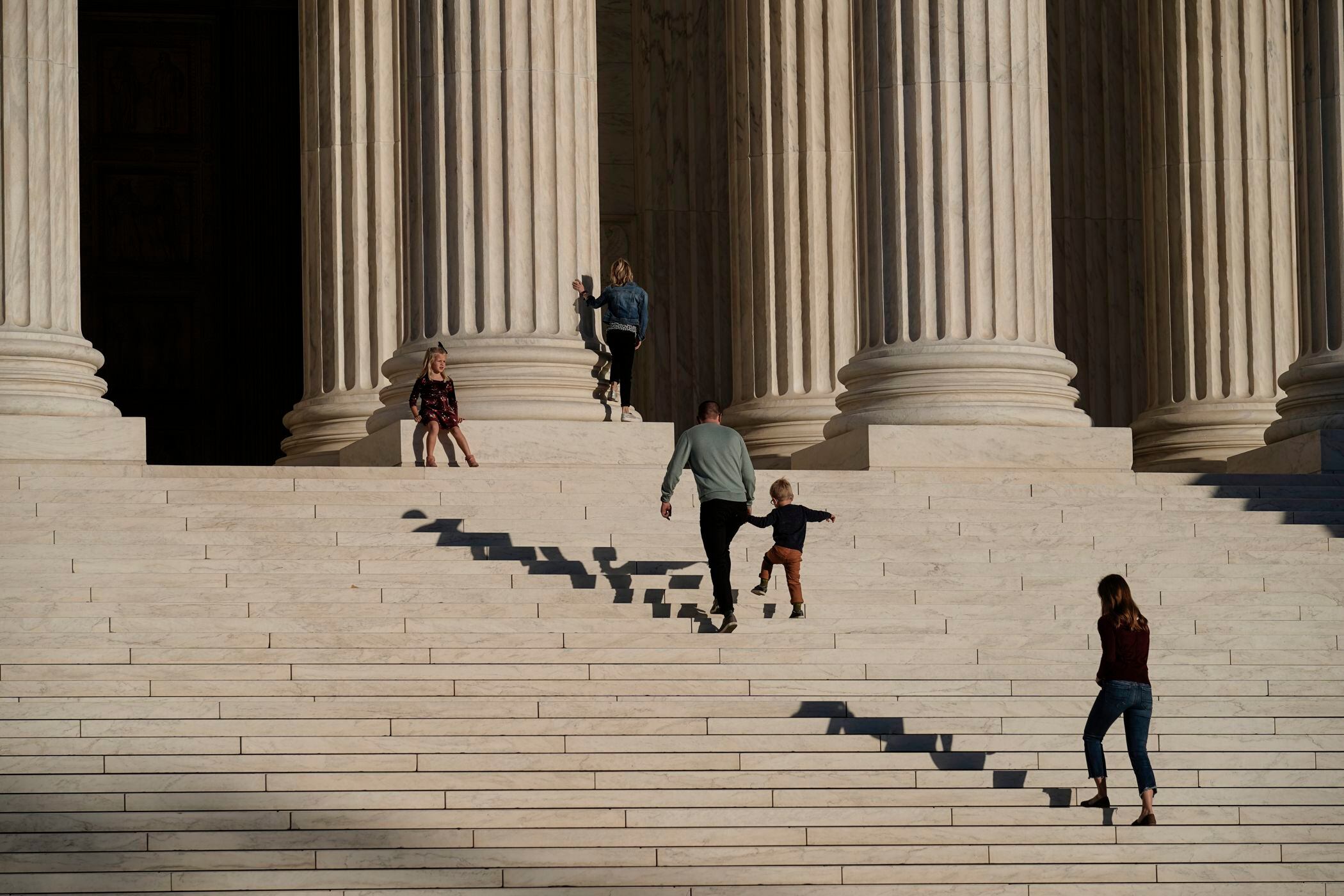
Trump, addressing supporters at the White House early Wednesday, talked about taking the undecided race to the Supreme Court. Though it was unclear what he meant, his comments evoked a reprise of the court’s intervention in the 2000 presidential election, which ended with a decision effectively handing the presidency to George W. Bush.
But there are important differences from 2000 and they already are on display. In 2000, Republican-controlled Florida was the critical state and Bush clung to a small lead. Democrat Al Gore asked for a recount and the Supreme Court stopped it.
To some election law experts, calling for the Supreme Court to intervene now seemed premature, if not rash.
A case would have to come to the court from a state in which the outcome would determine the election’s winner, Richard Hasen, a University of California, Irvine, law professor, wrote on the Election Law blog. The difference between the candidates’ vote totals would have to be smaller than the ballots at stake in the lawsuit.
“As of this moment (though things can change) it does not appear that either condition will be met,” Hasen wrote.
___
Associated Press writers Ben Nadler in Atlanta, John Flesher in Traverse City, Mich., Mike Householder and Ed White in Detroit, Nomaan Merchant in Houston, Kathleen Ronayne in Sacramento, Calif., and David Eggert in Lansing, Mich., contributed to this report.