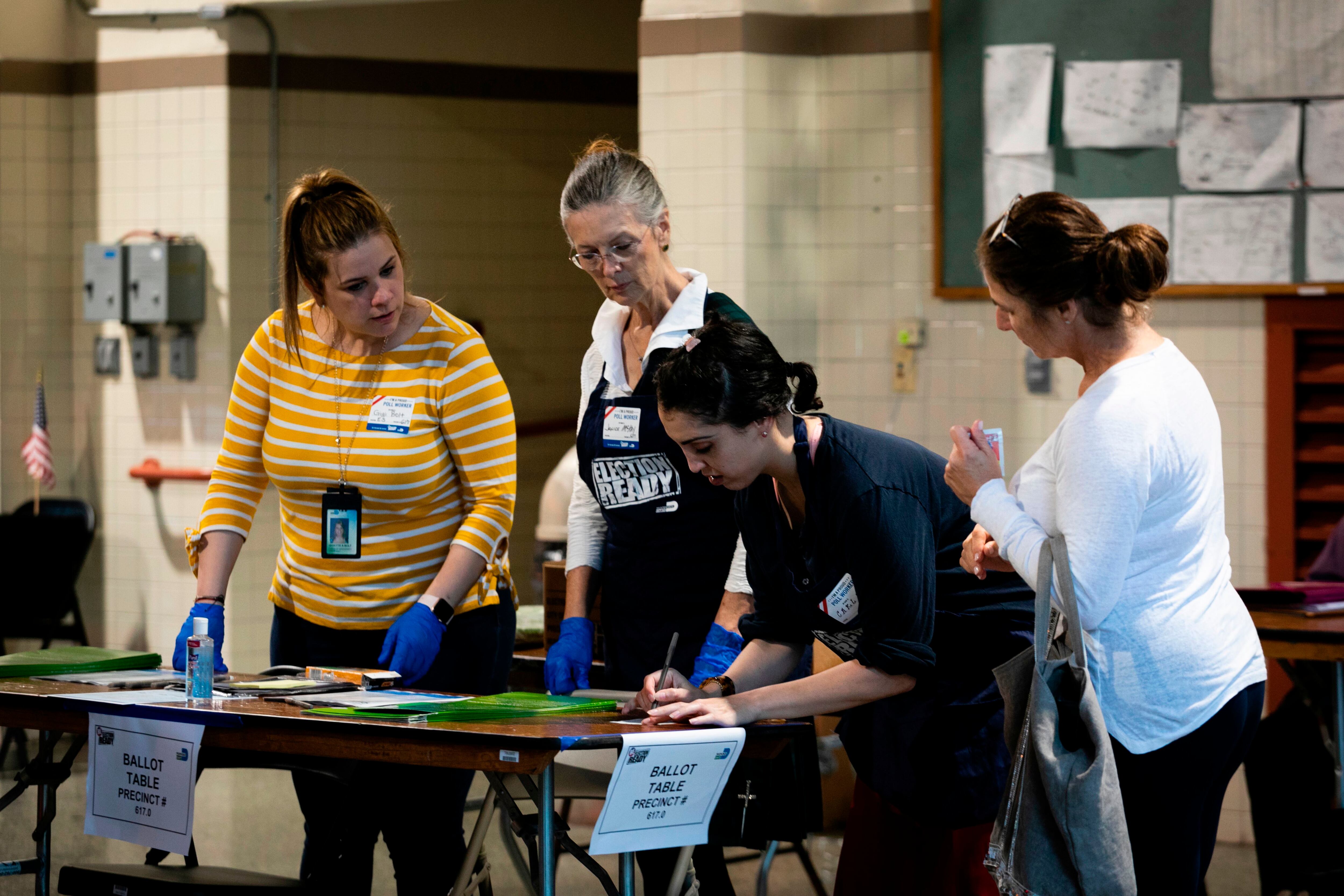
Some Florida polling places couldn't open as poll workers didn't arrive because of fears over the potentially deadly virus. The Palm Beach County elections department said many workers failed to show up in at least five locations. The county had 800 volunteers back out as of Monday, with just 100 new volunteers offering to take their place. (Photo by EVA MARIE UZCATEGUI/AFP via Getty Images)
Only three of the four scheduled primaries will take place today, and each of those states has confirmed multiple cases of the novel coronavirus.
Millions of voters in Arizona, Florida, and Illinois have already cast ballots for the 441 Democratic pledged delegates up for grabs in today and those who haven't are expected to head to the polls. Today's vote is the first held as in the nation since the coronavirus changed life in the U.S. There is concern about turnout, particularly after the Trump Administration yesterday advised avoiding groups of more than 10 people.
According to the Associated Press, the Palm Beach County elections department in Florida said workers were no shows in at least five polling sites after 800 volunteers had already backed out on Monday due to virus fears.
Ohio, originally scheduled to vote today, called off its primary late last night after the health director declared an emergency. A judge had denied a last-minute request to delay the primary, but Republican Gov. Mike DeWine later said the Health Department Director Amy Acton could "order the polls closed as a health emergency," which she inevitably did.
The 12 hours of back and forth in Ohio that led, finally, to a delay in voting, was so chaotic a local paper reminded voters that "Today is NOT really Election Day."
In Illinois, Gov. J.B. Pritzker told reporters the Illinois primary would move forward as planned with extra precautions in place to clean machines and offer hand sanitizers. Illinois had seen increased early voting numbers in Chicago and Cook County.
Government officials are imploring citizens to take advice from the Centers for Disease Control and Prevention seriously (which advised canceling events of more than 50 people) but also encouraging voters to head to the polls — safely.
Votes today are moving forward, but with a few changes. To encourage safe voting, polling sites in Florida, Illinois, and Arizona senior centers had been moved to separate at-risk elderly voters from the general population. Arizona recommended that voters cast mail ballots or drop off a vote-by-mail ballot at polling centers and Illinois will allow all nursing home residents in Chicago and Cook County to vote-by-mail.
Ohio is the fourth state to move its primary, joining Louisiana, Kentucky, and Georgia in postponing primaries.
Arizona is one of a few states believed to be competitive in the general election. Former Vice President Joe Biden and Vermont Senator Bernie Sanders had campaigned there before the coronavirus pandemic hit the U.S., and each candidate's response to the outbreak could potentially help voters see how they would respond to a crisis. Biden is ahead of Sanders in polling in all three states.
Matt Hayden, vice president of govtech solutions at Exiger and a former assistant secretary of cyber at Department of Homeland Security, joined Cheddar to discuss the surprise phone call initiated by Russian President Vladimir Putin to President Joe Biden, ahead of January security talks about the rising tensions over Ukraine. "We're hoping to hear that we're able to talk about the aggression and the leadup of the Ukrainian militarization," Hayden said. "But we're also looking to hear is how the Kremlin leveraged their talking points to try to test their negotiation stance with the United States leading into this January 10th meeting."
The No Surprises Act begins implementation on January 1, 2022. The legislation is meant to curb the practice of unexpected billing for care from providers the patient was unaware were out-of-network from their insurance. Patricia Kelmar, director of health care campaigns for U.S. PIRG joined Cheddar to describe the hundreds, sometimes thousands, of dollars charged to unsuspecting patients and how things will change under the new law. "If we are picking an in-network doctor and an in-network hospital, we should not see those added costs from anesthesiologists, radiologists, scrub-in surgeons," she said. "The other area it protects you is in air ambulances — not ground ambulances, unfortunately — but the helicopters or the airplanes you might need to transport you in an emergency situation."
President Joe Biden and Russian President Vladmir Putin are expected to have another conversation surrounding escalating tensions between Russia and Ukraine. Ariel Cohen, senior fellow at the Atlantic Council, joined Cheddar's Ken Buffa to discuss the ongoing tensions and why Putin's request for a conversation with Biden comes now. "This is very serious. This is the worst security crisis we had since the collapse of the Soviet Union," Cohen told Cheddar.
Stocks closed mixed on Wednesday, but two indexes - the Dow and the S&P 500 - ended the session with a new record. Akshata Bailkeri, Equity Analyst at Bruderman Asset Management, joins Cheddar News' Closing Bell, where she says there is a consensus for robust consumer spreading in 2022, especially as the Omicron variant is proving to be milder than other COVID-19 strains.
John Quelch, Dean of Miami Herbert Business School, joins Cheddar News' Closing Bell, where he says the retail giant is acting in accordance to President Biden's new law banning goods from China's Xinjiang region. Quelch also elaborates on the importance of China in Walmart's overall strategy.