In this March 23, 2021 file photo, pedestrians walk past the New York Stock Exchange in New York's Financial District. (AP Photo/Mary Altaffer, File)
By Damian J. Troise and Alex Veiga
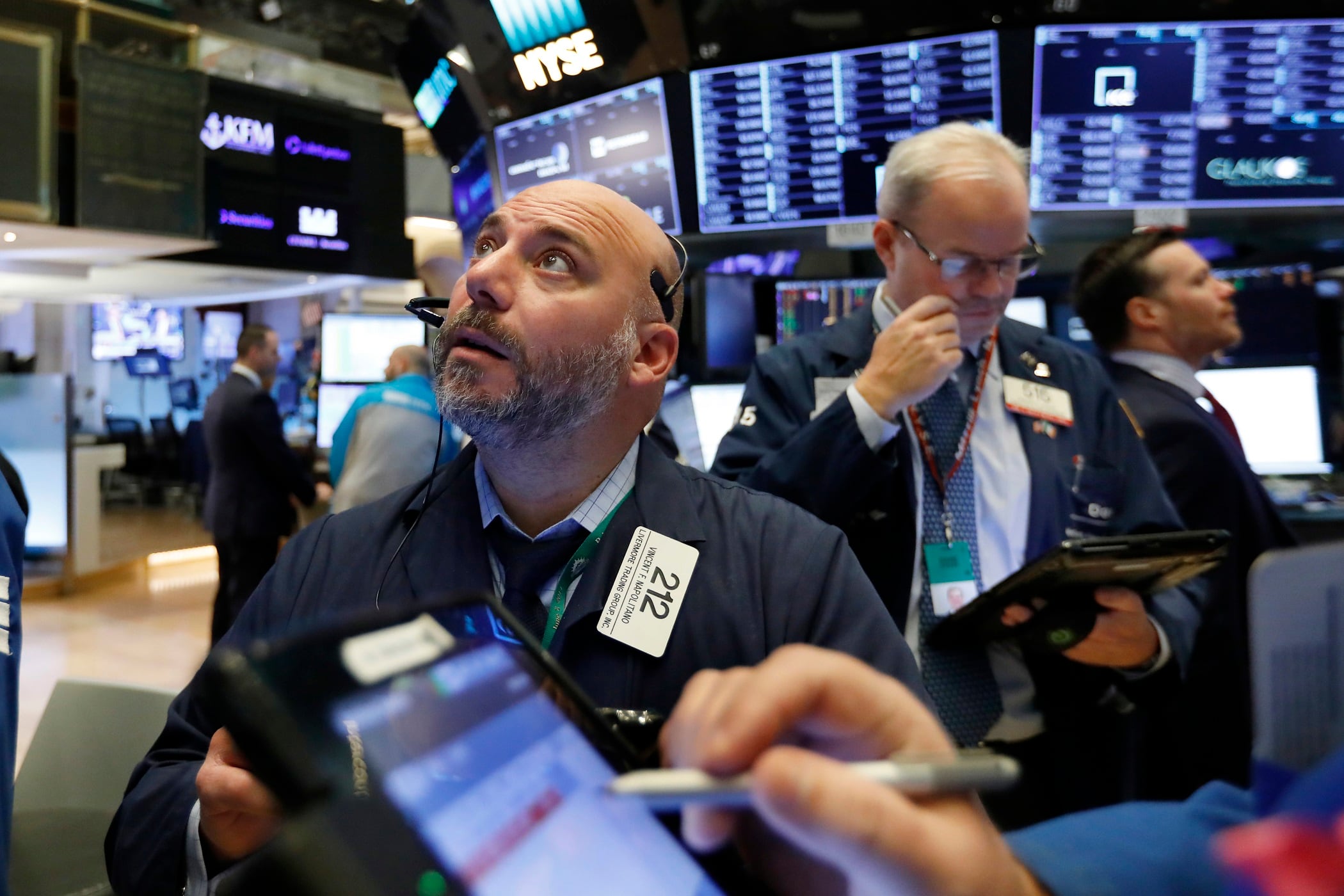
Technology and energy companies led stocks lower on Wall Street Monday, easing the market back from its recent all-time highs.
The S&P 500 slipped 0.1%, erasing an early gain. Technology companies accounted for a big share of the decline. Industrial and consumer-centric stocks also fell. Those losses outweighed gains in health care companies, banks and elsewhere in the market.
Energy companies slumped the most among S&P 500 stocks as the price of benchmark U.S. crude oil fell 2.6% to its lowest levels since May. The move lower follows a decline of 7.7% last week. Occidental Petroleum shed 3%.
Every major index was coming off weekly gains last week, which ended with record highs for the S&P 500 and the Dow Jones Industrial Average.
The modest pullback is another example of the volatility the market has seen amid uncertainty over the impact COVID-19 variants will have on the economy and the Federal Reserve’s next monetary policy moves, said Sylvia Jablonski, chief investment officer at Defiance ETFs.
“People who got in and saw some of the stocks that they hold at all-time highs on Friday, perhaps they’re selling a little bit off today and might be opportunistically trading some of this volatility,” she said.
The S&P 500 fell 4.17 points to 4,432.35. The Dow dropped 106.66 points, or 0.3%, to 35,101.85. The Nasdaq added 24.42 points, or 0.2%, to 14,860.18.
Smaller companies fell more than the rest of the market. The Russell 2000 index lost 12.95 points, or 0.6%, to 2,234.81.
Bond yields moved higher. The yield on the 10-year Treasury rose to 1.32% from 1.28% late Friday. Bond yields tend to move with expectations for the economy and for inflation.
The latest round of corporate earnings is winding down, and nearly 90% of companies in the S&P 500 have reported their latest results. The reports have been mostly solid. Tyson Foods jumped 8.7% for one of the biggest gains in the S&P 500 Monday after handily beating Wall Street's profit forecasts.
Investors are also closely watching the world's reaction to the latest surge of the coronavirus. Some governments have reimposed limits on business and travel. China canceled flights as it tries to stop a rash of outbreaks. Australia’s two most populous states have told people to stay home except to go to work or for a handful of other reasons.
Analysts expect the U.S. and global economies to continue growing, but have cautioned that the resurgent virus could slow down the pace.
“That's one part of the story and that could be holding back" the stock market, said David Kelly, chief global strategist at JPMorgan Funds. “We don't really have a handle on how bad the delta variant might get.”
Investors have been taking in a steady stream of encouraging economic reports. The latest from the Labor Department shows that U.S. employers posted a record 10.1 million job openings in June. That follows Friday's report that the economy generated 943,000 jobs last month and the unemployment rate fell to 5.4% from 5.9% in June.
The solid jobs figures also raise some concerns about wage inflation and the pace of economic growth.
“We’re burning our way back to full employment fast," Kelly said. “Once we get there the economy is going to slow down.”
The latest figures also raise concerns about inflation fueled by the improving job market, as employers are potentially forced to raise wages to fill jobs.
Investors will get another piece of data on inflation when the Labor Department releases its consumer price index for July on Wednesday. Wall Street is still trying to gauge how much inflation might rise as the economy recovers and whether that will push the Federal Reserve to trim back its support for the economy sooner than expected.
Major indexes Europe edged lower while indexes in Asia ended mixed.
Doug Flynn, Co-founder of Flynn Zito Capital Management, joins Cheddar News' Closing Bell, where he explains why the S&P and Nasdaq faded into the red to begin the week and what investors will be monitoring most closely when the Fed announces its latest policy decision on Wednesday.
Tim Davis, Partner and Executive Managing Director at Steward Partners, joins Cheddar News' Closing Bell, where he discusses what activity we could expect to see from the crypto market this week as the Fed decision approaches, the prices of Bitcoin and Ether struggle to find a spark, and the industry continues to digest President Biden's executive order on crypto.
Mission-driven fintech company Propel raised $50 million in a Series B round led by Nyca Partners. Propel's mission is to help low-income Americans improve their financial health. The company's free app is called Providers, designed as a one-stop-shop for Americans to manage government benefits and other income side-by-side. Jimmy Chen, founder and CEO of Propel, joins Cheddar News' Closing Bell to discuss.
Slingshot Aerospace, a company focused on the future of space sustainability, raised $25 million in its latest Series A funding round. The company's projects will allow commercial, government, and civil satellite operators to share traffic information. Slingshot Aerospace's co-founder and CEO Melanie Stricklan joined Cheddar News' Closing Bell to talk about the up-and-coming company.
Russia may be asking China for help with its war in Ukraine, according to several reports citing unnamed U.S. officials. Russia is reportedly calling on its ally for military and economic assistance, in an attempt to avoid punishment from sanctions imposed by the U.S., Europe, and Asia, which have hammered Russia's economy. Chinese and Russian officials denied the reports. Meanwhile, top U.S. and Chinese officials are meeting today, with both countries confirming the conflict in Ukraine will be the meeting's main topic. Edward Wong, diplomatic correspondent for the New York Times, joins Cheddar News' Closing Bell to discuss.
Ford has released its plans to grow its electric vehicle business to Europe — despite a potential lack of full features due to the ongoing chip shortage. Dan Ives, managing director of equity research at Wedbush, joined Cheddar News to talk about the challenges facing the automaker. "I mean for them, it's really a Catch-22 because they can't lose out on demand," he said. "And they're having to make some tough decisions." He noted that Ford's stock is under pressure even as the electric vehicle play is the right long-term decision.
Damian Mason, farm owner, agricultural economist and author of "Food Fear" joined Cheddar News to talk about how the Russian invasion of Ukraine is putting pressure on commodities, which could lead to a 20 percent price hike according to the United Nations. “Russia and Ukraine are responsible for about 35 percent of exports, 35 percent of grain exports, specifically wheat,” said Mason. He also added, "You've got Russia saying, 'we're going to hoard and hold back our wheat,' which of course crimps global supply, and you've got Ukraine that maybe won't even get harvested."
In order to qualify for one of the coveted first retail licenses in New York's adult-use cannabis program, you'll have to have a conviction on cannabis-related charges or have an immediate family member who does. It's part of the latest effort by New York lawmakers to create a diverse and inclusive industry — but some advocates still have reservations. Amber Littlejohn, the executive director of the Minority Cannabis Business Association, joined Cheddar News' Closing Bell to discuss. "We definitely applaud the state of new york, but ultimately the devil will be in the details as to whether or not this actually works out to create equity in the cannabis industry," she said.
Ryan Shearman, chief alchemist and co-founder at Aether, and Henry Elkus, founder of Helena, join Cheddar News to talk about the completion of an $18 million Series A funding round led by Helena.