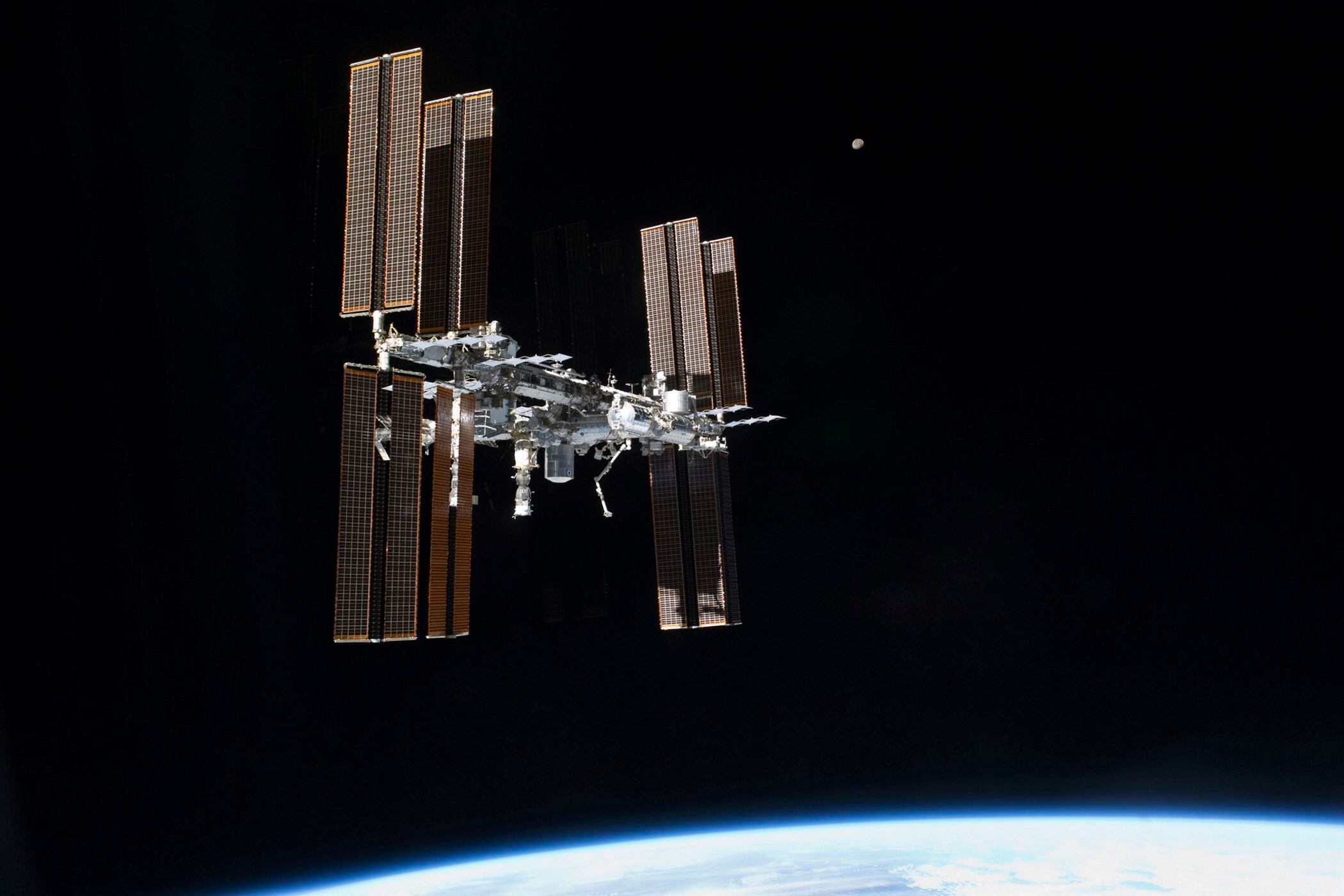
This July 19, 2011 photo of the International Space Station was taken from the space shuttle Atlantis. On Tuesday, Sept. 29, 2020, NASA said that the two Russians and one American on board were awakened late Monday to hurriedly seal hatches between compartments and search for the ongoing leak, which appeared to be getting worse. It was the third time in just over a month that the crew had to isolate themselves on the Russian side, in an attempt to find the growing leak. (NASA via AP)
By Marcia Dunn
A small air leak at the International Space Station finally has been traced to the Russian side, following a middle-of-the-night search by astronauts.
NASA said Tuesday that the two Russians and one American on board were awakened late Monday to hurriedly seal hatches between compartments and search for the ongoing leak, which appeared to be getting worse. It was the third time in just over a month that the crew had to isolate themselves on the Russian side, in an attempt to find the growing leak.
It turns out instead of the leak getting bigger this time, a temporary temperature change caused the erroneous cabin air pressure reading, according to NASA. The leak was first spotted a year ago.
NASA officials stress that the leak remains small and poses no danger. The astronauts will now use leak detectors to try to pinpoint the leak in Russia’s main living and working compartment called Zvezda, Russian for Star.
Space station deputy program manager Kenny Todd said the good news is that “instead of a bunch of haystacks, we're down to maybe one haystack." But he added: “It's still a needle we're looking for.”
NASA is sending up extra air supply tanks on its next space station delivery, scheduled for a Thursday departure from Virginia. As long as the leak does not worsen, Todd said, the space station should be fine through next spring.
In two weeks, two Russians and an American are scheduled to arrive at the space station, followed by a crew of three Americans and a Japanese on SpaceX's second launch of astronauts, now targeted for Oct. 31.
During a news conference Tuesday from Houston, NASA astronaut Mike Hopkins, the commander, announced that the SpaceX capsule would be called Resilience — to reflect how the world is coping with this year's challenges.
“We hope that it brings a smile to your face and we hope that it provides something positive in your lives. Quite frankly, we hope that it’s an inspiration,” Hopkins said of the name and the mission.
___
The Associated Press Health and Science Department receives support from the Howard Hughes Medical Institute’s Department of Science Education. The AP is solely responsible for all content.
Jill and Carlo discuss the pending approval for Pfizer's vaccine for kids, the state of anti-Semitism three years after Tree of Life, potential criminal charges in the 'Rust' prop gun shooting and more.
Amalgamated Bank is the first U.S. bank to publish science-based targets to reach net-zero greenhouse gas emissions by 2045. The bank says it will reach this goal through how it engages with customers and how it finances projects. Amalgamated Bank Chief Sustainability Officer Ivan Frishberg joined Cheddar Climate to provide more details about the bank's ambitious climate goals.
COP26 been dealt a blow as Chinese President Xi Jinping and Russian President Vladimir Putin, whose countries are responsible for a third of the world's annual greenhouse gas emissions, will not be in attendance. Bertrand Piccard, Chairman and Founder of the Solar Impulse Foundation, joins Cheddar Climate, where he discusses what he expects to see when the summit commences in Glasgow.
John Nosta, WHO Technology Expert, joins Cheddar News to discuss evolving technology in the healthcare industry and the role 5G is playing in advancing healthcare delivery.
According to the latest report from the UN, several countries around the world are "nowhere near" towards their goal of limiting gas emissions. This report comes ahead of the COP26 which is slated to take place in the month of November in Scotland. Senior Advisor at CDP Paula Diperna, joined Cheddar to discuss what the report highlights and what this tells us about the future plans of the Paris Climate Agreement.
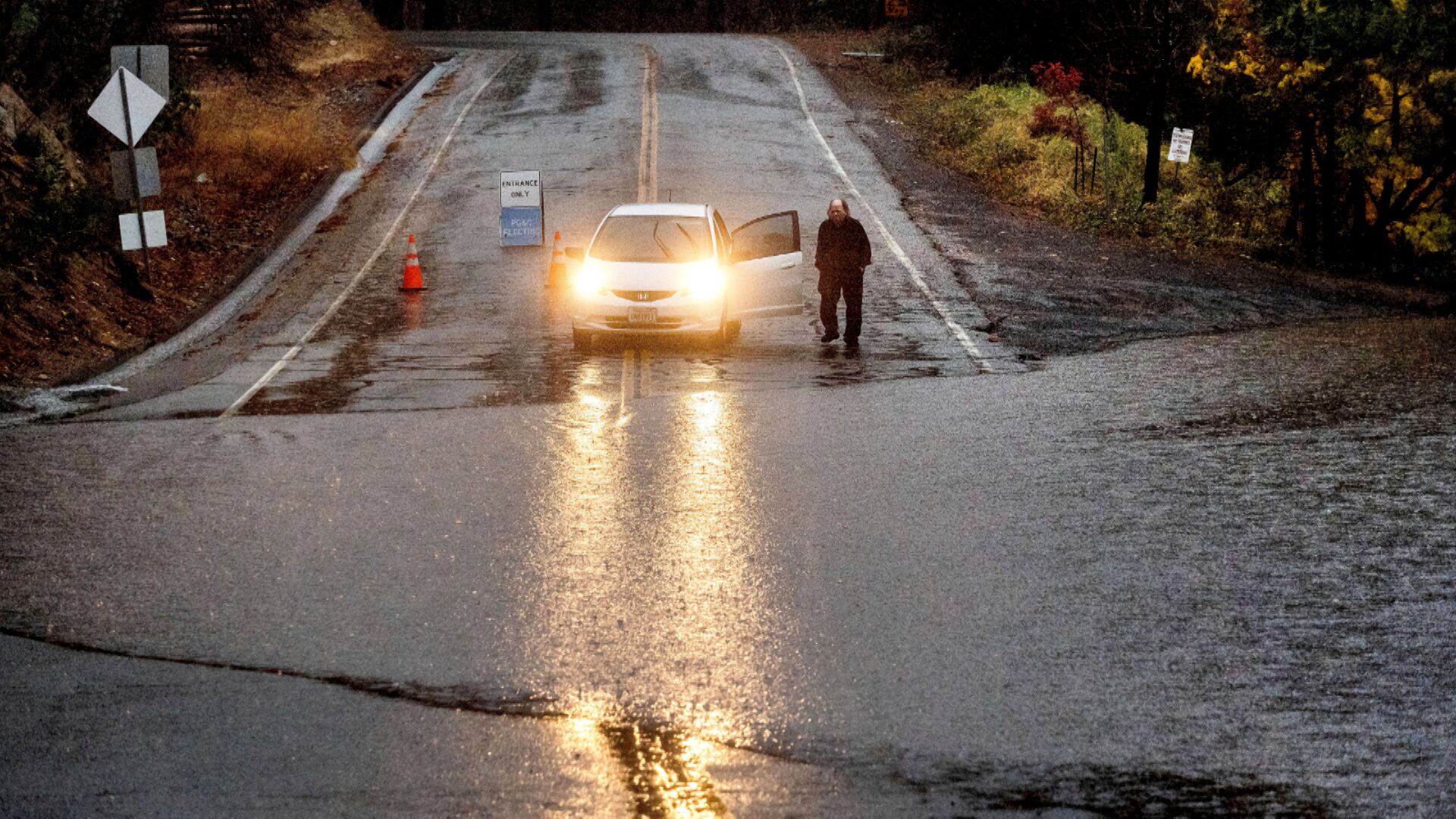
Powerful weather systems over California have caused record amounts of rainfall in the state, including over wildfire-scorched lands since triggering massive landslides.
The FDA meets today on whether or not vaccines for children ages 5-11 can potentially become available to the public. Cheddar News was joined by Dr. Richard Besser, President and CEO of the Robert Wood Johnson Foundation and former Acting Director of the CDC to discuss what could come next for these vaccines.
Dan DePodwin, Director of Forecasting Operations at AccuWeather, joined Wake Up With Cheddar to talk about the extreme weather across the country, including damaging rains in the drought-stricken western U.S. and an incoming Nor'easter that's likely to cause flooding and power outages along the Atlantic coast.
Jill and Carlo cover the news out of Facebook's latest earnings, Tesla's monumental day, Dave Chappelle addresses controversy and the tragedy of the climate emergency.
The UN's World Meteorological Organization reported that carbon dioxide in the atmosphere hit record levels in 2020, despite coronavirus-related lockdowns. With the COP26 international meeting on climate change less than a week away, Risk and behavioral scientist Dr. Sweta Chakraborty joined Cheddar to break down the "code red for humanity" the report represents and what actual commitments must be made to prevent significant global temperature increases.