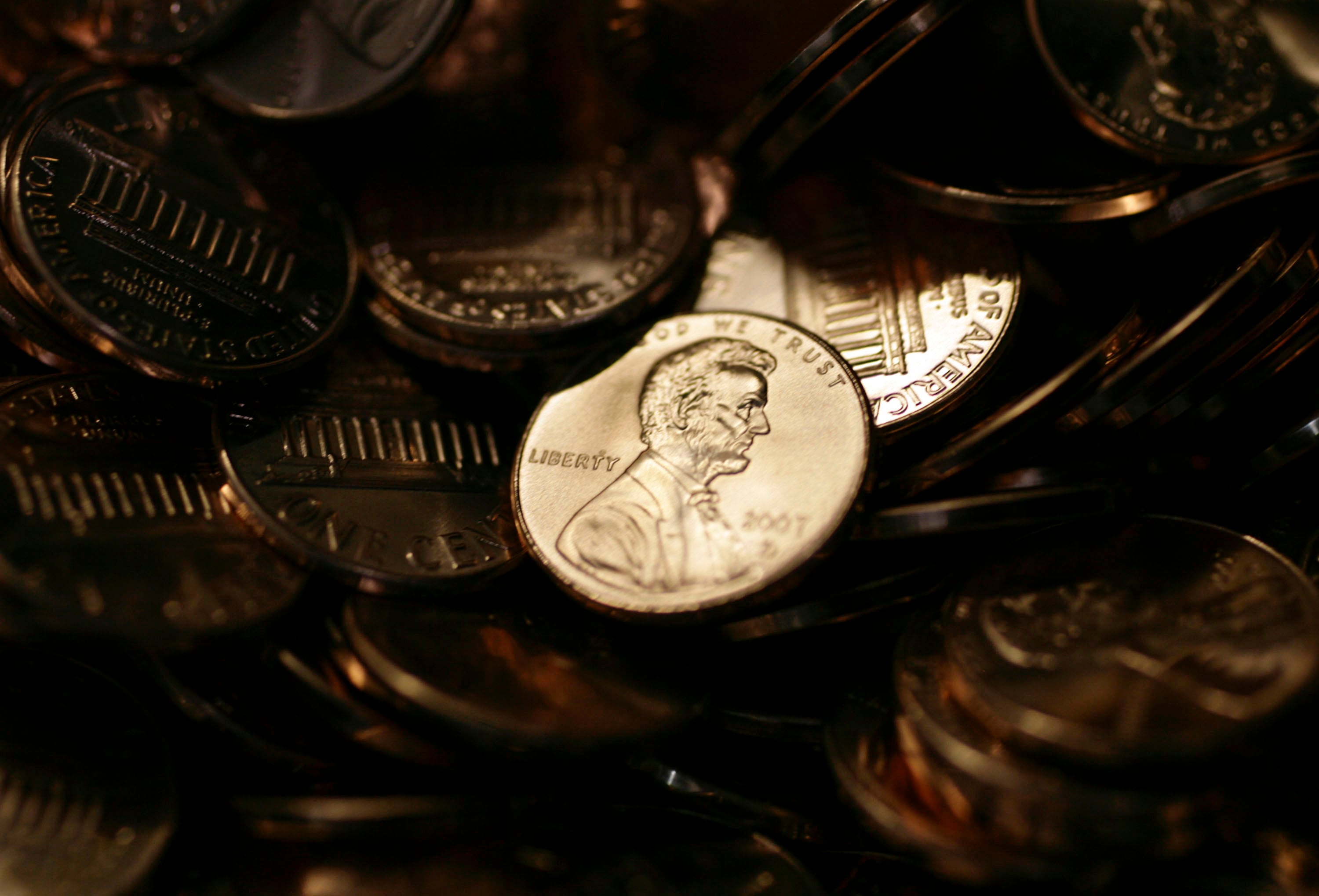
RICHMOND, Va. (AP) — The lowly penny, the forgotten mainstay of coin jars and car cupholders everywhere, may soon be no more.

President Donald Trump announced Sunday he’s ordered his administration to cease production of the 1-cent coin, whose buying power is long past its prime.

Advocates for ditching the penny cite its high production cost — currently almost 4 cents per penny, according to the U.S. Mint — and limited utility. Fans of the penny cite its usefulness in charity drives and relative bargain in production costs compared with the nickel, which costs almost 14 cents to mint.

Trump’s surprise order comes after decades of unsuccessful efforts to pitch the penny.

“Only tradition explains our stubborn attachment to the penny. But sometimes traditions get ridiculous,” the Farmers’ Almanac said in its 1989 edition.

Here’s a look at some questions surrounding Trump’s order.

Can Trump really order the Treasury to stop minting pennies without Congress' approval?

Yes, according to legal scholar Laurence H. Tribe, the Carl M. Loeb University Professor of Constitutional Law Emeritus at Harvard University.

U.S. code gives the Treasury Secretary the authority to mint and issue coins “in amounts the secretary decides are necessary to meet the needs of the United States.”

If Treasury Secretary Scott Bessent decides the amount necessary for the penny is zero, he’s within his legal rights, Tribe said.

“Unlike a lot of what the new administration has been doing pursuant to the flood of executive orders since Jan. 20, this action seems to me entirely lawful and fully constitutional,” Tribe said, referring to the aggressive executive action Trump’s taken on other issues since taking office.

Congress, which dictates currency specifications like the size and metal content of coins, could make Trump’s order permanent through law. But past congressional efforts to ditch the penny have failed.

Pennies are mostly made of zinc, and the American zinc lobby has been a major opponent to suggestions that the penny be eliminated.

How many pennies are in circulation?

It depends on what you mean by circulation.

Pennies are the most popular coin made by the U.S. Mint, which reported making 3.2 billion of them last year. That’s more than half of all the new coins it made last year.

MIT professor Jeff Gore, who founded Citizens to Retire the Penny, said coins are supposed to stay in circulation for about 30 years and that in the last three decades the U.S. Mint has made about 250 billion pennies.

But, he says, “because nobody wants to use pennies, they fall out of active circulation much faster than other coins.”

If pennies sit in drawer for a decade, Gore asks, “Does that qualify as being in circulation?”

Will Americans miss pennies?

The experience in other countries suggests no.

Canada started phasing out its penny a dozen years ago and urged store owners to round prices to the nearest nickel for cash transactions. Electronic purchases were still billed to the nearest cent. The move came after New Zealand, Australia, the Netherlands, and others dropped their lowest-denomination coins.

After dropping the penny or its equivalent, those countries have not looked back.

What comes next?

Trump's order, which he announced in a social media post as he was departing New Orleans after watching the first half of the Super Bowl, was the latest in his administration's rapid-fire efforts to cut government costs.

“Let’s rip the waste out of our great nation's budget, even if it’s a penny at a time,” Trump wrote in his post, which was light on details about plans for a post-penny future.

After Canada stopped minting new pennies, it began recycling them for their “valuable” copper and zinc, according to a 2022 report from the Canadian Mint.

Share:
More In Politics
US tariffs are having an uneven effect on holiday prices and purchases
Many U.S. consumers say they’ve noticed higher than usual prices for holiday gifts in recent months, according to a a December poll from The Associated Press-NORC Center for Public Affairs Research. A contributing factor is the unusually high import taxes the Trump administration put on foreign goods. While the worst-case consumer impact that many economists foresaw from the administration’s trade policies hasn’t materialized, some popular gift items have been affected more than others. Most toys and electronics sold in the U.S. come from China. So do most holiday decorations. Jewelry prices have risen due to the cost of gold.
Serbia organized crime prosecutors charge minister, others in connection with Kushner-linked project
Serbia’s prosecutor for organized crime has charged a government minister and three others with abuse of position and falsifying of documents related to a luxury real estate project linked to U.S. President Donald Trump’s son-in-law Jared Kushner. The charges came on Monday. The investigation centers on a controversy over a a bombed-out military complex in central Belgrade that was a protected cultural heritage zone but that is facing redevelopment as a luxury compound by a company linked to Kushner. The $500 million proposal to build a high-rise hotel, offices and shops at the site has met fierce opposition from experts at home and abroad. Selakovic and others allegedly illegally lifted the protection status for the site by falsifying documentation.
Trump signs executive order to block state AI regulations
President Donald Trump has signed an executive order to block states from regulating artificial intelligence. He argues that heavy regulations could stifle the industry, especially given competition from China. Trump says the U.S. needs a unified approach to AI regulation to avoid complications from state-by-state rules. The order directs the administration to draw up a list of problematic regulations for the Attorney General to challenge. States with laws could lose access to broadband funding, according to the text of the order. Some states have already passed AI laws focusing on transparency and limiting data collection.
New York Times, after Trump post, says it won’t be deterred from writing about his health
The New York Times and President Donald Trump are fighting again. The news outlet said Wednesday it won't be deterred by Trump's “false and inflammatory language” from writing about the 79-year-old president's health. The Times has done a handful of stories on that topic recently, including an opinion column that said Trump is “starting to give President Joe Biden vibes.” In a Truth Social post, Trump said it might be treasonous for outlets like the Times to do “FAKE” reports about his health and "we should do something about it.” The Republican president already has a pending lawsuit against the newspaper for its past reports on his finances.
Trump approves sale of more advanced Nvidia computer chips used in AI to China
President Donald Trump says he will allow Nvidia to sell its H200 computer chip used in the development of artificial intelligence to “approved customers” in China. Trump said Monday on his social media site that he had informed China’s leader Xi Jinping and “President Xi responded positively!” There had been concerns about allowing advanced computer chips into China as it could help them to compete against the U.S. in building out AI capabilities. But there has also been a desire to develop the AI ecosystem with American companies such as chipmaker Nvidia.
Swing district Republicans brace for political fallout if health care subsidies expire
House Republicans in key battleground districts are working to contain the political fallout expected when thousands of their constituents face higher bills for health insurance coverage obtained through the Affordable Care Act. For a critical sliver of the GOP majority, the impending expiration of the enhanced premium tax credits after Dec. 31 could be a major political liability as they potentially face midterm headwinds in a 2026 election critical to President Donald Trump’s agenda. For Democrats, the party’s strategy for capturing the House majority revolves around pinning higher bills for groceries, health insurance and utilities on Republicans.
Load More