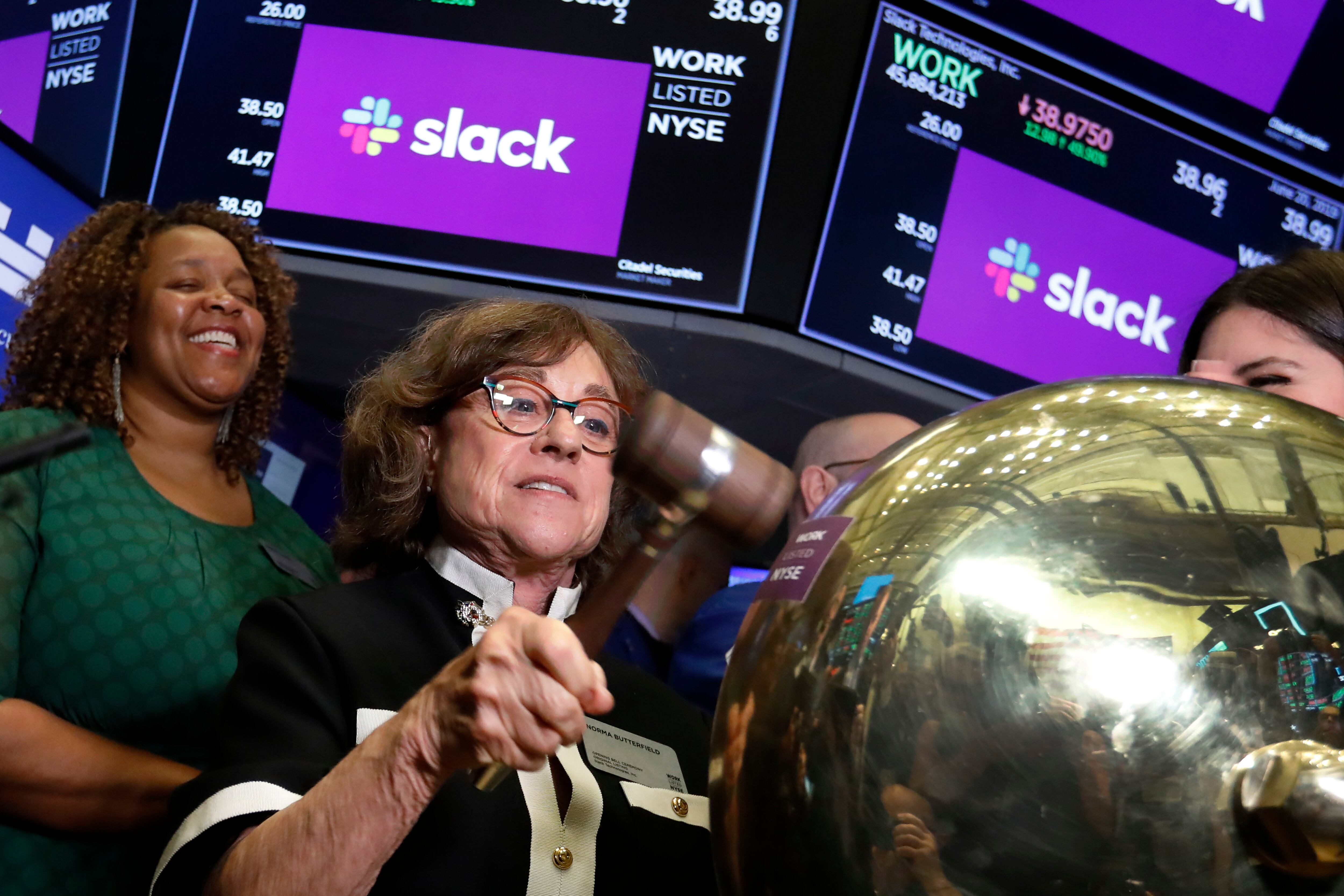
Slack made its market debut Thursday with opening shares trading at $38.50, way up from the $26 a piece reference price set by the New York Stock Exchange. The opening price gives the workplace message platform a valuation of over $23 billion.
The company's shares dipped throughout the day but regained the slight losses, closing at $38.62.
Trading under the ticker WORK, Slack follows a number of successful tech startups, such as Uber ($UBER) and Lyft ($LYFT), that have gone public in recent months.
“The number of tech companies that have IPO’d to date have, on average, performed very, very well,” Stacey Cunningham, president of the NYSE, told Cheddar. Investors “are excited about the opportunities that are presented.”
Slack, however, took an alternative route to market, directly listing shares on the market. The big difference between that and a traditional initial public offering is that the company did not issue new shares, but instead existing shareholders sold their stock to public investors. That means, unlike Uber and Lyft, Slack did not raise additional capital as part of the IPO. The last major company to complete a direct listing was Spotify ($SPOT), which went public in April 2018.
“The direct listing is not going to displace the IPO, because most companies come to market to raise capital,” John Tuttle, the NYSE’s vice chairman and chief commercial officer, told Cheddar. “But for those companies that meet the profile of a Spotify or a Slack, where they don’t need capital at the time of their listing … this is an option for them.”
Slack’s designated market maker, Citadel Securities — whose specialists maintain fair and orderly trading during a company’s public debut — also brought Spotify to market.
Joe Mecane, the head of execution services at Citadel Securities, told Cheddar that there is “a lot more comfort with direct listings this time around.”
“To every person who depends on us to bring their team together, achieve more, or simply get their work done. Thank you,” Slack said in a statement on Thursday marking the milestone.
Since its founding in 2014, Slack — officially Slack Technologies, Inc. — has grown to be used by over 600,000 organizations in 150 countries. The messaging platform, which has free and paid subscription plans, is now used by an estimated 10 million people who send over 1 billion messages a week.
“Slack’s success will be determined in the short-term based on the answer to one question: Can Slack prove to the enterprise buyer that it is more than a chat app, more than a collaboration tool, but instead an enterprise collaboration platform?” Michael Facemire, vice president of the market research firm Forrester, told Cheddar in a statement. “If Slack can do this, expanding out of a tech-savvy user base and into all parts of the business become much easier, as it starts to do work for everyone.”
Currently, over 500,000 organizations use Slack’s free subscription plan. The company has nearly 100,000 paid subscribers, including dozens of Fortune 100 businesses.
In August 2018, Slack was valued at over $7 billion following a Series H funding round that raised an additional $427 million in investment. Lead investors included Dragoneer Investment Group, General Atlantic, and Wellington Management, among others.
The company reported $400 million in revenue and $139 million in losses in its filing with federal regulators. Among its risk factors, Slack noted that it anticipates increasing operating expenses and stated “we may not be able to achieve and, if achieved, maintain profitability.”
Slack said its growth strategy includes expanding its user base, increasing the number of paid customers, and platform improvements.
“I think it is going to rally over the short term period … in part, because of the popularity of the company itself and the crowd that uses it,” Bob Iaccino, chief market strategist at Path Trading Partners, told Cheddar. “I think the six month to 12 month time frame is a very positive story.”