*By Chloe Aiello* E-commerce and mobile was the breakout star this Thanksgiving weekend with more customers picking the couch over the queue, shopping earlier ー and increasingly on their phones. "It's not just about Black Friday anymore ー there's the day before Thanksgiving, there's Thanksgiving Day, Black Friday. Small Business Saturday was pretty big too ... It's basically a whole week at this point," Rob Marvin, associate features editor at PCMag told Cheddar on Monday. This year, shoppers didn't even wait until Black Friday to pull out their phones or jump on a computer to shop. Shoppers spent an estimated $3.7 billion online on Thanksgiving Day ー up 27.9 percent since last year ー before spending an additional $6.2 billion online on Black Friday, according to Adobe Analytics. And many of those sales were done on mobile devices. More than half ー 54 percent ー of all digital orders fielded on Thanksgiving Day and 49 percent of sales on Black Friday came from phones, according to Salesforce ($CRM). "Mobile is the headline this holiday," Rob Garf, VP of Industry Strategy and Insights at Salesforce Commerce Cloud, told Cheddar on Monday. Cyber Monday is expected to shatter records ー with an additional $7.7 billion in online sales projected, up 17.6 percent year-over-year, according to Adobe. Marvin attributes the bump in Cyber Monday sales to "bigger ticket items," like the latest in technology. "Black Friday is always bigger for clothes and gifts and stuff like that. Cyber Monday is when you should get all of your tech. There's going to be huge deals on laptops, phones ... everything from home security systems to smart light bulbs and thermostats," he said. And those deals should be pretty good. Marvin recommended shoppers look for 30 to 60 percent off the ticket price ー or just wait for a better deal. Front and center is e-commerce giant Amazon (AMZN), which is gearing up for a major day in deals. Last year, Amazon customers bought about 83 million products globally on Cyber Monday ー that's about 961 items per second. "We expect this year to be even higher than that," Amazon spokesperson Adam Sedo told Cheddar's Nora Ali Monday on the floor of a company fulfillment center in Robbinsville, N.J. Sedo said Amazon expects many of the shoppers this year to be millennials. Millennials love shopping online, especially when there's something in it for them, he added. "Actually 62 percent of millennials said they would buy a gift for themselves," Sedo said. Amazon has reason to be optimistic this year. Shoppers are migrating an ever greater amount of their business online. Even on Black Friday, a day once known for door-busting deals and elbow-throwing shoppers, more of this year's transactions were done by computer. Foot traffic to retail stores fell on Black Friday, down 1.7 percent from 2017, [CNBC reported.](https://www.cnbc.com/2018/11/24/black-friday-thanksgiving-foot-traffic-drops-1-percent-shoppertrak.html) Meanwhile, online shopping hit new highs, surging 23.6 percent year-over-year, according to Adobe. Next year, however, could be a different story. Kathryn Hopkins, senior financial editor at WWD, cautions economic concerns may squeeze Thanksgiving weekend sales next year ー making 2018 the last year for major Black Friday and Cyber Monday blowouts. "We may have some trouble for retailers next year though, because a few things are going to make consumers feel a bit nervous," Hopkins told Cheddar on Monday. She cited among her concerns rising interest rates and President Trump's trade war with China. "Trump's "threatened to put tariffs on basically everything if him and the president of China [Xi Jinping] can't come to an agreement when they meet next month," Hopkins said. "Maybe I'm being a bit pessimistic but I think we're going to have a lot more trouble. I'm not sure we're going to make a record next year."
Share:
More In Business
Biden EV Push to Bring Tritium Vehicle Charger Factory to Tennessee
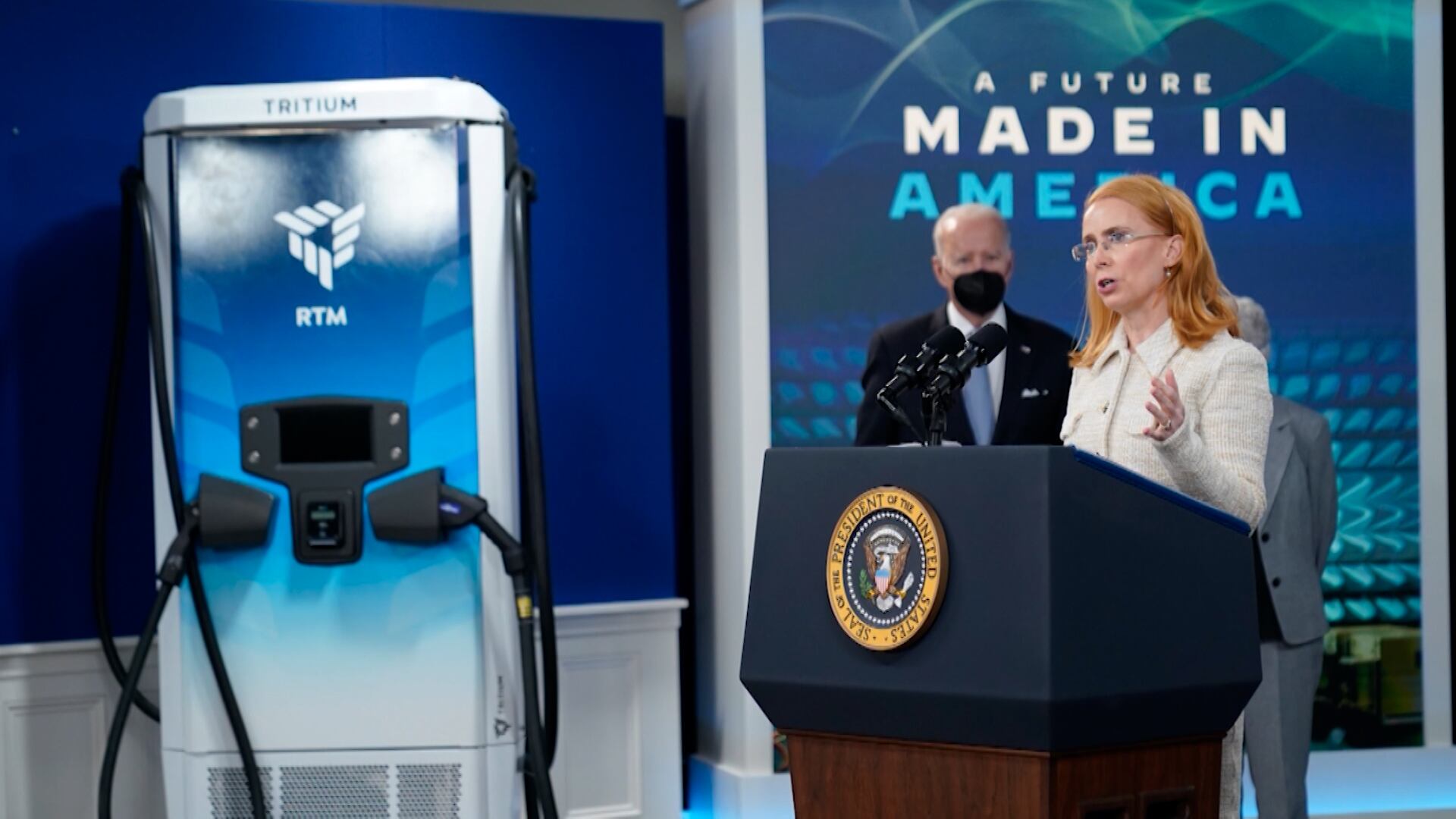
President Biden's push for electric vehicles is doing more than trying to hold off climate change as it also hopes to revive American manufacturing jobs. The latest company to open an EV charging production plant in the U.S. is Australia-based Tritium, looking to open its new Lebanon, Tennessee, facility in the fall of 2022. It's expected to create at least 500 jobs in the region and reach a production capacity of 10,000 charging units per year. Jane Hunter, CEO and executive director of Tritium, joined Closing Bell to discuss the plant, production capacity, and working with the Biden administration. "The policies that they put in place have directly driven demand for our fast charging products," she said. "Discussions that we have are just incredibly positive because this administration wants to have an electric superhighway that runs all across the country so that it's open equitably for all people to drive electric vehicles."
Cheddar Unpacks Latest Samsung Devices: Galaxy S22, Tab S8 Ultra, and More
Samsung unveiled its latest product lineup, including a new family of Galaxy S22 smartphones featuring the S22 Ultra with a larger screen, more powerful camera, and the Samsung S Pen stylus. The company also revealed its latest tablet, the Tab S8 Ultra, featuring a 14.6" screen, expanded storage, and 4K video capability. Cheddar News was able to showcase each device as Allison Johnson, ​reviews writer at The Verge, joined Closing Bell to discuss the new releases, the standout features, and more.
Canopy Growth Q3 Earnings Shows Record Sales for Its BioSteel, Storz & Bickel Brands
Shares of Canadian cannabis giant Canopy Growth surged after the company reported Q3 earnings Wednesday morning, with shares up more than 15 percent at the close of the day's trading session. Despite net revenue declining year-over-year, Canopy beat analyst expectations and has ramped up efforts to develop a "THC ecosystem' in the U.S. Canopy Growth's CEO, David Klein, joined Cheddar News' Closing Bell to discuss the report. He noted that its brands Storz & Bickel vaporizers and BioSteel beverages showed record growth.
Property Ownership Platform for Small Businesses withco Announces $30 Million in Equity Funding
Commercial property ownership platform withco recently raised $32 million across a seed and Series A funding round. The company purchases properties and then rents them back to small business owners and works to transition them into full ownership. Founder and CEO Kevin Song says withco was inspired by his family's experience of operating a Brooklyn grocery store for two decades and being forced to shutter the business due to a doubling in rent by a new landlord. Now, Song says his mission is to help small business owners become commercial property owners, in a way that's simple and affordable. Song joined Cheddar News' Closing Bell to discuss.
Stocks Close Near Session Highs as Nasdaq Continues Rebound
David Nelson, Chief Strategist at Belpointe, joins Cheddar News' Closing Bell, where he says that Wednesday's market movement shows a rotation back into the industries that were hit hard in January, but says his eyes are firmly fixed on the January CPI data set to be released Thursday.
New Era Begins for Peloton as Company Makes Change at CEO Level
Earlier this week, Peloton announced a change in its C-suite, with new chief executive Barry McCarthy telling the company's remaining staff in an email that he’s, 'here for the comeback story.' Greg Martin, Co-Founder of Rainmaker Securities, joins Cheddar's Closing Bell where he discusses how difficult are Peloton's challenges will be to overcome, especially after the company recently laid off approximately 20% of its staff.
Federal Agencies, Lawmakers Hone in on Crypto Regulation
Ben McMillan, Founder and CIO at IDX Digital Assets, joins Cheddar News' Closing Bell, where he discusses the significance of CFTC Chairman Rostin Behnam testifying at Wednesday's Senate Agriculture Committee hearing, and when we could expect to see more regulation in place following the second straight day of congressional hearings on the crypto industry.
Load More