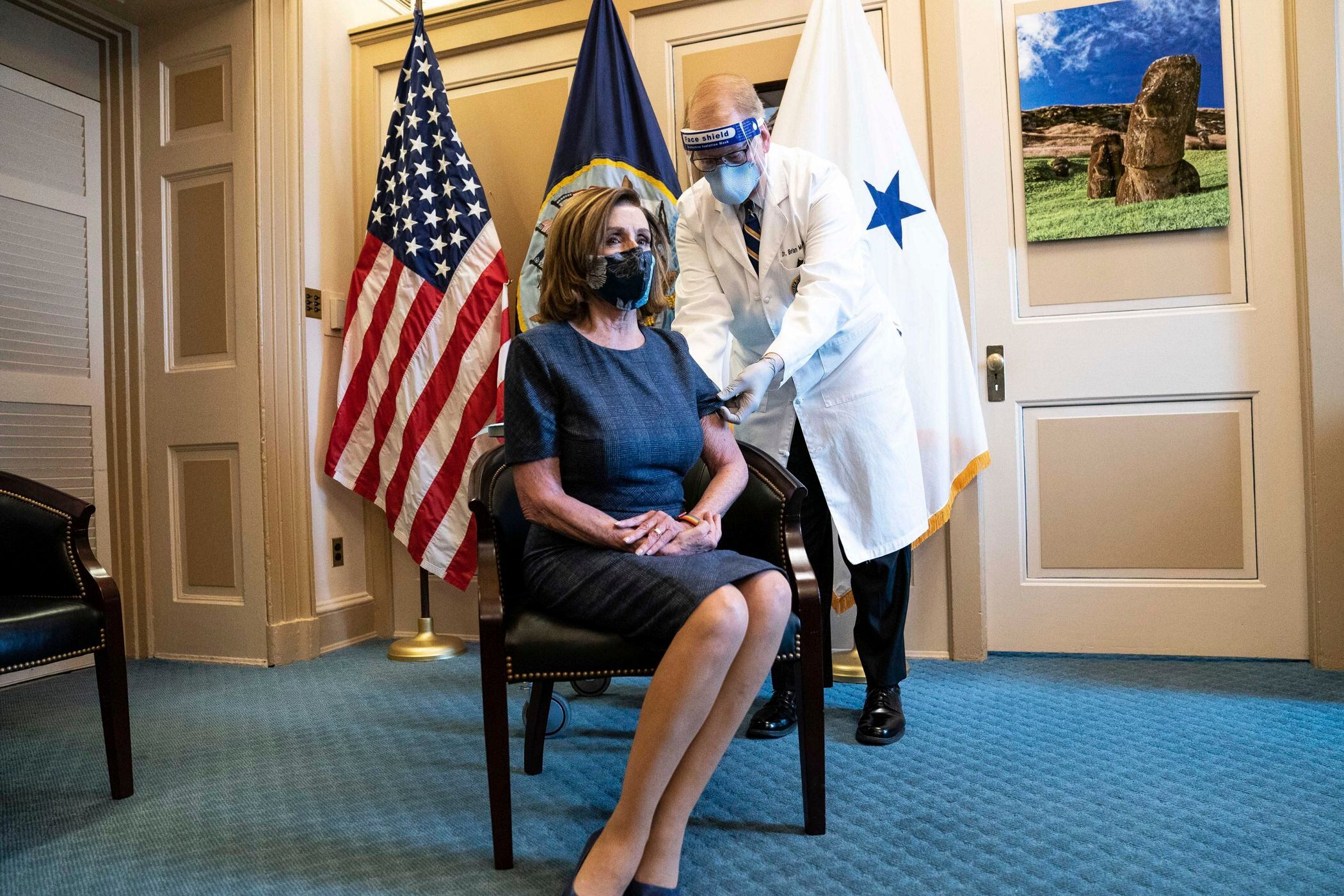
Speaker of the House Nancy Pelosi, D-Calif., sits and waits before being inoculated with a Pfizer-BioNTech COVID-19 vaccine shot by Dr. Brian Monahan, attending physician Congress of the United States in Washington, Friday, Dec. 18, 2020. (Anna Moneymaker/The New York Times via AP, Pool)
By Mary Clare Jalonick
The legislative branch of government is rapidly moving to receive the coronavirus vaccine, with both House Speaker Nancy Pelosi and Senate Majority Leader Mitch McConnell getting the shot on Friday and the top Capitol doctor urging all members of Congress to join them.
Both Pelosi and McConnell tweeted photos of themselves receiving the vaccine from the Capitol physician, Dr. Brian P. Monahan. Monahan informed lawmakers Thursday evening that they are all eligible for the shots under government continuity guidelines and asked members of the House and Senate to make appointments with his office to be vaccinated.
The leaders' vaccinations came hours after Vice President Mike Pence received it on live television and called it a “medical miracle." The public displays from all three come as top U.S. health officials are trying to convince regular Americans who may be skeptical of the vaccinations to get them and allow the country to rebound from the pandemic.
“Today, with confidence in science & at the direction of the Office of the Attending Physician, I received the COVID-19 vaccine,” Pelosi tweeted. “As the vaccine is being distributed, we must all continue mask wearing, social distancing & other science-based steps to save lives & crush the virus.”
The speaker said in October that she does not like getting shots and even had a hard time getting her ears pierced.
“They have to talk me into the flu shot under great duress each year," she said. "But if it serves as a model to other people, yes, I would take the vaccine if it is approved by regular order.”
McConnell tweeted that he had “just received the safe, effective COVID vaccine following continuity-of-government protocols. Vaccines are how we beat this virus.”
On Thursday, McConnell said that as a survivor of childhood polio, “I know both the fear of a disease and the extraordinary promise of hope that vaccines bring.”
It is unclear whether all 535 members of the House and Senate will choose to get the vaccine. Only about half of Americans say they are willing to get it, according to a survey this month by The Associated Press-NORC Center for Public Affairs Research, despite a rigorous federal review process and health officials' insistence that it is safe.
Several other members of Congress have expressed an eagerness to receive the vaccine, especially as an example to some of their constituents who may be wary. House Republican Leader Kevin McCarthy said Friday that he would also be getting the shot.
Two senators, Rob Portman, R-Ohio, and Steve Daines, R-Mont., have been participating in the vaccine trials. But lawmakers are also reluctant to be first to be vaccinated so they’re not seen as jumping the line.
Pelosi is third in the line of succession for the presidency, after President Donald Trump and Pence. Trump, who was hospitalized with COVID-19 in October, has yet to indicate when or if he will receive the shot.
Monahan, the Capitol physician, said that his office will follow a process to identify “continuity-essential staff members” in Congress after members have been vaccinated. He said his office would continue with appointments “until the small vaccine supply is exhausted.”
___
AP Congressional Correspondent Lisa Mascaro contributed to this report.
Liana Guzmán, CEO of FOLX Health, joins Cheddar News to discuss the company launching billboards across the country in response to anti-LGBTQ+ legislation.
President Biden has announced an additional $800 million in military assistance to Ukraine, including artillery, armored personnel carriers, and helicopters. It comes as Russian forces appear to be preparing for a new, aggressive offensive in the eastern part of Ukraine. Paul McLeary, defense reporter for Politico, joined Cheddar to discuss this new round of aid and what it means for the U.S. commitment to arming the embattled country.
Catching you up on what you need to know on April 18, 2022, with Russian missile attacks on the Ukrainian city of Lviv killing seven, mass shootings in South Carolina and Pittsburgh, Lucky Charms cereal under official investigation by the FDA, and more.
Activism is growing around the country in response to school boards banning books from shelves that focus on sexuality, gender, identity, or race. Jen Cousins, co-founder of The Florida Freedom to Read Project, joins Cheddar News to discuss.
As the Russian invasion of Ukraine intensifies, President Biden has announced a ban on importing Russian oil, gas, and energy. To discuss how this ban will impact the war and Americans, Amir Handjani, non-resident fellow at Quincy Institute, joins Cheddar News.
Thousands of protesters around the world are expressing their solidarity with Ukraine against Russia's invasion.
Jason Beardsley, national executive director of the Association of the U.S. Navy and national security expert, joins Cheddar News to discuss.
As gas prices surge amid the Russian invasion of Ukraine, other nations could potentially transition faster to using clean energy than previously expected. Philip K. Verleger, a senior fellow at the Niskanen Center, joined Cheddar News to explain how this could be a possibility in the near future. "Part of the reason I think we have this invasion and the tantrum that's being thrown by Russia, terrible tantrum, is because the Russians were trying to slow down the transition," he said. "Ironically they speeded it up."
Following the invasion of Ukraine, a multitude of Western companies have paused doing business with Russia. PepsiCo, Coca-Cola, McDonald's, and Starbucks are the most recent companies to temporarily cease operations in Russia. Dean of Miami Herbert Business School at the University of Miami, John Quelch, joined Cheddar News to discuss what message this sends to Russia and the Russian consumer. “I would not underestimate the collective strength of all of these multinational companies, essentially coming together to make their collective statement in support of the political statements that have come out of Washington," he said.
The war in Ukraine continues to reveal heartbreaking gut-wrenching stories. The war in itself is not only devastating but also expensive. Experts estimate that Russia is draining nearly $20 million dollars each day to continue occupying and invading Ukraine. All this could force the country to turn to cryptocurrencies. It's a major turn for the country that briefly considered outlined digital assets entirely, but it could also have serious implications for cryptos. Managing Director at Quantum Fintech Group, Harry Yeh, joined Cheddar to discuss more.