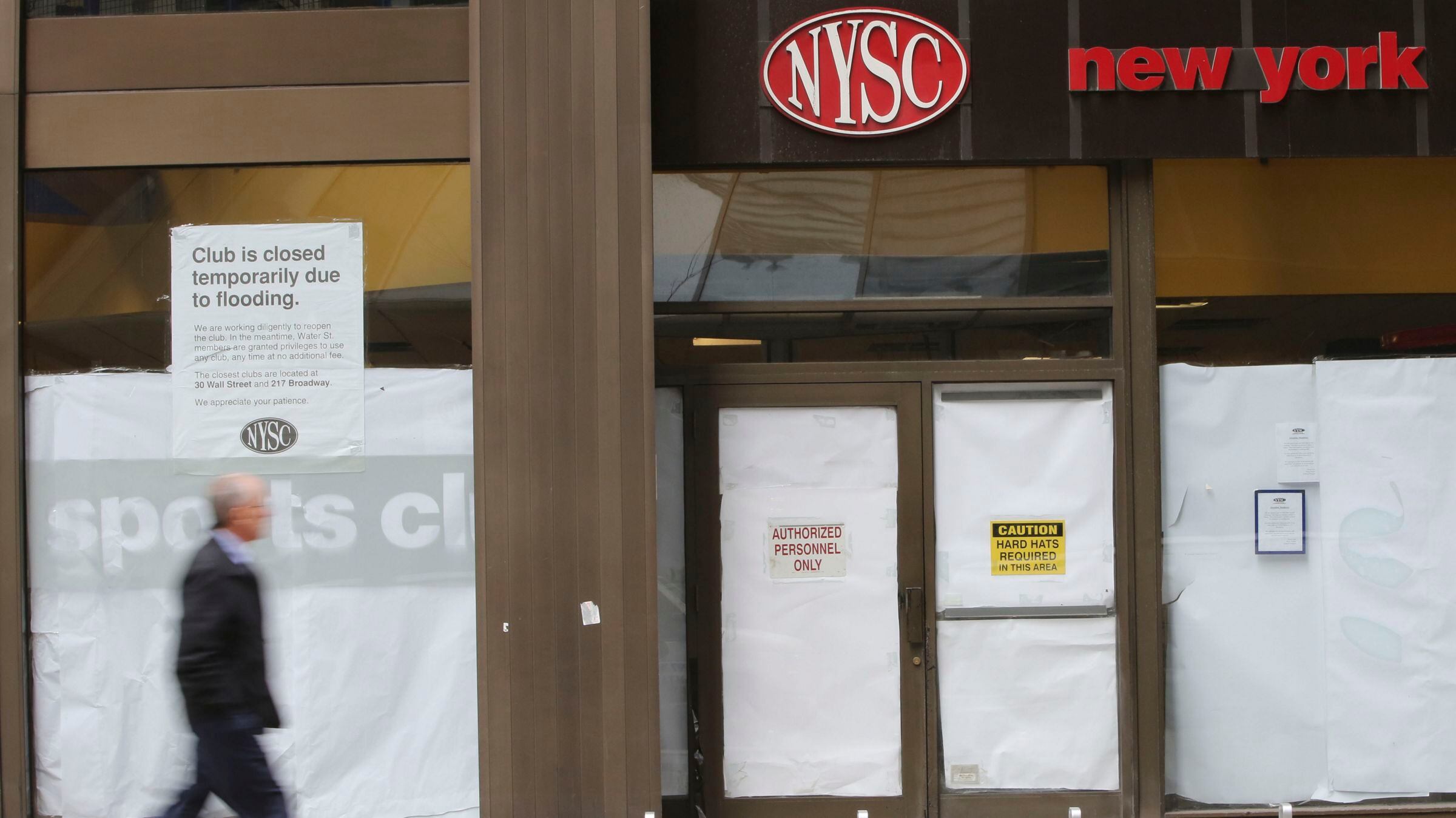
In this Feb. 7, 2013 photo, a man walks past a shuttered New York Sports Club on Water St. in New York. Town Sports International Holdings Inc., the owner of New York Sports Club and Lucille Roberts filed for Chapter 11 bankruptcy Monday, Sept. 14, 2020, as gym operators struggle to keep afloat amid nationwide shutdowns. (AP Photo/Mary Altaffer, File)
By Damian J. Troise
The company that runs New York Sports Club and Lucille Roberts gyms filed for bankruptcy protection with COVID-19, still prevalent in man parts of the U.S., gutting membership rolls at fitness companies nationwide.
Gold's Gym sought bankruptcy protection in May and 24 Hour Fitness Worldwide filed for bankruptcy in June. Many companies, including Planet Fitness, furloughed workers in order to conserve cash.
Town Sports International Holdings Inc., which also operates Washington Sports Club and Total Woman Gym and Spa, said Monday that it can no longer pay its debts.
The company lost $136 million during the first quarter this year, only a fraction of which included state- and city-mandated shutdowns of retail shops, gyms, salons, restaurants, and bars. By the end of the three-month reporting period, 95 percent of Town Sports' clubs had been closed.
Town Sports operates 185 clubs and serves 580,000 members, mostly in the Northeast.
Gyms have been allowed to reopen at a fraction of their capacity in some regions like the Northeast. Those who do go to gyms in New York City are required to wear a mask at all times and gyms can only operate at one-third capacity. Group fitness classes are still not permitted.
Yet with more than 33,000 COVID-19 related deaths in New York, most of them in New York City, thousands of one-time gymgoers have taken their routines outdoors, or to their own homes.
Home fitness company Peloton reported a 172 percent surge in revenue during its most recent quarter and it doubled its subscribers. Bike shops in New York, as well as most outdoor fitness gear sellers, have been largely cleared out.
Tesla posted solid delivery numbers over the last year, with deliveries surpassing over 930,000, an 87 percent jump from the same period in 2020. Anthony Sassine, CFA, Senior Investment Strategies, KraneShares joined Wake Up with Cheddar to discuss the top EV stocks as well as how Tesla will stay relevant in the crowded space.
Apple became the first publicly traded U.S. company to hit the $3 trillion valuation mark after its stock price jumped to $182.86 in morning trading before slipping back just under the mark. The tech giant has tripled its worth since 2018.
Several Silicon Valley insiders are being accused of contorting a 1990s-era tax break to avoid taxes on millions of dollars of investment profits. The tax break is known as the qualified small business stock exemption, and it allows early investors in certain companies to avoid half of the taxes on up to $10 million in capital gains. A piece recently published in the New York Times says venture capital firms like Andreessen Horowitz replicated the tax exemption by giving shares of companies to friends and family, who would otherwise face a 23.8% capital gains bill. The CEO of Roblox is also accused of replicating the tax break for his family members at least 12 times. Although the loophole known as 'stacking' is considered to be legal, the Times piece implies that the exemption has been manipulated for the ultra-wealthy to become more wealthy. Greycroft co-founder and Chairman Emeritus Alan Patricof joins Cheddar News' Closing Bell to discuss.
There is a new player in the mobile app stock trading space.
Zingeroo recently announced a funding round of $8.5 million. The company says it aims to bring 'friendly competition' to stock trading, by literally breaking trading down into daily and weekly competitions between friends. Zingeroo also says it hopes its new approach can make trading more accessible, educational, and social than ever before. Zingeroo co-founder and CEO Zoe Barry joins Cheddar News' Closing Bell for more.
Stocks closed higher on the first trading day of 2022, with both the Dow and the S&P 500 hitting record closes. Apple and Tesla created momentum, with the tech giant hitting a $3 trillion market cap, and the EV maker reporting over 300,000 deliveries in the fourth quarter of 2021. Investors are taking an optimistic approach to start the year even as COVID-19 continues to linger and omicron cases soar. Rebecca Walser, President at Walser Wealth Management, joins Cheddar News' Closing Bell to discuss today's market movement, her broad predictions for the year, and more.
As cell carriers AT&T and Verizon planned to roll out nationwide 5G service this week, the FAA and U.S. DOT are asking the companies to pause their plans so more research can be done on the impact 5G has on aircraft technology. The companies are refusing, citing French regulations that limit wireless signals around airports while allowing research to continue. This week's launch wasn't the first time concerns have delayed 5G — last year, Airbus and Boeing express concerns, pushing the deadline into November, December, and then into this year. So what happens now — and what happens next? Will 5G roll out this year as expected? Jon Swartz, Senior Reporter at MarketWatch, joins Cheddar News' Closing Bell to discuss the state of the planned 5G rollout, why the FAA and U.S. Department of Transportation are asking carriers to stall the launch, and more.