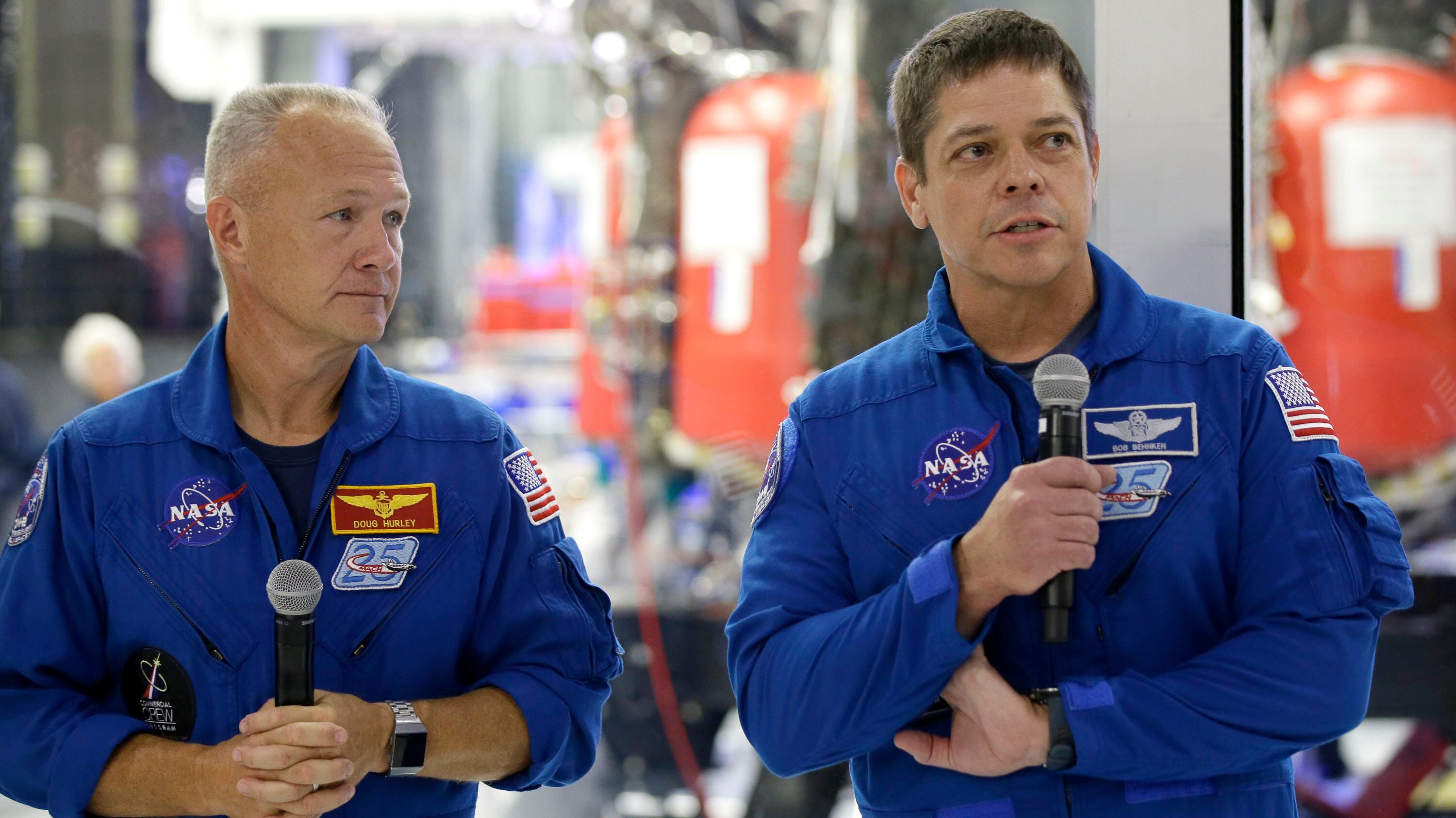
In this Thursday, Oct. 10, 2019 file photo, NASA astronauts Bob Behnken, right, and Doug Hurley talk to the media in front of the Crew Dragon spacecraft at SpaceX headquarters in Hawthorne, Calif. On Friday, April 17, 2020, NASA and SpaceX announced May 27 for resuming human launches from the U.S. after nearly a decade. Hurley and Behnken will blast off atop a SpaceX Falcon 9 rocket, departing from the same Kennedy Space Center launch pad used by Atlantis in July 2011. (AP Photo/Alex Gallardo)
By Marcia Dunn
NASA and SpaceX have picked May 27 for resuming astronaut launches from the U.S. after nine years of complete Russian dependence.
NASA Administrator Jim Bridenstine announced the launch date Friday. Astronauts haven’t launched into orbit from the U.S. since NASA’s last space shuttle flight in 2011. SpaceX aims to end the drought by sending two NASA astronauts to the International Space Station.
“On May 27, @NASA will once again launch American astronauts on American rockets from American soil!” Bridenstine tweeted.
Astronauts Doug Hurley and Bob Behnken will blast off atop a SpaceX Falcon 9 rocket, departing from the same Kennedy Space Center launch pad used by shuttle Atlantis in July 2011, as well as the Apollo moonshots a half-century ago. Hurley served as pilot on that last shuttle mission and will be the spacecraft commander for SpaceX's Dragon crew capsule.
Launch day will be a Wednesday, with a liftoff time of 4:32 p.m. EDT. It's too soon to know whether the coronavirus pandemic will prompt crowd restrictions.
Only three countries have launched people into orbit since 1961: Russia, the U.S. and China, in that order. SpaceX would be the first company.
SpaceX successfully conducted its first test flight of a Dragon crew capsule a year ago, sending the capsule — minus a crew — to the space station. The returned capsule was accidentally destroyed during ground testing at Cape Canaveral, further delaying the astronaut launch.
With the space station crew now down to three, Hurley and Behnken will spend weeks, perhaps months, helping to maintain the orbiting lab. The length of their mission is still under review, according to NASA.
NASA, meanwhile, is in the process of buying another seat on a Russian rocket. Russian Soyuz capsules have been the sole means of crew transportation to and from the space station since 2011.
SpaceX has been using Falcon 9 rockets to launch cargo to the space station in the company’s original Dragon capsules since 2012. NASA turned to private companies for deliveries once the shuttle program ended.
Boeing also is working to launch astronauts under NASA's commercial crew program, but the company's effort suffered a serious setback following last December's botched test flight. Launching without anyone on board, Boeing's Starliner capsule failed to reach the space station after ending up in the wrong orbit and came close to destruction twice because of software errors.
Boeing plans to repeat the test flight, again without astronauts, this fall.
___
The Associated Press Health and Science Department receives support from the Howard Hughes Medical Institute’s Department of Science Education. The AP is solely responsible for all content.
Liana Guzmán, CEO of FOLX Health, joins Cheddar News to discuss the company launching billboards across the country in response to anti-LGBTQ+ legislation.
President Biden has announced an additional $800 million in military assistance to Ukraine, including artillery, armored personnel carriers, and helicopters. It comes as Russian forces appear to be preparing for a new, aggressive offensive in the eastern part of Ukraine. Paul McLeary, defense reporter for Politico, joined Cheddar to discuss this new round of aid and what it means for the U.S. commitment to arming the embattled country.
Catching you up on what you need to know on April 18, 2022, with Russian missile attacks on the Ukrainian city of Lviv killing seven, mass shootings in South Carolina and Pittsburgh, Lucky Charms cereal under official investigation by the FDA, and more.
Activism is growing around the country in response to school boards banning books from shelves that focus on sexuality, gender, identity, or race. Jen Cousins, co-founder of The Florida Freedom to Read Project, joins Cheddar News to discuss.
As the Russian invasion of Ukraine intensifies, President Biden has announced a ban on importing Russian oil, gas, and energy. To discuss how this ban will impact the war and Americans, Amir Handjani, non-resident fellow at Quincy Institute, joins Cheddar News.
Thousands of protesters around the world are expressing their solidarity with Ukraine against Russia's invasion.
Jason Beardsley, national executive director of the Association of the U.S. Navy and national security expert, joins Cheddar News to discuss.
As gas prices surge amid the Russian invasion of Ukraine, other nations could potentially transition faster to using clean energy than previously expected. Philip K. Verleger, a senior fellow at the Niskanen Center, joined Cheddar News to explain how this could be a possibility in the near future. "Part of the reason I think we have this invasion and the tantrum that's being thrown by Russia, terrible tantrum, is because the Russians were trying to slow down the transition," he said. "Ironically they speeded it up."
Following the invasion of Ukraine, a multitude of Western companies have paused doing business with Russia. PepsiCo, Coca-Cola, McDonald's, and Starbucks are the most recent companies to temporarily cease operations in Russia. Dean of Miami Herbert Business School at the University of Miami, John Quelch, joined Cheddar News to discuss what message this sends to Russia and the Russian consumer. “I would not underestimate the collective strength of all of these multinational companies, essentially coming together to make their collective statement in support of the political statements that have come out of Washington," he said.
The war in Ukraine continues to reveal heartbreaking gut-wrenching stories. The war in itself is not only devastating but also expensive. Experts estimate that Russia is draining nearly $20 million dollars each day to continue occupying and invading Ukraine. All this could force the country to turn to cryptocurrencies. It's a major turn for the country that briefly considered outlined digital assets entirely, but it could also have serious implications for cryptos. Managing Director at Quantum Fintech Group, Harry Yeh, joined Cheddar to discuss more.