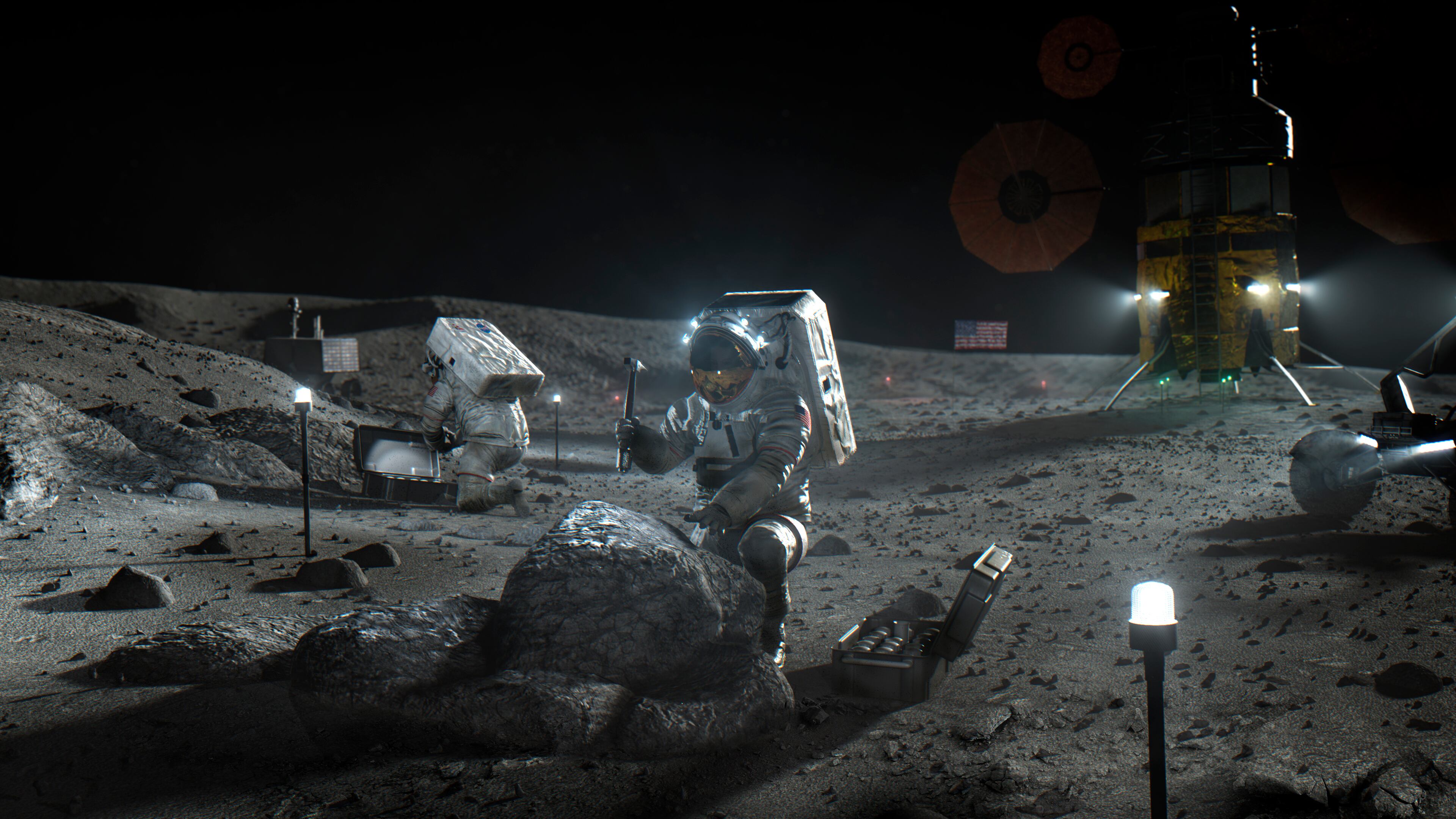
This illustration made available by NASA in April 2020 depicts Artemis astronauts on the Moon. On Thursday, April 30, 2020, NASA announced the three companies that will develop, build and fly lunar landers, with the goal of returning astronauts to the moon by 2024. The companies are SpaceX, led by Elon Musk; Blue Origin, founded by Amazon’s Jeff Bezos; and Dynetics, a Huntsville, Ala., subsidiary of Leidos. (NASA via AP)
By Marcia Dunn
NASA is turning to private industry for the first lunar landers for astronauts in a half-century, with three competing, quite contrasting versions.
NASA Administrator Jim Bridenstine announced Thursday the three companies that will develop, build and fly lunar landers, with the goal of returning astronauts to the moon in 2024 and ultimately on to Mars.
The companies are SpaceX in Hawthorne, California, led by Elon Musk; Blue Origin in Kent, Washington, founded by Amazon’s Jeff Bezos; and Dynetics, a Huntsville, Alabama, subsidiary of Leidos. Altogether, the contracts for the initial 10-month period total $967 million.
“This is the last piece that we need in order to get to the moon” by 2024, Bridenstine said.
He noted it will be the first lunar lander since the last Apollo moon mission in 1972.
Over the next 10 months, each company will refine its concept and NASA will decide which lander to test first. Bridenstine said NASA will go with the company that has the highest probability of success by 2024.
NASA will rely on its own Orion capsules and Space Launch System megarockets — still under development — to launch astronauts to the moon.
The two other companies, Boeing and Vivace, put in bids but were eliminated early on, leaving the three awarded contracts. Blue Origin got more than half the total amount— $579 million — more than four times more than SpaceX's $135 million. Dynetics was in between, with $253 million.
SpaceX’s proposed Starship lander is so tall that astronauts will use an elevator to get to and from the lunar surface. Blue Origin’s version comes with a big ladder, according to artistic renderings. The Dynetics lander is so low to the ground that only a few steps are needed, like a front porch, a feature that NASA gave high marks for safety and efficiency.
SpaceX is using its own Starship spacecraft — still under development in Texas — and its own rockets. Blue Origin and Dynetics are partnering with numerous subcontractors, including commercial launch companies.
Going commercial, Bridenstine said, will drive down costs while increasing access. It builds off of NASA’s commercial cargo and crew programs for the International Space Station. Just last November, SpaceX and Blue Origin were among the companies that won contracts to make cargo deliveries to the moon.
NASA wants the new Artemis moon-landing program to be sustainable, unlike Apollo, with multiple missions and multiple locations on the lunar surface. While only one company will carry the first woman and next man to the lunar surface, all three will participate over the long haul, officials noted.
By learning how to live and work on another world — the moon — NASA will be better equipped to eventually send astronauts to Mars, Bridenstine said.
In a teleconference with reporters, Musk embraced this "potential for an incredibly exciting future in space with a base on the moon and ultimately sending people and having a self-sustaining city on Mars.”
Dynetics’ vice president of space systems, Kim Doering said her team is excited not just about 2024 but the long-term lunar economy.
And Blue Origin chief executive Bob Smith was among those calling it a historic day. “Going to the moon is the reason why we got into this business,” he said.
The Associated Press Health and Science Department receives support from the Howard Hughes Medical Institute’s Department of Science Education. The AP is solely responsible for all content.
A big-screen adaptation of the anime “Chainsaw Man” has topped the North American box office, beating a Springsteen biopic and “Black Phone 2.” The movie earned $17.25 million in the U.S. and Canada this weekend. “Black Phone 2” fell to second place with $13 million. Two new releases, the rom-com “Regretting You” and “Springsteen — Deliver Me From Nowhere,” earned $12.85 million and $9.1 million, respectively. “Chainsaw Man – The Movie: Reze Arc” is based on the manga series about a demon hunter. It's another win for Sony-owned Crunchyroll, which also released a “Demon Slayer” film last month that debuted to a record $70 million.
The Federal Aviation Administration says flights departing for Los Angeles International Airport were halted briefly due to a staffing shortage at a Southern California air traffic facility. The FAA issued a temporary ground stop at one of the world’s busiest airports on Sunday morning soon after U.S. Transportation Secretary Sean Duffy predicted that travelers would see more flights delayed as the nation’s air traffic controllers work without pay during the federal government shutdown. The hold on planes taking off for LAX lasted an hour and 45 minutes and didn't appear to cause continued problems. The FAA said staffing shortages also delayed planes headed to Washington, Chicago and Newark, New Jersey on Sunday.
Boeing workers at three Midwest plants where military aircraft and weapons are developed have voted to reject the company’s latest contract offer and to continue a strike that started almost three months ago. The strike by about 3,200 machinists at the plants in the Missouri cities of St. Louis and St. Charles, and in Mascoutah, Illinois, is smaller in scale than a walkout last year by 33,000 Boeing workers who assemble commercial jetliners. The president of the International Association of Machinists says Sunday's outcome shows Boeing hasn't adequately addressed wages and retirement benefits. Boeing says Sunday's vote was close with 51% of union members opposing the revised offer.
The stunning indictment that led to the arrest of more than 30 people — including Miami Heat guard Terry Rozier and other NBA figures — has drawn new scrutiny of the booming business of sports betting in the U.S. The multibillion-dollar industry has made it easy for sports fans — and even some players — to wager on everything from the outcome of games to that of a single play with just a few taps of a cellphone. But regulating the rapidly-growing industry has proven to be a challenge. Professional sports leagues’ own role in promoting gambling has also raised eyebrows.
Tesla, the car company run by Elon Musk, reported Wednesday that it sold more vehicles in the past three months after boycotts hit hard earlier this year, but profits still fell sharply. Third-quarter earnings fell to $1.4 billion, from $2.2 billion a year earlier. Excluding charges, per share profit of 50 cents came in below analysts' estimate. Tesla shares fell 3.5% in after-hours trading. Musk said the company's robotaxi service, which is available in Austin, Texas, and San Francisco, will roll out to as many as 10 other metro areas by the end of the year.
Starbucks’ AI barista aims to speed service and improve experience. Nick Lichtenberg, Fortune Business Editor, explains its impact on workers and customers.
As Big Tech reports Q3 earnings, investors await proof that massive AI and cloud investments from Meta, Apple, Microsoft, and Alphabet are driving real growth.
Eric Trump joins us to discuss American Bitcoin’s mission, market strategy, and why he believes the U.S. must lead the next era of digital currency innovation.