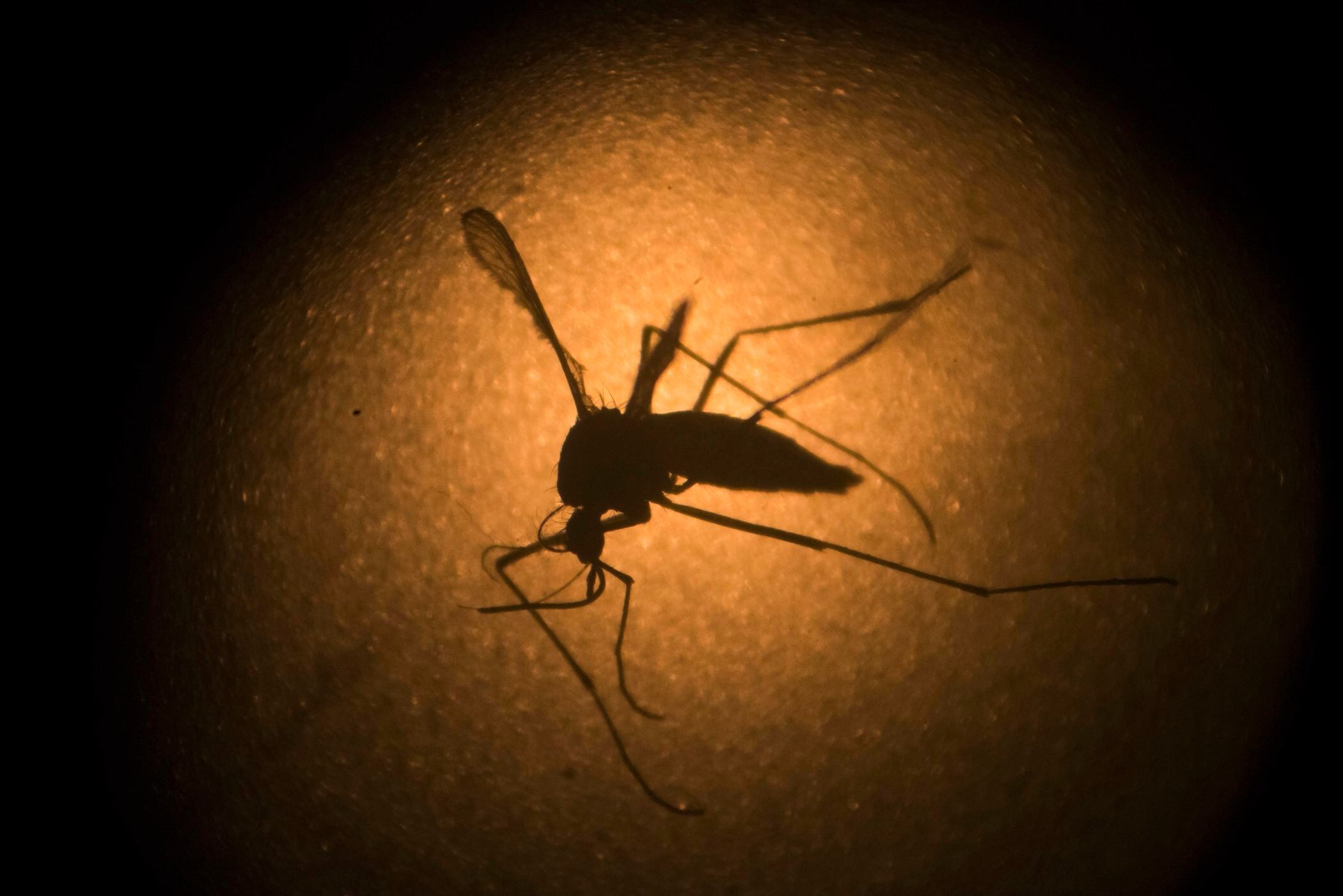
In this Jan. 27, 2016, file photo, an Aedes aegypti mosquito known to carry the Zika virus, is photographed through a microscope at the Fiocruz institute in Recife, Pernambuco state, Brazil. (AP Photo/Felipe Dana, File)
Genetically modified mosquitoes are being released in the Florida Keys in an effort to combat persistent insect-borne diseases such as Dengue fever and the Zika virus.
The Florida Keys Mosquito Control District and the Oxitec biotechnology company announced Thursday that release boxes, non-release boxes and netted quality control boxes are being placed this week in six locations: two on Cudjoe Key, one on Ramrod Key and three on Vaca Key.
Starting early next month, less than 12,000 mosquitoes are expected to emerge each week for approximately 12 weeks. Untreated comparison sites will be monitored with mosquito traps on Key Colony Beach, Little Torch Key and Summerland Key.
“We really started looking at this about a decade ago, because we were in the middle of a dengue fever outbreak here in the Florida Keys,” Florida Keys Mosquito Control District executive director Andrea Leal said during a video news conference. “So we’re just very excited to move forward with this partnership, working both with Oxitec and members of the community.”
Keys officials approved the pilot project last year involving the striped-legged Aedes aegypti mosquito, which is not native to Florida. The insect transmits several diseases to humans, particularly in the Keys island chain where dozens of cases of dengue fever were reported last year.
Oxitec’s non-biting male mosquitoes are expected to mate with the local biting female mosquitoes. The female offspring of these encounters cannot survive, controlling the Aedes aegypti population. The Aedes aegypti mosquito makes up about 4% of the mosquito population in the Keys but is responsible for virtually all mosquito-borne diseases transmitted to humans. This mosquitoes transmit dengue, Zika, yellow fever and other human diseases, and can transmit heartworm and other potentially deadly diseases to pets and other animals.
An earlier version of the genetically-modified mosquitoes was used in Brazil, but this is the first time they have been used in the United States.
“We’re an organization comprised of very passionate individuals working to develop solutions that can have a public health impact,” Oxitec CEO Grey Frandsen said. “We have people living in the Keys. We have spent a huge amount of time engaging with residents, with community leaders, with small businesses, and have seen the results of that.”
Some people worry about using genetically-modified organisms, or GMOs, that they believe could alter the planet’s natural balance. Barry Wray, director of the Florida Keys Environmental Coalition, has said that officials have no idea what the insects will do.
It’s also unclear whether the genetically-modified mosquitoes will be able to accomplish their intended task, said Max Moreno, an expert in mosquito-borne diseases at Indiana University who is not involved in the company or the pilot project. Moreno has said the lab-created males might have a difficult time competing with rivals that have gone through the natural selection process, in which only the fittest survive and mate.
The genetically-modified mosquitoes have been approved by the Environmental Protection Agency and the Florida Department of Agriculture and Consumer Services, officials said. It also has support from the U.S. Centers for Disease Control and Prevention. The project is being funded by Oxitec.
Jurors in the trial against Theranos CEO Elizabeth Holmes have entered day six of deliberations. Holmes is accused of lying to investors about the functionality of a newly developed blood-testing technology. Andrew George, partner at Baker Botts, joined Cheddar to break down key points in the case and what the jury might be considering during their deliberations. He also noted that the rest of Silicon Valley, including Holmes' business partner, Ramesh "Sunny" Balwani, who is facing identical charges, is closely watching the outcome of deliberations — as it could set the tone for future regulations and Balwani's own trial.
According to researchers, the state of California's cap-and-trade program is currently being undermined by forest fires caused primarily by climate change. Over the past few years, trees that were set aside for the program have been releasing carbon as they continue to burn in fires. Climate Researcher and Policy Director at CarbonPlan Danny Cullenward, joined Cheddar to discuss more.
The CDC's latest update to its COVID-19 quarantine guidelines reduces the isolation period from ten days to just five for people who test positive but are asymptomatic. Dr. Bayo Curry-Winchell, regional clinical director at Carbon Health, spoke to Cheddar's Baker Machado about the new guidance. She noted that while the reduced quarantine time "makes sense," the CDC should also require that a person test negative after their quarantine and before interacting with the public. "There is science behind it. We know that the majority of illness happens, or transmission, one to two days before the onset of symptoms and then two to three days as you have symptoms. So there is science behind the reducement of the actual five days," she said.
Prices at the pump this year reached a seven-year high, and a new forecast from GasBuddy shared with CNN predicts that gas prices will only continue to rise in 2022 and that the national average could even reach $4.00 a gallon; however, analysts at GasBuddy say anything could happen when it comes to gas prices in the future, as the pandemic has made it difficult to make any predictions about the economy. Consumer Energy Alliance federal policy advisor Michael Zehr joins Cheddar News' Closing Bell to discuss.
As the Omicron variant is fueling a surge in COVID-19 cases, parents and schools are faced with tough choices between absences and outbreaks. Matt Barnum, a national reporter at Chalkbeat, joins Cheddar News to discuss.
Ron Gutman, Co-CEO of Intrivo, joins Cheddar News to discuss how the company is creating a test and tech solution for Covid testing called 2Gather, and how it's using data-driven digital diagnostics to make these tests widely available and affordable.
As 2021 winds down, the number of positive COVID-19 cases has surged dramatically with numbers not seen since the heights of the pandemic. Dr. Laolu Fayanju, the regional medical director at primary care provider Oak Street Health, joined Cheddar to discuss the numbers, how the healthcare system is handling the surge this time around, and what it means that the CDC just cut the quarantine time guideline in half for those who are infected. "These are incredibly high numbers because they reflect the transmissibility of the omicron variant," Fayanju said.