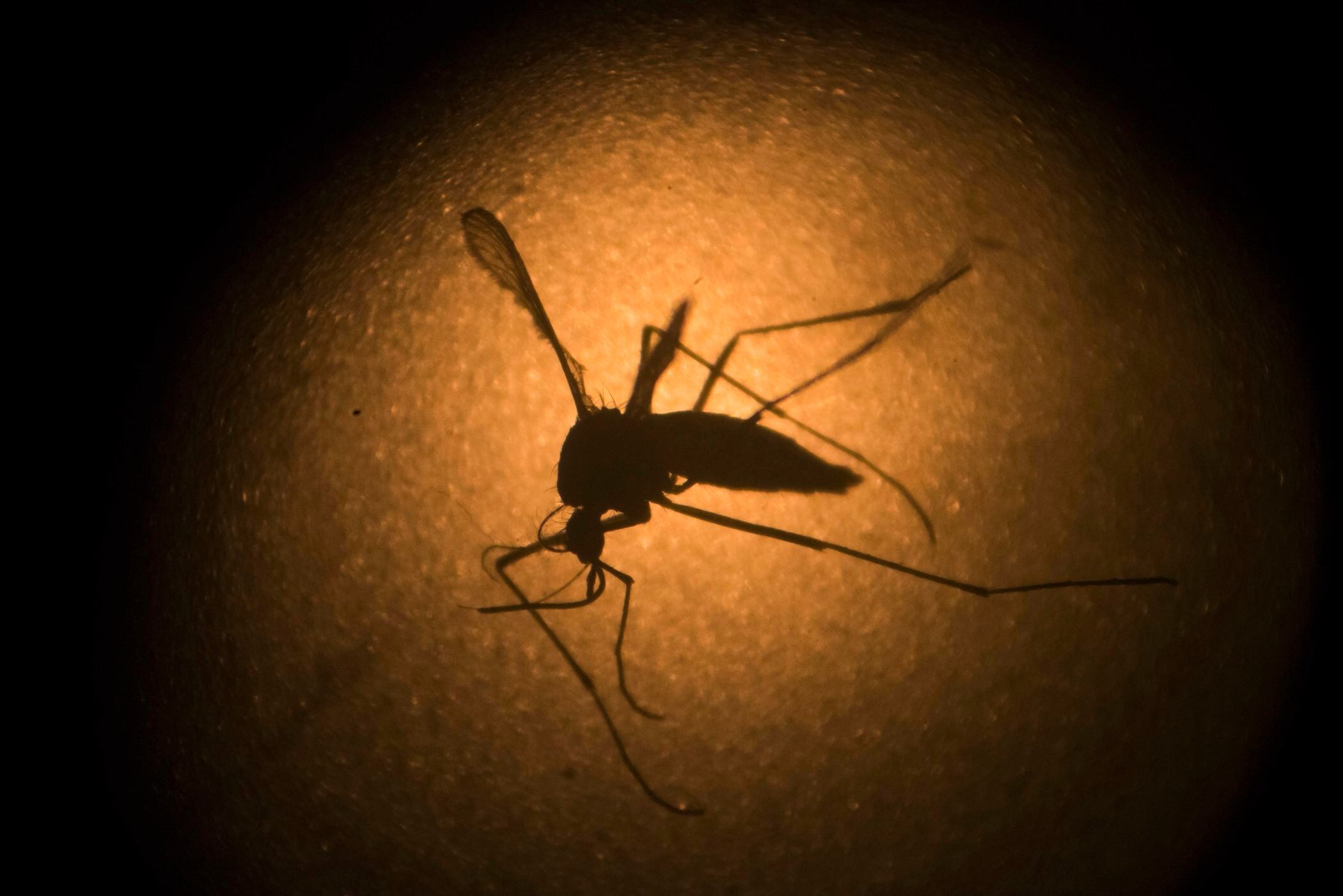
In this Jan. 27, 2016, file photo, an Aedes aegypti mosquito known to carry the Zika virus, is photographed through a microscope at the Fiocruz institute in Recife, Pernambuco state, Brazil. (AP Photo/Felipe Dana, File)
Genetically modified mosquitoes are being released in the Florida Keys in an effort to combat persistent insect-borne diseases such as Dengue fever and the Zika virus.
The Florida Keys Mosquito Control District and the Oxitec biotechnology company announced Thursday that release boxes, non-release boxes and netted quality control boxes are being placed this week in six locations: two on Cudjoe Key, one on Ramrod Key and three on Vaca Key.
Starting early next month, less than 12,000 mosquitoes are expected to emerge each week for approximately 12 weeks. Untreated comparison sites will be monitored with mosquito traps on Key Colony Beach, Little Torch Key and Summerland Key.
“We really started looking at this about a decade ago, because we were in the middle of a dengue fever outbreak here in the Florida Keys,” Florida Keys Mosquito Control District executive director Andrea Leal said during a video news conference. “So we’re just very excited to move forward with this partnership, working both with Oxitec and members of the community.”
Keys officials approved the pilot project last year involving the striped-legged Aedes aegypti mosquito, which is not native to Florida. The insect transmits several diseases to humans, particularly in the Keys island chain where dozens of cases of dengue fever were reported last year.
Oxitec’s non-biting male mosquitoes are expected to mate with the local biting female mosquitoes. The female offspring of these encounters cannot survive, controlling the Aedes aegypti population. The Aedes aegypti mosquito makes up about 4% of the mosquito population in the Keys but is responsible for virtually all mosquito-borne diseases transmitted to humans. This mosquitoes transmit dengue, Zika, yellow fever and other human diseases, and can transmit heartworm and other potentially deadly diseases to pets and other animals.
An earlier version of the genetically-modified mosquitoes was used in Brazil, but this is the first time they have been used in the United States.
“We’re an organization comprised of very passionate individuals working to develop solutions that can have a public health impact,” Oxitec CEO Grey Frandsen said. “We have people living in the Keys. We have spent a huge amount of time engaging with residents, with community leaders, with small businesses, and have seen the results of that.”
Some people worry about using genetically-modified organisms, or GMOs, that they believe could alter the planet’s natural balance. Barry Wray, director of the Florida Keys Environmental Coalition, has said that officials have no idea what the insects will do.
It’s also unclear whether the genetically-modified mosquitoes will be able to accomplish their intended task, said Max Moreno, an expert in mosquito-borne diseases at Indiana University who is not involved in the company or the pilot project. Moreno has said the lab-created males might have a difficult time competing with rivals that have gone through the natural selection process, in which only the fittest survive and mate.
The genetically-modified mosquitoes have been approved by the Environmental Protection Agency and the Florida Department of Agriculture and Consumer Services, officials said. It also has support from the U.S. Centers for Disease Control and Prevention. The project is being funded by Oxitec.
Amazon is betting that ammonia could be the fuel of the future, participating in a Series A round for the Brooklyn-based company Amogy in December. Amogy aims to de-carbonize transportation with a clean energy system that uses ammonia as a renewable fuel. Amogy is partnering with Amazon on its first commercial product - an ammonia-powered cargo-shipping vessel. Amogy CEO Seonghoon Woo joins Cheddar Climate to discuss.
Cryptocurrency is expected to become a part of our daily lives — but what sort of environmental impact does it have? As the U.S. becomes the crypto mining capital of the world, climate advocates are worried about mining companies reopening old coal plants, using massive amounts of energy, wasteful hardware, and more. Congressional Democrats led by Senator Elizabeth Warren are demanding answers from mining firms about their electricity use and waste levels. John Belizaire, CEO of Soluna Computing, joins Cheddar Climate to discuss the congressional letters, how crypto mining can become a green industry, and more.
Driver assistance monitoring systems are meant to keep the driver's eyes on the road, but according to a report from AAA, different ways of monitoring provide significantly different results. The study found that direct camera-based systems that scanned the driver's eye movements were faster and more reliable than those indirect systems that looked at steering-wheel input. Megan McKernan, the manager of automotive services for the Automobile Club of Southern California, joined Cheddar to discuss the findings. "Triple-A is recommending that automakers include both direct and indirect systems just to really prevent consumers from trying to misuse these systems," she said, noting that neither system on its own is not foolproof.
Wave Neuroscience is a neurological health tech company that specializes in clinical and at-home personalized brain stimulation technology. Erik Won, president and chief medical officer and Fred Walke, CEO, joined Cheddar's Opening Bell to discuss their company's hopes for allowing patients to identify and treat unique brain disorders while empowering them to understand their unique neurological makeups — including for the high-stress positions of professional athletes. "We have a mobile device that provides a very light stimulation that gives them a therapy that gives them confidence so there's a just knowing that they're doing something for it," said Walke. "But it also helps them get back into a rhythm. It helps their brain synchronize around certain frequencies that that we target, and it helps them really understand that they've done everything they can to get to their highest level of success."
Democratic lawmakers are now calling on Bitcoin mining companies in the U.S. to assess how much electricity they use and how it could all potentially impact residents and the environment in the near future. Since its conception, crypto mining has been at the center of a debate. The question is: Is crypto mining playing a key role in renewable energy or could it totally derail U.S. climate goals? Host of The Wendy O show Wendy O, joined Cheddar to discuss more.
Nutritional supplement beverage company Athletic Greens has achieved unicorn status. The company announced a new $115 million funding round, bringing its valuation to $1.2 billion. The company's flagship product AG1 combines 75 different vitamins, minerals, and other nutrients into one daily serving. Athletic Greens says it is poised to reach the millions of consumers who are currently driving the health and wellness market's exponential growth. Athletic Greens founder and CEO Chris Ashenden joins Cheddar News' Closing Bell to discuss.
A powerful winter storm hit the Northeast over the weekend leaving 100,000 New Yorkers in the dark as well as snowfall up to 30.9 inches in parts of Massachusetts. The nor'easter hit with blizzard conditions of wind speed and poor visibility.