Mike Bloomberg broke the internet Wednesday night, but like a lot of social media sensations, not all press is good press.
Dozens of popular meme accounts on Instagram feature screenshots of messages from the presidential candidate. "Hello Mr. Salad. Can you post this meme to make me seem cool for the upcoming democratic primary?" reads a message from Mike Bloomberg's account to Kale Salad, an account with 3.5 million followers.
The caption includes a note that said, "yes, this is really #sponsored by @mikebloomberg."
"Mike Bloomberg 2020 has teamed up with social creators to collaborate with the campaign, including the meme world," Sabrina Singh, a national spokeswoman for the campaign, said in a statement. "While a meme strategy may be new to presidential politics, we're betting it will be an effective component to reach people where they are and compete with President Trump's powerful digital operation."
Bloomberg's move had mixed results. In comment sections, some are praising the campaign and others think it's disingenuous.
"At first I didn't realize they were ads and just thought they were bizarre satire, but then I saw a headline about it and was pretty annoyed," Allyn Rosenberger, a Stanford Law School student told Cheddar. "Trying to be objective, it is interesting and getting a lot of attention. And it's going to reach a ton of people."
Samantha Bell, who works in digital marketing, called the meme move a "missed opportunity."
"I do think influencer marketing for political campaigns is a smart decision." But Bloomberg's campaign, so far "is trying to reach a group of people that are very thoughtful in politics as well as social media and it kind of comes off slightly too 'try-hard,'" said Bell, who has led other paid influencer campaigns. "You have actual people you follow and look up to. It could absolutely become more of a community PR campaign with actual people who have opinions. People who follow influencers in an organic sense care about the people they're following." She thinks it makes more sense to pay those influencers than paying meme accounts, which is "like inserting yourself in the zeitgeist."
Influencers and online personalities often promote specific products or companies in exchange for money or exposure. But Bloomberg's memes did not provide a call-to-action, like a link to a landing page or a note for where to learn more about a candidate, Sian Rigby, who also works in growth marketing, told Cheddar.
"I would have found it more redeeming if there was an educational aspect," Rigby said. "I'm not going to vote for a candidate because I think they're cool."
Neither Rigby or Bell disagree that social media may prove to be a useful marketing tool for political figures — but they don't think Bloomberg's execution accomplished the intended goal.
"I don't think using Instagram or using social media is a bad thing," Rosenberger said. "It should encourage people to get engaged, not just provide another form of name recognition."
Some endorsements — like that of Rep. Alexandria Ocasio-Cortez for Sen. Bernie Sanders, involve social media. She regularly posts about her support. But she's doing it for free.
"People of power and influence endorse candidates very publicly," Annabel Gordon, another growth marketer, told Cheddar. "I feel like it's an untapped market to do that via social media."
"Why haven't they taken their endorsements digitally? That's where people are getting news and taking in content," Gordon offered.
California's new composting law will affect what residents do in their kitchens. As of this week, Californians will have to recycle excess food in an effort to reduce emissions caused by food waste. Cities and counties will turn recycled food into compost or use it as a renewable energy source. California's new law is the largest mandatory residential food waste recycling program in the country. Rachel Wagoner, Director of the California Department of Resources, Recycling and Recovery called the law 'the biggest change to trash' since recycling started in the 1980s. She joined Cheddar Climate to discuss.
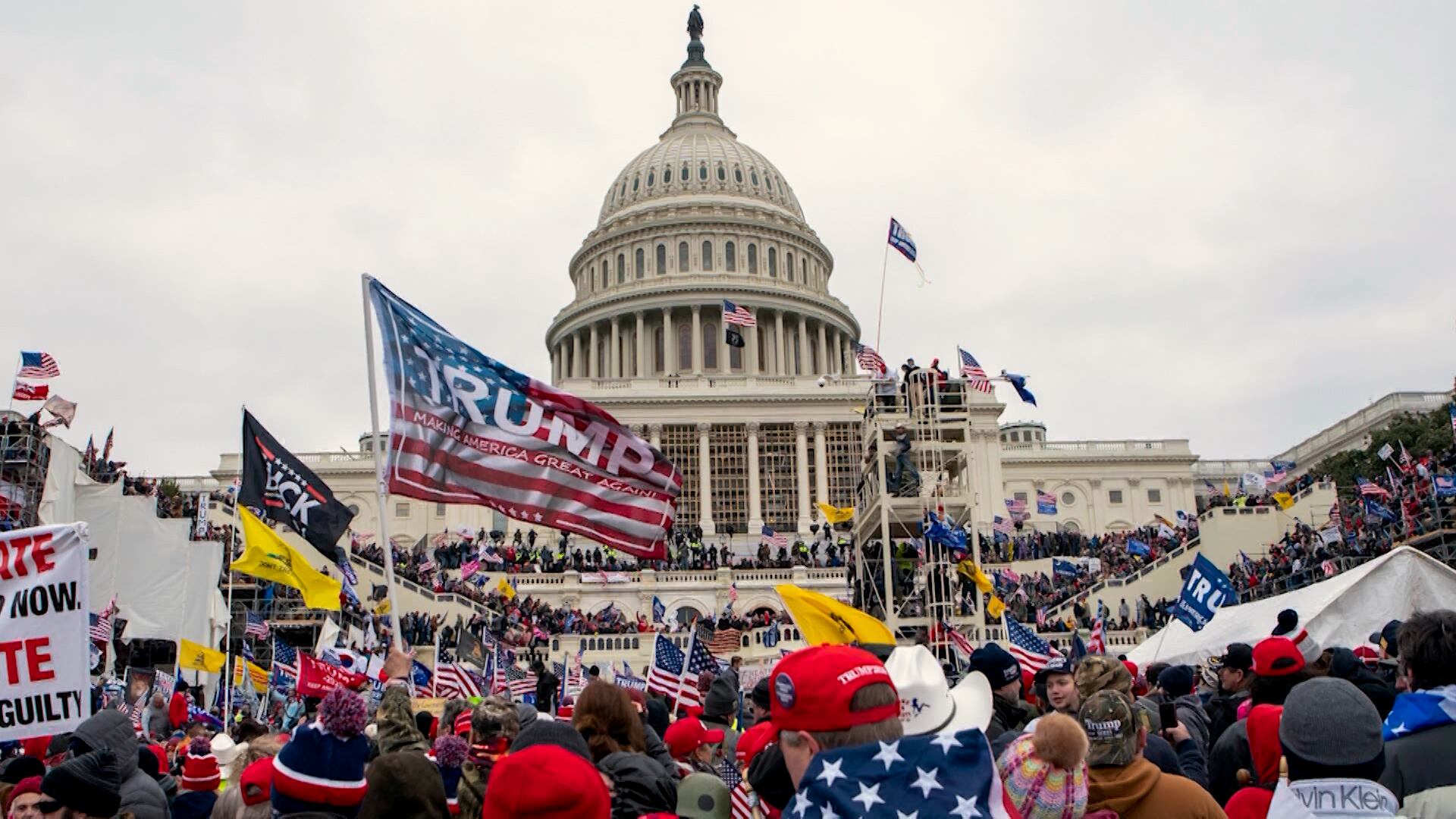
As the U.S. comes up on the first anniversary of the January 6 insurrection.,A.C. Thompson, investigative reporter at ProPublica, joined Cheddar's Baker Machado to discuss updates to American Insurrection by FRONTLINE, ProPublica and Berkeley Journalism’s Investigative Reporting Program. The documentary investigates the attack on the Capitol touched off by the lie that the presidential election was stolen from Donald Trump but with new information gleaned since the event including interviews with lawmakers and law enforcement and the evolution of groups like the Boogaloo Boys and the Proud Boys behind the attack. "In some ways those groups that were kind of the vanguard of January 6 are maybe no longer relevant because their message is everywhere," he said.
A new report from ProPublica and the Washington Post found that Facebook Groups played a major role in the spread of misinformation linked to the January 6 insurrection with more than 650,000 posts claiming that Joe Biden's election victory was illegitimate.
Millions of Americans with young children have relied on the child tax credit since the federal government began issuing checks in July 2021. The last round of payments was sent out just before the Christmas holiday — at the same time as the omicron variant surged. Leah Hamilton, associate professor of social work at Appalachian State University, joined Cheddar to discuss what the end to the tax credit means as the U.S. sees the end of many relief programs and its highest number of COVID cases since the start of the pandemic. "It'll become harder for families to meet their basic needs, increasing national childhood poverty rates and the proportion of families who have difficulty putting food on the table, maintaining stable housing, and paying their bills," Hamilton said. She also pointed to research that the credit as a long-term investment in children offsets claims that it contributes to macroeconomic impacts like inflation.
U.S. President Joe Biden spoke with Ukrainian President Volodymyr Zelensky over the week-end, just days after he spoke with Russian President Vladimir Putin. The call comes as Washington prepares to meet with Moscow on January 10, as tensions mount over Russia's military build up near its border with Ukraine. Cheddar News speaks with Mustafa Tameez, a former advisor to the U.S. Department of Homeland Security, about the issue.
Several Silicon Valley insiders are being accused of contorting a 1990s-era tax break to avoid taxes on millions of dollars of investment profits. The tax break is known as the qualified small business stock exemption, and it allows early investors in certain companies to avoid half of the taxes on up to $10 million in capital gains. A piece recently published in the New York Times says venture capital firms like Andreessen Horowitz replicated the tax exemption by giving shares of companies to friends and family, who would otherwise face a 23.8% capital gains bill. The CEO of Roblox is also accused of replicating the tax break for his family members at least 12 times. Although the loophole known as 'stacking' is considered to be legal, the Times piece implies that the exemption has been manipulated for the ultra-wealthy to become more wealthy. Greycroft co-founder and Chairman Emeritus Alan Patricof joins Cheddar News' Closing Bell to discuss.
Chris Sommerfeldt, City Hall reporter for the New York Daily News, joins Cheddar News' Closing Bell, where he discusses both the wins and losses of Bill de Blasio's eight years as New York City Mayor.