By Lisa Mascaro, Farnoush Amiri and Stephen Groves
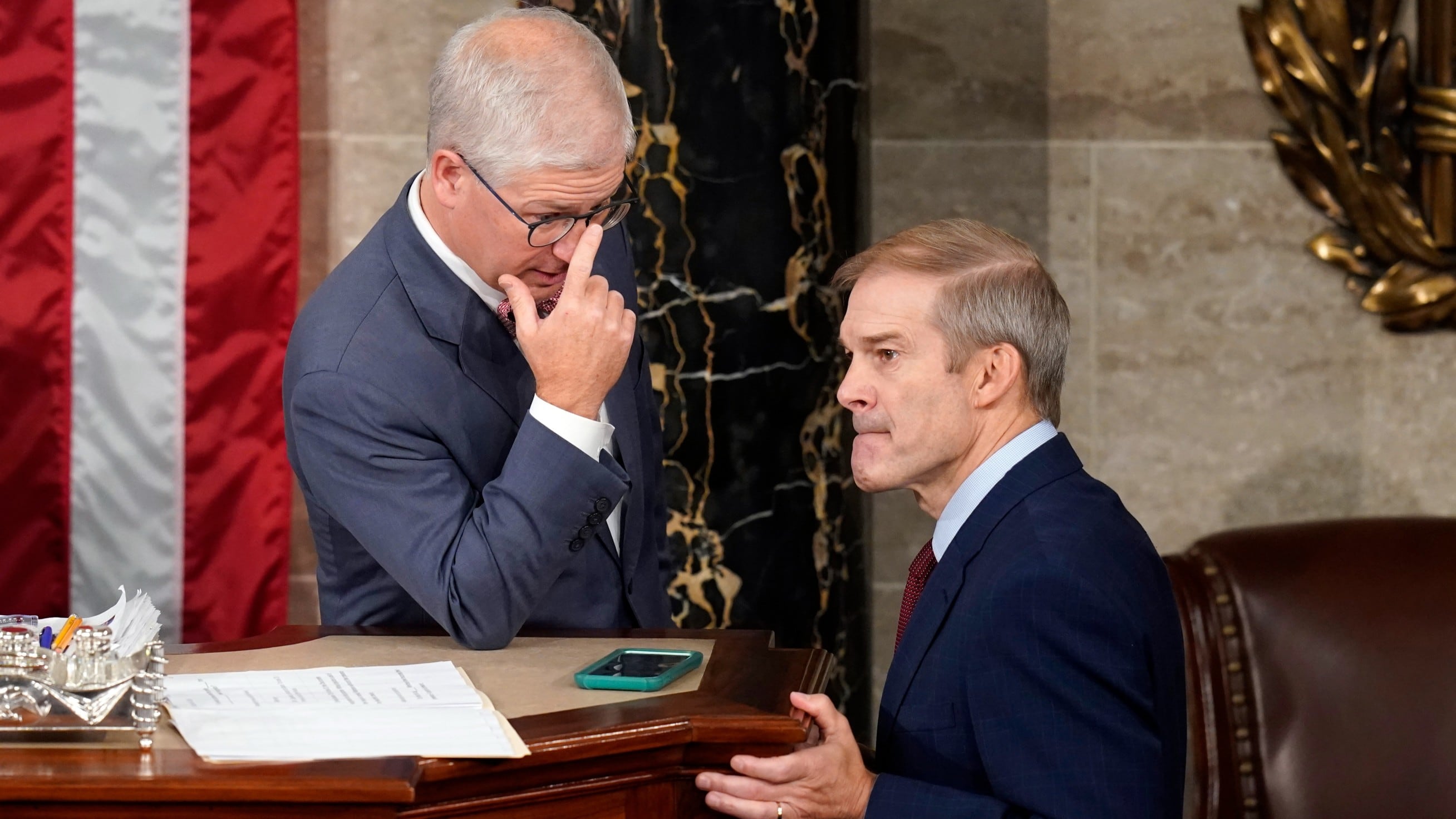
Republican Rep. Jim Jordan failed again Wednesday on a crucial second ballot to become House speaker, the hard-fighting ally of Donald Trump losing even more GOP colleagues who refused to give him the the gavel.
Next steps were highly uncertain as a bipartisan group of lawmakers floated an extraordinary plan — to give the interim speaker-pro-tempore, Rep. Patrick McHenry, R-N.C., more power to reopen the House and temporarily conduct routine business.
What was clear was that Jordan's path to become House speaker was almost certainly lost. He was opposed by two more than the 20 Republican detractors he lost in first round voting the day before.
The House gaveled in with angry, frustrated GOP lawmakers looking at other options. And as the rollcall was underway, a few new detractors emerged to oppose Jordan who did not seem to be picking up new votes beyond one lawmaker who was absent the day before.
Ahead of the morning vote, Jordan made an unexpected plea for party unity, the combative Judiciary Committee chairman telling his colleagues on social media, “We must stop attacking each other and come together.”
A surprisingly large and politically diverse group of 20 Republicans had rejected Jordan's nomination the day before, many resenting the hardball tactics seeking to enforce support, and viewing the Ohio congressman as too extreme for the powerful position of House speaker, second in line to the presidency.
The House has hit a standstill, stuck while Jordan worked to shore up backing from Republican colleagues for the job to replace the ousted Kevin McCarthy. Republicans are exhausted by the infighting since McCarthy's sudden removal by hard-liners, who are now within reach of a central seat of U.S. power.
The vote for House speaker, once a formality in Congress, has devolved into another bitter showdown for the gavel.
With Republicans in majority control 221-212, Jordan must pick up most of his GOP foes to win. Tuesday's tally, with 200 Republicans voting for Jordan and 212 for the Democratic leader Hakeem Jeffries of New York, left no candidate with a clear majority, as the 20 Republicans voted for someone else. .
In nominating Jordan, veteran Republican Rep. Tom Cole of Oklahoma said it was time to end the upheaval that he had warned against with McCarthy’s sudden ouster.
“We have a chance today to end that chaos, end that uncertainty,” Cole said.
He said that Jordan was “not a shrinking violet” but someone who could lead the House.
Democratic Rep. Pete Aguilar noted that Jeffries continues to win more votes and is the best choice to move the country forward.
“The country cannot afford more delays and more chaos,” Aguilar said.
Bipartisan groups of lawmakers have been floating ways to operate the House by giving greater power to McHenry or another temporary speaker. The House had never ousted its speaker before McCarthy.
The novel concept of boosting the interim speaker's role was gaining favor with a pair of surprising high-profile Republicans: Former GOP speakers Newt Gingrich and John Boehner.
Gingrich said while he likes Jordan, he has “no faith” the nominee can get much beyond the 200 votes he won in the first vote.
“We can’t sit around and suck our thumbs and hope the world will wait until the House Republicans get their act together,” Gingrich told Fox News' Sean Hannity on his show.
Boehner reposted Gingrich's views saying, “I agree,” on social media.
The two men have deep experience with the subject. Both were chased to early retirement by threats of ouster from right-flank insurgents like those who toppled McCarthy.
“The Republicans are unable to function right now,” said Jeffries. He said talks would “accelerate” between Democrats and Republicans on alternative plans.
“Jim Jordan will be a great speaker,” Trump had said Tuesday said outside a courthouse in Manhattan, where he is facing business fraud charges. "I think he’s going to have the votes soon, if not today, over the next day or two."
Flexing their independence, the holdouts are a mix of pragmatists — ranging from seasoned legislators and committee chairs worried about governing, to newer lawmakers from districts where voters back home prefer President Joe Biden to Trump.
Some Republicans resent being pressured by Jordan’s allies and say they are being threatened with primary opponents if they don’t support him as speaker. Others are simply upset at the way the whole process has dragged out.
One holdout, Republican Rep. Ken Buck of Colorado, said Tuesday that Jordan’s role in the runup to the Jan. 6, 2021, attack on the Capitol and his refusal to admit that Biden, a Democrat, won the 2020 election remained an issue.
Jordan has been a top Trump ally, particularly during the Jan. 6 Capitol attack by the former president’s backers who were trying to overturn the 2020 election he lost to Biden. Days later, Trump awarded Jordan a Medal of Freedom.
The political climb has been steep for Jordan, the combative Judiciary Committee chairman and a founding member of the right-flank Freedom Caucus. He is known more as a chaos agent than a skilled legislator, raising questions about how he would lead. Congress faces daunting challenges, risking a federal shutdown at home if it fails to fund the government and fielding Biden's requests for aid to help Ukraine and Israel in the wars abroad.
First elected in 2006, Jordan has few bills to his name from his time in office. He also faces questions about his past. Some years ago, Jordan denied allegations from former wrestlers during his time as an assistant wrestling coach at Ohio State University who accused him of knowing about claims they were inappropriately groped by an Ohio doctor. Jordan has said he was never aware of any abuse.
Associated Press writers Kevin Freking and Mary Clare Jalonick contributed to this report.