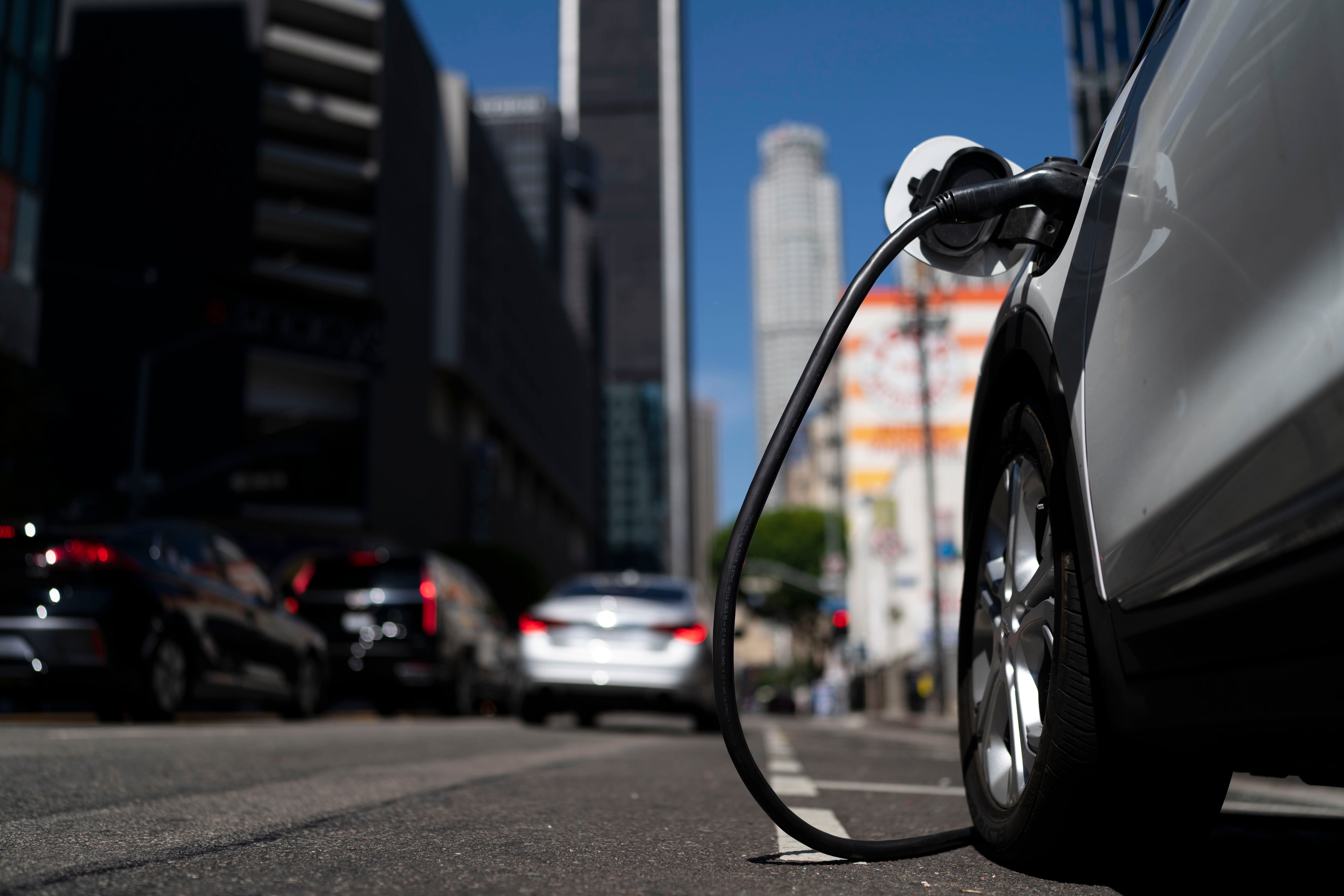
Electric vehicles made by General Motors will be able to use much of Tesla's extensive charging network beginning early next year. In addition, GM will adopt Tesla's connector, the plug that links an electric vehicle to a charging station.
GM joins Ford in shifting its electric vehicles to work with about 12,000 of Tesla's roughly 17,000 chargers, and both Detroit automakers are pushing to make Tesla's connector the industry standard. GM CEO Mary Barra and her Tesla counterpart, Elon Musk, made the announcement Thursday during a Twitter Spaces conversation.
Their discussion comes two weeks after Ford CEO Jim Farley joined Musk to announce that Ford's electric vehicles would gain access to much of Tesla's EV-charging network, the largest in the nation. Farley also said Ford would switch to Tesla's connector rather than go with the connector used by the rest of the industry.
Before the opening bell Friday, shares of Tesla Inc. jumped 6% and appeared headed for a new high for the year. General Motors Co. rose 4%, and Ford Motor Co. rose more than 1%.
At first, GM and Ford EV owners will need an adapter to hook into the Tesla stations, which have their own connector. But both GM and Ford will switch to Tesla’s North American Charging Standard connector starting with new EVs produced in 2025.
Tesla has about 17,000 Supercharger stations in the U.S. There are about 54,000 public charging stations in the U.S., according to the Department of Energy, but many charge much more slowly than the Tesla stations.
“Like Ford, we see this as an opportunity to expand access to charging,” Barra said, adding that GM hopes the rest of the industry will move to the Tesla charging connector, which is different from the CCS connector used on most other EVs.
Musk said that GM and Tesla vehicles would have an even playing field at the charging stations.
“We will provide support equally to both,” he said. “The most important thing is we advance the electric vehicle revolution.”
Financial details of the agreement between the two companies were not released Thursday, but GM spokesman Darryll Harrison said GM isn't paying Tesla.
“Tesla will get better utilization of their network and all the new charging revenue, which will help them expand the network further,” Harrison said. “There are other opportunities both companies can take advantage of as a result of the agreement.”
Details of how customers would gain access are still being worked out. GM EV owners may have to pay a monthly charge to access Tesla’s charging network, or they could pay for each use. Current GM owners probably will need to buy the adapter, Harrison said.
Tesla’s supercharger network is a huge competitive advantage for the company based in Austin, Texas, which sells more EVs than anyone else in the U.S. Chargers often are located near freeways to enable long trips, where most fast-charging plugs are needed, and generally they're more reliable than other networks.
But opening access to EVs from GM and Ford, which rank a distant second and third in U.S. EV sales, will make it easier for those owners to charge while traveling. It also could rankle some Tesla owners who already are jockeying for space at some of the busier Supercharger stations, largely in California.
Barra said joining Tesla’s network would almost double the number of chargers available to GM electric vehicle owners.
“At the end of the day, we’re looking at what’s best for our customers,” Barra said. “We aren’t the only company that comes up with good ideas.”
Mike Austin, an electric vehicles analyst for Guidehouse Insights, said GM joining the Tesla network is a huge step toward making Tesla's connector the industrywide standard.
“It seems like there's a lot of momentum going the way of the North American Charging Standard, for sure,” he said.
If other large EV makers such as Hyundai, Kia, Volkswagen and Nissan, also switch connectors, Tesla would get a large amount of revenue from its chargers, Austin said.
Still, Tesla appears to be holding back at least part of its network for use only by Tesla owners, he said. The risk, he said, is that Tesla owners could have to wait for access to a plug.
“Tesla owners are used to not having to wait,” he said.
The Tesla connector and cord are much lighter and easier to handle than the CCS system used by the rest of the auto industry, Austin said.
Earlier this year, the White House announced that at least 7,500 chargers from Tesla’s Supercharger and Destination Charger network would be available to non-Tesla electric vehicles by the end of 2024. But the rollout thus far has been slow.