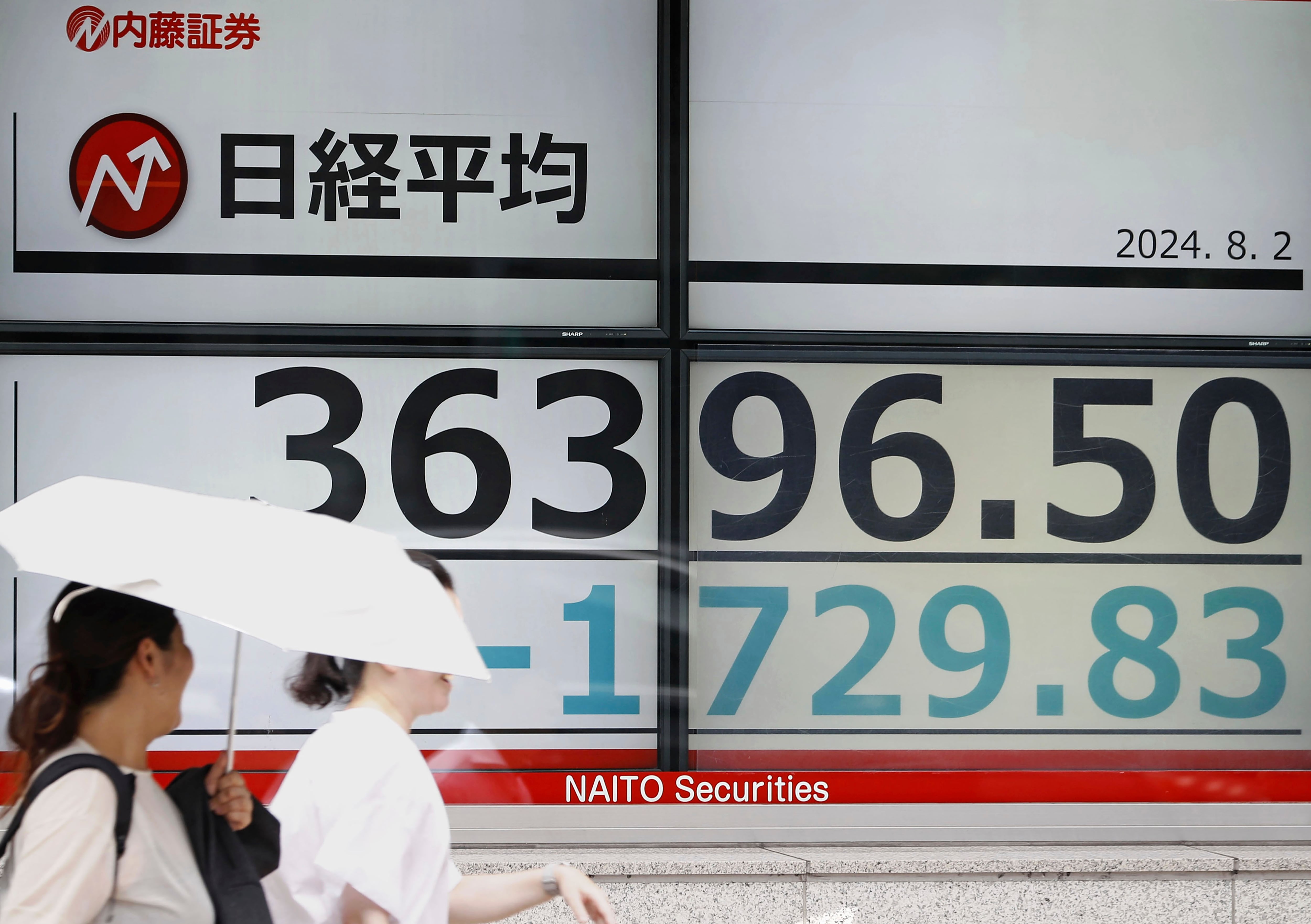
BANGKOK (AP) — Shares in Europe and Asia tumbled Friday, with Japan’s Nikkei 225 index slumping 5.8% as investors panicked over signs of weakness in the U.S. economy.
Bracing for a highly anticipated employment report coming on Friday, the future for the S&P 500 was down 1.3%, while that for the Dow Jones Industrial Average sank 0.9%.
The declines followed a retreat on Wall Street after weak manufacturing data raised worries the Federal Reserve may have waited too long to cut interest rates, raising risks of a recession. After the U.S. central bank held steady at a meeting this week, Fed Chair Jerome Powell said a cut could come in September.
“The short-lived satisfaction of Fed Chief Powell communicating decent odds of a September rate cut has turned sour as investors are now panicking that the central bank isn’t trimming soon enough,” José Torres, a senior economist at Interactive Brokers, said in a report.
A nearly 19% decline in Intel's shares in aftermarket trading deepened the gloom. The chipmaker said it was cutting 15% of its massive workforce — about 15,000 jobs — to better compete with more successful rivals like Nvidia and AMD.
In early European trading, Germany's DAX shed 1.5% to 17,806.65, while the CAC 40 slipped 1% to 7,298.81. In London, the FTSE 100 fell 0.6% to 8,233.49.
Japan’s market retreated to where it was trading in January before it surged to an all-time high last month of over 42,000. The Nikkei 225 lost 2,216.63 points Friday to 35,909.70, with banks’, technology-related and manufacturers’ shares hit by heavy selling.
The Nikkei has lost 6.2% in the past three months.
Japanese shares were pummeled after the central bank raised its benchmark interest rate on Wednesday, to 0.25% from 0.1%. That pushed the value of the Japanese yen higher against the U.S. dollar, potentially hurting overseas earnings of major manufacturers and deflating a boom in tourism.
The dollar fell to 148.77 yen early Friday from 149.37 yen late Thursday. It had recently traded above 160 yen. The euro rose to $1.0820 from $1.0789.
Elsewhere in Asia on Friday, Hang Seng in Hong Kong dropped 2.1% to 16,945.51, while the Shanghai Composite index saw a more modest loss, of 0.9% to 2,905.34.
Chinese shares have extended losses this week as investors registered disappointment with the government's latest efforts to spur growth through various piecemeal measures, instead of hoped-for infusions of broader stimulus.
The Kospi in Seoul dropped 3.7% to 2,676.19 and Taiwan's Taiex sank 4.4%. Both markets tend to be hit hard by weakness in technology shares.
South Korea's Samsung Electronics dropped 4.2% while another maker of computer chips and other components, SK Hynix, dropped 10.4%. Taiwan Semiconductor Manufacturing Co., the world's largest chip maker, lost 5.9%.
Elsewhere in Asia, Australia's S&P/ASX gave up 2.1% to 7,943.20 and the Sensex in India was down 1.1%. Bangkok's SET fell 0.7%.
It has been a nerve wracking week for markets even as central banks in Japan, the United States and England acted much as had been expected. Japan raised its benchmark, the Fed stood pat, and the Bank of England lowered its key rate by 0.25%, to 5%, its first cut in more than four years.
Commodity prices have also had a rough ride, with oil prices surging after the killings of leaders of Hamas and Hezbollah that fueled fears conflict in the Middle East might escalate into a wider war. But prices fell back Thursday and were only marginally higher early Friday.
Benchmark U.S. crude oil gained 12 cents to $76.43 per barrel. Brent crude, the international standard, was up 12 cents at $79.64 per barrel.
The price of gold, a traditional refuge for investors in uncertain times, has surged to over $2,500 an ounce.
Meanwhile, other commodities sank on concerns that weakness in the U.S. and other major economies will hurt demand. The price of nickel dropped 2.4%, aluminum dropped 1% and copper traded in New York dropped 2.3%.
Worry is mounting that the Fed has kept its main interest rate at a two-decade high for too long in its zeal to stifle inflation by making it more costly to borrow. A rate cut could take months to a year to filter through the economy.
On Thursday, the S&P 500 sank 1.4% after a report from the Institute for Supply Management showed U.S. manufacturing activity is still shrinking. The Dow fell 1.2%, and the Nasdaq composite dropped 2.3%. The small stocks in the Russell 2000 index dropped 3%.
Other reports Thursday showed the number of U.S. workers applying for jobless benefits hit its highest level in about a year and that productivity for U.S. workers improved in the spring. The data are likely to relieve pressure on inflation and give the Fed more leeway to cut rates.
Employment growth does appear to be slowing more than expected, Philip Marey, senior U.S. strategist for Rabobank, said in a commentary.
“This suggests that the Fed’s strategy to bring better balance between labor demand and supply through restrictive interest rates is working, but of course the risk is that employment growth is brought to a halt and the economy slides into a recession.”