By Laurie Kellman
The Jordan River is a winding, 200-plus-mile run on the eastern flank of Israel and the occupied West Bank. The sea is the glittering Mediterranean to its west.
But a phrase about the space in between, “from the river to the sea,” has become a battle cry with new power to roil Jews and pro-Palestinian activists in the aftermath of Hamas' deadly rampage across southern Israel Oct. 7 and Israel's bombardment of the Gaza Strip.
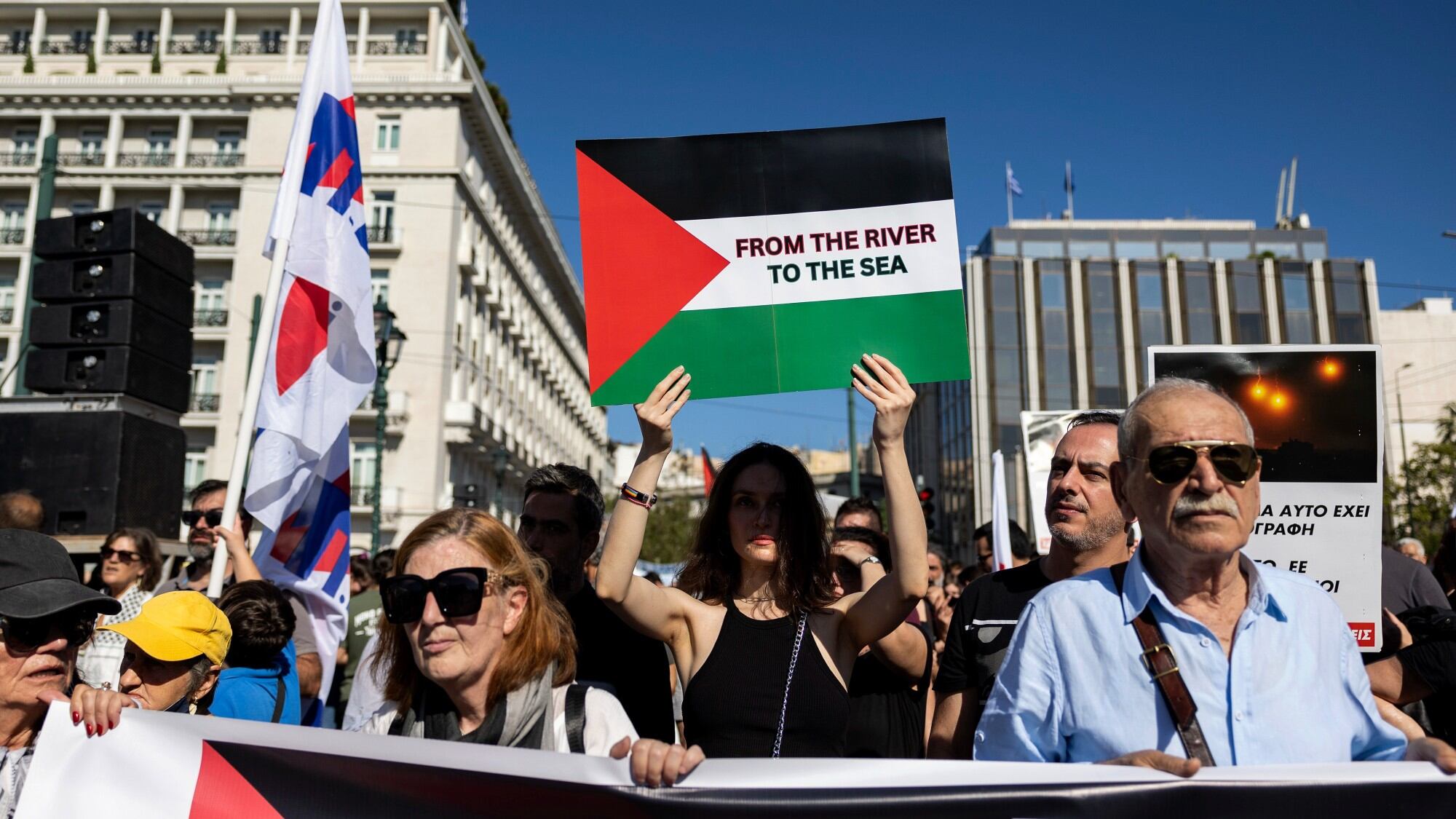
"From the river to the sea, Palestine will be free," pro-Palestinian activists from London to Rome and Washington chanted in the volatile aftermath of Israel's bloodiest day. Adopting or defending it can be costly for public figures, such as U.S. Rep. Rashida Tlaib, who was censured by the House on Tuesday.
But like so much of the Mideast conflict, what the phrase means depends on who is telling the story — and which audience is hearing it.
Many Palestinian activists say it's a call for peace and equality after 75 years of Israeli statehood and decades-long, open-ended Israeli military rule over millions of Palestinians. Jews hear a clear demand for Israel's destruction.
This much is clear: Hamas fighters killed more than 1,400 people in Israel and hauled at least 240 back to Gaza as hostages in the worst violence against Jews since the Holocaust. Israel responded with heavy bombardment of Gaza and a ground offensive, that has killed more than 11,000 Palestinians, according to the Health Ministry in Hamas-run Gaza. The death toll is certain to rise. The result is the deadliest round of Israeli-Palestinian fighting in decades.
In the raw afterburn of the Hamas attacks, the chant seems to put everyone on edge.
SLOGAN ADOPTED BY HAMAS
“From the river to the sea” echoes through pro-Palestinian rallies across campuses and cities, adopted by some as a call for a single state on the land between the Jordan River and the Mediterranean.
By 2012, it was clear that Hamas had claimed the slogan in its drive to claim land spanning Israel, the Gaza Strip and the West Bank.
“Palestine is ours from the river to the sea and from the south to the north," Khaled Mashaal, the group's former leader, said that year in a speech in Gaza celebrating the 25th anniversary of the founding of Hamas. "There will be no concession on any inch of the land.”
The phrase also has roots in the Hamas charter.
The story behind the phrase is much larger, and reaches across the decades.
In the months before and during the 1948 war, an estimated 700,000 Palestinians fled or were expelled from what is now Israel. Many expected to return. Israel captured the West Bank, along with Gaza and east Jerusalem, in the 1967 war. In 2005, Israel withdrew from Gaza, and in 2007, Hamas claimed the tiny strip from the Palestinian Authority after a violent coup.
WHAT JEWS SAY THEY HEAR
Even the shorthand, “from the river to the sea,” echoes through pro-Palestinian protests, crackles across social media and is available on a variety of merch, from sweatshirts to candles.
Ask Jewish people in London what's so chilled them about the current spike in antisemitism, and many will cite what seems like the ubiquity of the slogan. It is a sign, they suggest, that there's much to fear.
“Have no doubt that Hamas is cheering those ‘from the river to the sea’ chants, because a Palestine between the river to the sea leaves not a single inch for Israel," read an open letter signed by 30 Jewish news outlets around the world and released on Wednesday.
And in the wake of Hamas' killing of civilians on Oct. 7, they're not buying that the chant is merely anti-Israel. Backed by groups such as the Anti-Defamation League, they say it's inherently anti-Jewish.
“No one can now say that in the eyes of Hamas, a hatred of Israel does not mean a hatred of all Jews,” said London resident Sarah Nachshen. “The slogans and placards and chants calling for the eradication of Israel and, indeed, all Jews have clearly shown this.”
WHAT PALESTINIAN ACTIVISTS SAY
Tlaib, D-Mich., who has family in the West Bank and is Congress' only Palestinian-American, posted a video Nov. 3 that featured protesters chanting the slogan.
No stranger to criticism over her rhetoric on the U.S.-Israel relationship, Tlaib defended the slogan.
“From the river to the sea is an aspirational call for freedom, human rights, and peaceful coexistence, not death, destruction, or hate,” Tlaib tweeted, cautioning that conflating anti-Israel sentiment with antisemitism “silence(s) diverse voices speaking up for human rights.”
Tweeted Yousef Munayyer, head of the Palestine/Israel Program and a senior Fellow at Arab Center Washington: “There isn’t a square inch of the land between the river and the sea where Palestinians have freedom, justice and equality, and it has never been more important to emphasize this than right now.”
A TWO-STATE SOLUTION
Most of the international community supports a two-state solution, which calls for the partition of the land. To many, though, decades of Israeli settlement expansion have made the reality of a two-state solution impossible.
Right-wing Israelis have blurred the lines between Israel and the West Bank, where half a million people now live in settlements. Many in the Israeli government support the annexation of the West Bank, and official government maps often make no mention of the “green line” boundary between the two.
And the original platform of Prime Minister Benjamin Netanyahu's party, Likud, published a version of the slogan, saying that between the sea and the Jordan River, "there will only be Israeli sovereignty.”
THE RISK OF THE SLOGAN
Using the phrase for public figures can be costly. Tlaib's censure is a punishment one step short of expulsion from the House.
Last month, Vienna police banned a pro-Palestinian demonstration, citing the fact that the phrase “from the river to the sea” was mentioned in invitations and characterizing it as a call to violence.
And in Britain, the Labour Party issued a temporary punishment to a member of Parliament, Andy McDonald, for using the phrase during a rally at which he called for a stop to bombardment.
“We won’t rest until we have justice. Until all people, Israelis & Palestinians, between the river & the sea can live in peaceful liberty," he tweeted.
Then he explained: “These words should not be construed in any other way than they were intended, namely as a heart felt plea for an end to killings in Israel, Gaza, and the occupied West Bank, and for all peoples in the region to live in freedom without the threat of violence."