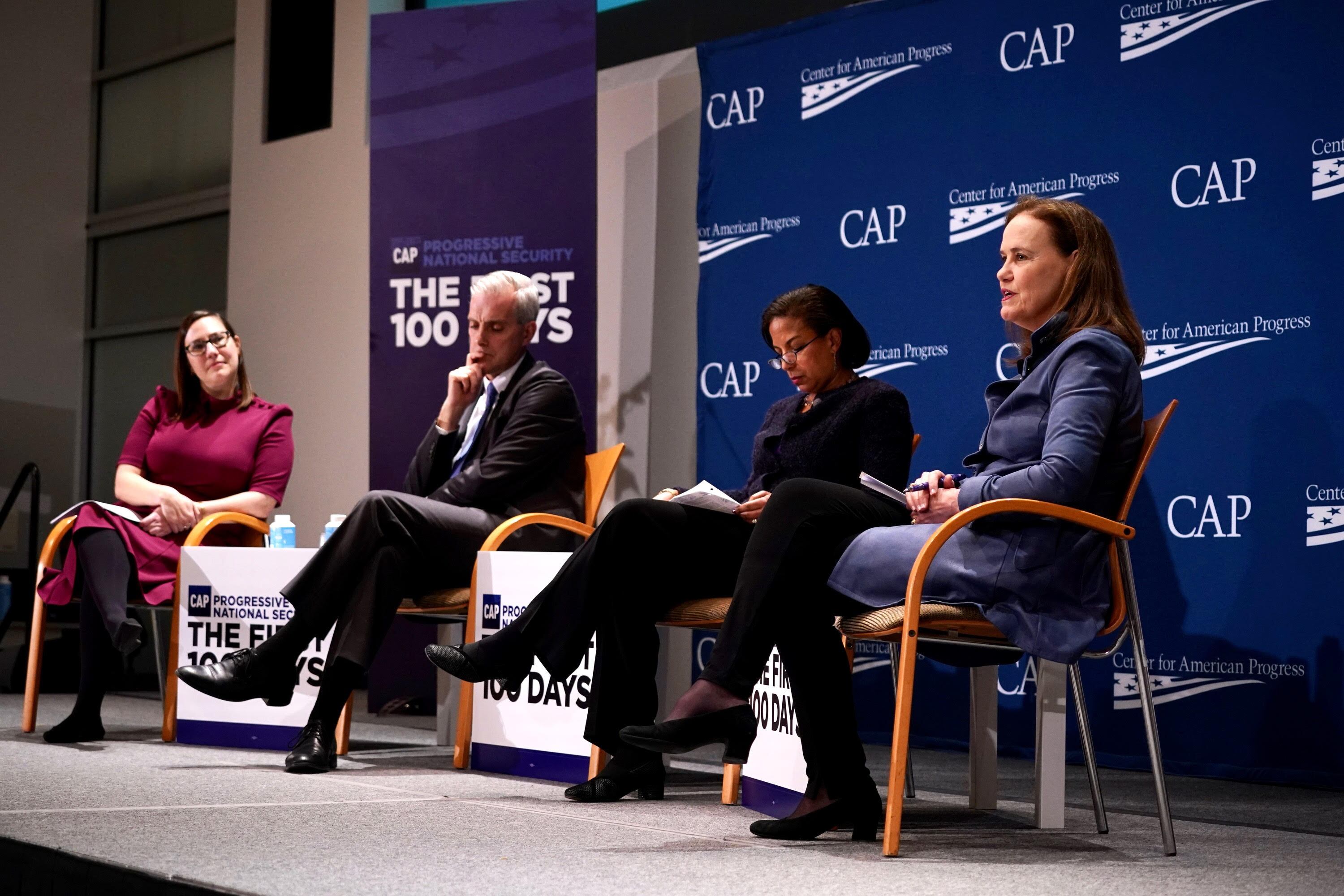
Senior foreign policy officials from the last several presidential administrations gathered in Washington D.C. Tuesday for a series of panels and workshops aimed at creating a “roadmap for an incoming administration’s first 100 days in office,” according to the Center for American Progress.

Solutions that stem from the summit, hosted by the progressive think tank, are intended to help provide a new administration with approaches to handling pressing issues, such as mending fences with European allies and de-escalating tensions with nations like Iran and China.

Though the roadmap would likely be of more interest to a new administration come 2021, it will also be available to President Donald Trump if he wins re-election this November, although the organization does not believe the president’s advisors would take the advice of the progressive experts who were gathered.

Katrina Mulligan, a former Department of Justice national security expert who now works on national security and international policy at CAP, said the eventual goal is to put together “a menu of options” with a “focus on those activities or actions that would have the highest impact.”

Mulligan said experts who were working with the White House as far back as the Reagan administration planned to be in attendance. She said she hopes the next administration takes advice on, what she describes as, both offensive and defensive moves. “What do you need to do to repair things that are inherited on day one and what are the things you need to do to lay out an affirmative agenda?”
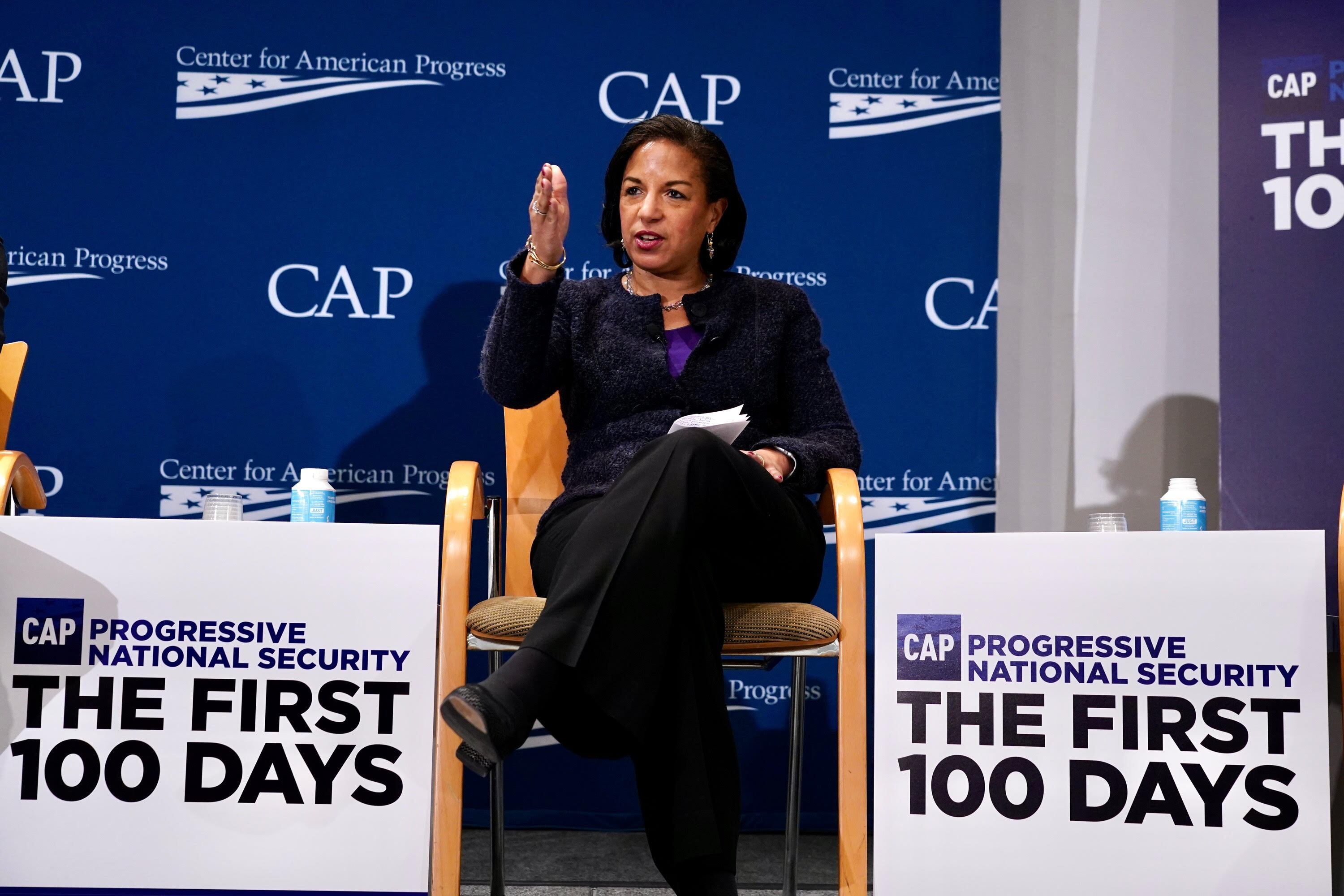
<i>Former Ambassador Susan Rice speaks at CAP’s opening event. / Center for American Progress</i>

Attendees include former Ambassador to the United Nations Samantha Power, former National Security Advisor Ambassador Susan Rice, former White House Chief of Staff Denis McDonough, former Under Secretary of Defense Michèle Flournoy and former Deputy National Security Advisor Avril Haines.

The group hopes to outline possible executive actions, diplomatic priorities and policy implementation activities, though Mulligan said there wasn’t a “specific catalyst” for the agenda- planning meetings.

After President Trump took office, employees left the State Department in droves. The State Department lost 12 percent of its foreign affairs specialists in the first eight months of Trump’s presidency.

Those who remain have worked on Trump’s ‘America First’ platform, which focuses on domestic priorities over stronger international ties. The president has also butted heads with allied leaders during his time in office, while actively working to strengthen bonds with leaders of nations traditional hostile toward the U.S. such as North Korea’s Kim Jong Un and Russia’s Vladimir Putin.

A new administration will need a robust employee base in order to accomplish lofty foreign policy goals, so Mulligan is leading a group to formulate ideas on that very issue. “I worry about the hollowing out of career civil service at the State Department, particularly,” Mulligan said. “I worry about the legacy of ‘America First’ and what it means for a lot of people who don’t understand the risk of isolating America by treating other countries the way we’ve been treating them.”

Together, she said CAP hopes to provide a roadmap in six to nine months for a new president.

Share:
More In Politics
Sen. Blackburn Disappointed With Instagram's Lack of Specifics at Child Safety Hearing
Instagram CEO Adam Mosseri faced a bipartisan Congressional grilling this week as the Senate inquired about safety practices for protecting the mental wellbeing of young people on the platform. Sen. Marsha Blackburn (R-Tenn.) joined Cheddar to talk about the hearing and how she was disappointed in Instagram coming unprepared with relevant information or documents. Blackburn also offered concern that the platform could continue with building a kids-only version despite having drawn significant opposition from the public.
Workers Demand Better Treatment Amid the Great Resignation
The Great Resignation has shown some signs of slowing in October with the number of those who quit their jobs falling by 4.7 percent to 4.16 million. This comes as worker strikes and calls for unionization ramp up. Jane Oates, president at WorkingNation joined Cheddar's "Opening Bell" to discuss the implications.
Markets Open Lower Despite Better-than-Expected Jobless Claims
U.S. markets opened lower despite positive jobs data, which saw weekly claims drop to a 52-year low. Kevin Nicholson, Co-CIO Global Fixed Income, RiverFront Investment Group joined Cheddar's Opening Bell to discuss the labor market, inflation, and the impact of the Omicron variant on global markets.
Trial Watch, Partygate & Fleeting Fame
A packed Thursday pod: Carlo and Baker cover the latest developments in the Ghislaine Maxwell, Jussie Smollett and Elizabeth Holmes trials. Plus, Dems are losing the Hispanic vote, Boris Johnson in trouble again, and is it possible that Adele has peaked?
Stocks Close Higher as Investors Shake Off Omicron Concerns
Jim Bruderman, Vice Chairman at 1879 Advisors, joins Cheddar News' Closing Bell, where he says investors experienced a 'panic attack' last week with the spread of the Omicron variant and the Fed's tapering plans. As a result, he says we're now seeing stocks climb due to a growing comfort level toward both developments.
Instagram Head Receives Bipartisan Anger Over App Impact on Teen Girl Mental Health"
Adam Mosseri, head of Instagram, faced withering questions on Capitol Hill about the reports the social media app was aware of the severe mental health impacts it was having on teenage girls. Karen Kornbluh, the director of digital innovation and democracy for the German Marshall Fund, joined Cheddar to discuss the rare show of bipartisan outrage on display at the Senate hearing. "The senators came really loaded for bear on both sides of the aisle," she said. Kornbluh explained how senators like Richard Blumenthal (D-Conn.) set up fake Instagram accounts with teen girl profiles in order to research the effects firsthand.
U.S.-China Relations Expert on Beijing Boycott
The Biden administration will not send an official U.S. delegation to the 2022 Winter Olympics in Beijing as a statement against China's "ongoing genocide and crimes against humanity in Xinjiang." Weifeng Zhong, senior research fellow at George Mason University's Mercatus Center, joins Cheddar News to discuss the boycott.
Load More