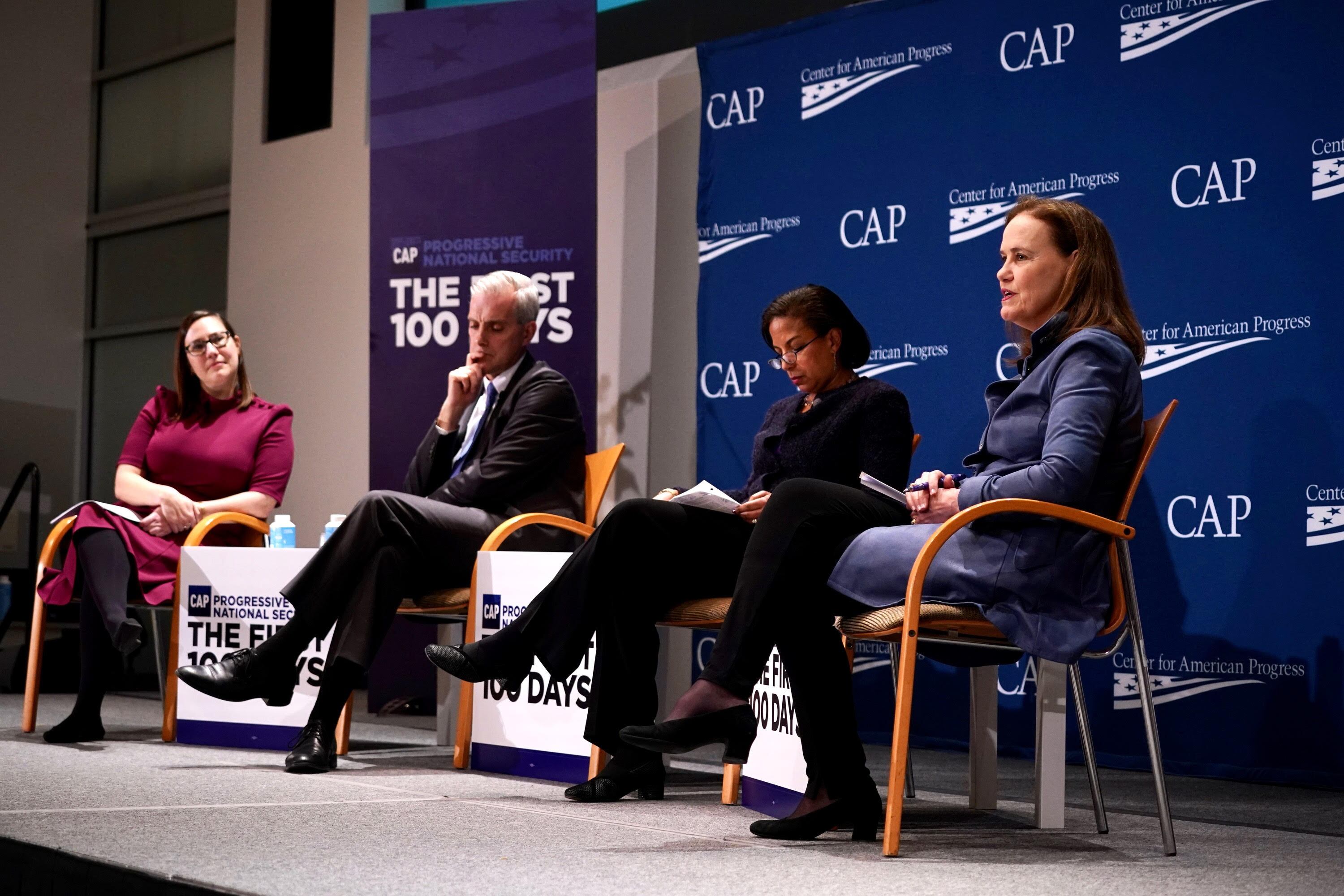
Senior foreign policy officials from the last several presidential administrations gathered in Washington D.C. Tuesday for a series of panels and workshops aimed at creating a “roadmap for an incoming administration’s first 100 days in office,” according to the Center for American Progress.
Solutions that stem from the summit, hosted by the progressive think tank, are intended to help provide a new administration with approaches to handling pressing issues, such as mending fences with European allies and de-escalating tensions with nations like Iran and China.
Though the roadmap would likely be of more interest to a new administration come 2021, it will also be available to President Donald Trump if he wins re-election this November, although the organization does not believe the president’s advisors would take the advice of the progressive experts who were gathered.
Katrina Mulligan, a former Department of Justice national security expert who now works on national security and international policy at CAP, said the eventual goal is to put together “a menu of options” with a “focus on those activities or actions that would have the highest impact.”
Mulligan said experts who were working with the White House as far back as the Reagan administration planned to be in attendance. She said she hopes the next administration takes advice on, what she describes as, both offensive and defensive moves. “What do you need to do to repair things that are inherited on day one and what are the things you need to do to lay out an affirmative agenda?”
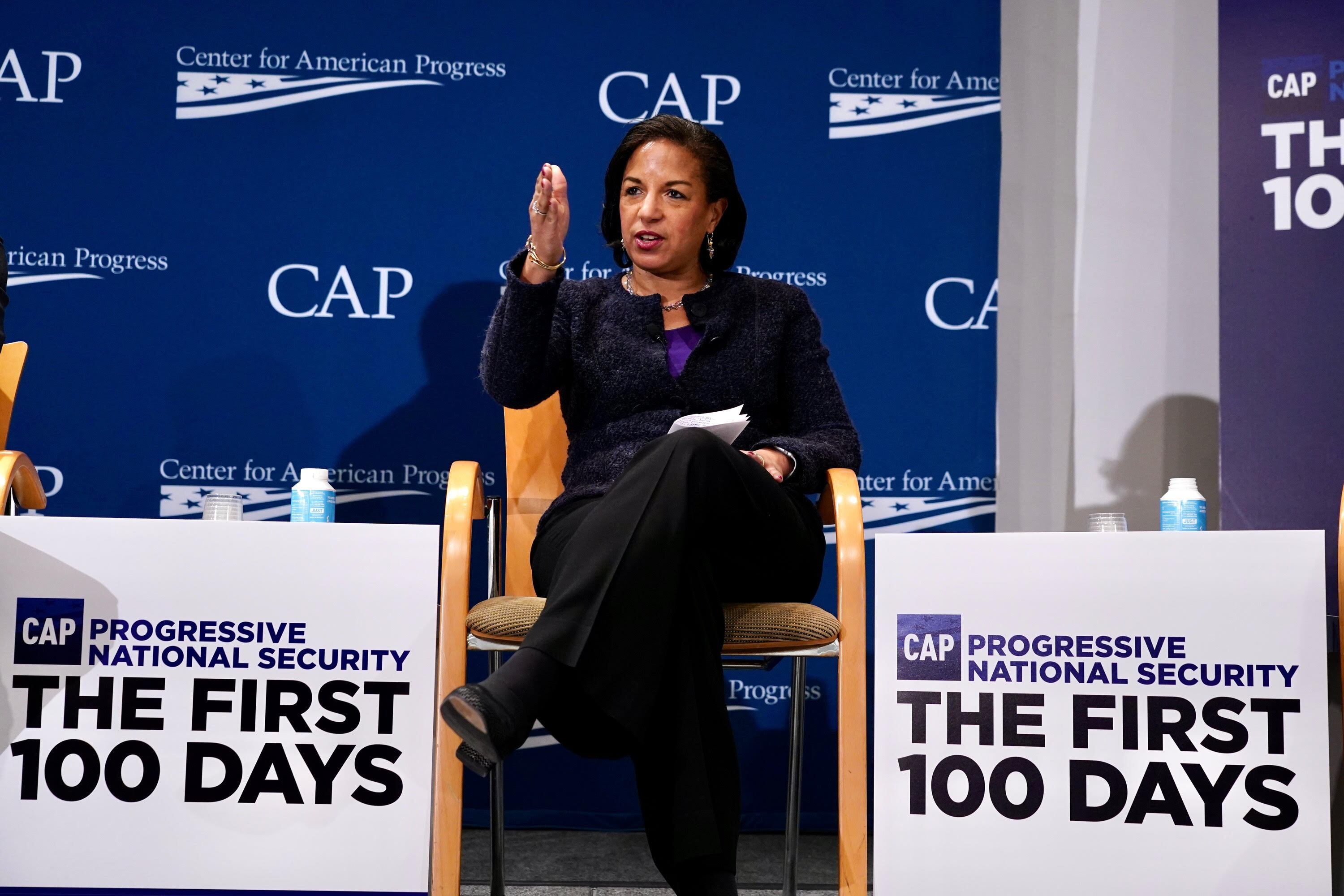
<i>Former Ambassador Susan Rice speaks at CAP’s opening event. / Center for American Progress</i>
Attendees include former Ambassador to the United Nations Samantha Power, former National Security Advisor Ambassador Susan Rice, former White House Chief of Staff Denis McDonough, former Under Secretary of Defense Michèle Flournoy and former Deputy National Security Advisor Avril Haines.
The group hopes to outline possible executive actions, diplomatic priorities and policy implementation activities, though Mulligan said there wasn’t a “specific catalyst” for the agenda- planning meetings.
After President Trump took office, employees left the State Department in droves. The State Department lost 12 percent of its foreign affairs specialists in the first eight months of Trump’s presidency.
Those who remain have worked on Trump’s ‘America First’ platform, which focuses on domestic priorities over stronger international ties. The president has also butted heads with allied leaders during his time in office, while actively working to strengthen bonds with leaders of nations traditional hostile toward the U.S. such as North Korea’s Kim Jong Un and Russia’s Vladimir Putin.
A new administration will need a robust employee base in order to accomplish lofty foreign policy goals, so Mulligan is leading a group to formulate ideas on that very issue. “I worry about the hollowing out of career civil service at the State Department, particularly,” Mulligan said. “I worry about the legacy of ‘America First’ and what it means for a lot of people who don’t understand the risk of isolating America by treating other countries the way we’ve been treating them.”
Together, she said CAP hopes to provide a roadmap in six to nine months for a new president.
Liana Guzmán, CEO of FOLX Health, joins Cheddar News to discuss the company launching billboards across the country in response to anti-LGBTQ+ legislation.
President Biden has announced an additional $800 million in military assistance to Ukraine, including artillery, armored personnel carriers, and helicopters. It comes as Russian forces appear to be preparing for a new, aggressive offensive in the eastern part of Ukraine. Paul McLeary, defense reporter for Politico, joined Cheddar to discuss this new round of aid and what it means for the U.S. commitment to arming the embattled country.
Catching you up on what you need to know on April 18, 2022, with Russian missile attacks on the Ukrainian city of Lviv killing seven, mass shootings in South Carolina and Pittsburgh, Lucky Charms cereal under official investigation by the FDA, and more.
Activism is growing around the country in response to school boards banning books from shelves that focus on sexuality, gender, identity, or race. Jen Cousins, co-founder of The Florida Freedom to Read Project, joins Cheddar News to discuss.
As the Russian invasion of Ukraine intensifies, President Biden has announced a ban on importing Russian oil, gas, and energy. To discuss how this ban will impact the war and Americans, Amir Handjani, non-resident fellow at Quincy Institute, joins Cheddar News.
Thousands of protesters around the world are expressing their solidarity with Ukraine against Russia's invasion.
Jason Beardsley, national executive director of the Association of the U.S. Navy and national security expert, joins Cheddar News to discuss.
As gas prices surge amid the Russian invasion of Ukraine, other nations could potentially transition faster to using clean energy than previously expected. Philip K. Verleger, a senior fellow at the Niskanen Center, joined Cheddar News to explain how this could be a possibility in the near future. "Part of the reason I think we have this invasion and the tantrum that's being thrown by Russia, terrible tantrum, is because the Russians were trying to slow down the transition," he said. "Ironically they speeded it up."
Following the invasion of Ukraine, a multitude of Western companies have paused doing business with Russia. PepsiCo, Coca-Cola, McDonald's, and Starbucks are the most recent companies to temporarily cease operations in Russia. Dean of Miami Herbert Business School at the University of Miami, John Quelch, joined Cheddar News to discuss what message this sends to Russia and the Russian consumer. “I would not underestimate the collective strength of all of these multinational companies, essentially coming together to make their collective statement in support of the political statements that have come out of Washington," he said.
The war in Ukraine continues to reveal heartbreaking gut-wrenching stories. The war in itself is not only devastating but also expensive. Experts estimate that Russia is draining nearly $20 million dollars each day to continue occupying and invading Ukraine. All this could force the country to turn to cryptocurrencies. It's a major turn for the country that briefly considered outlined digital assets entirely, but it could also have serious implications for cryptos. Managing Director at Quantum Fintech Group, Harry Yeh, joined Cheddar to discuss more.