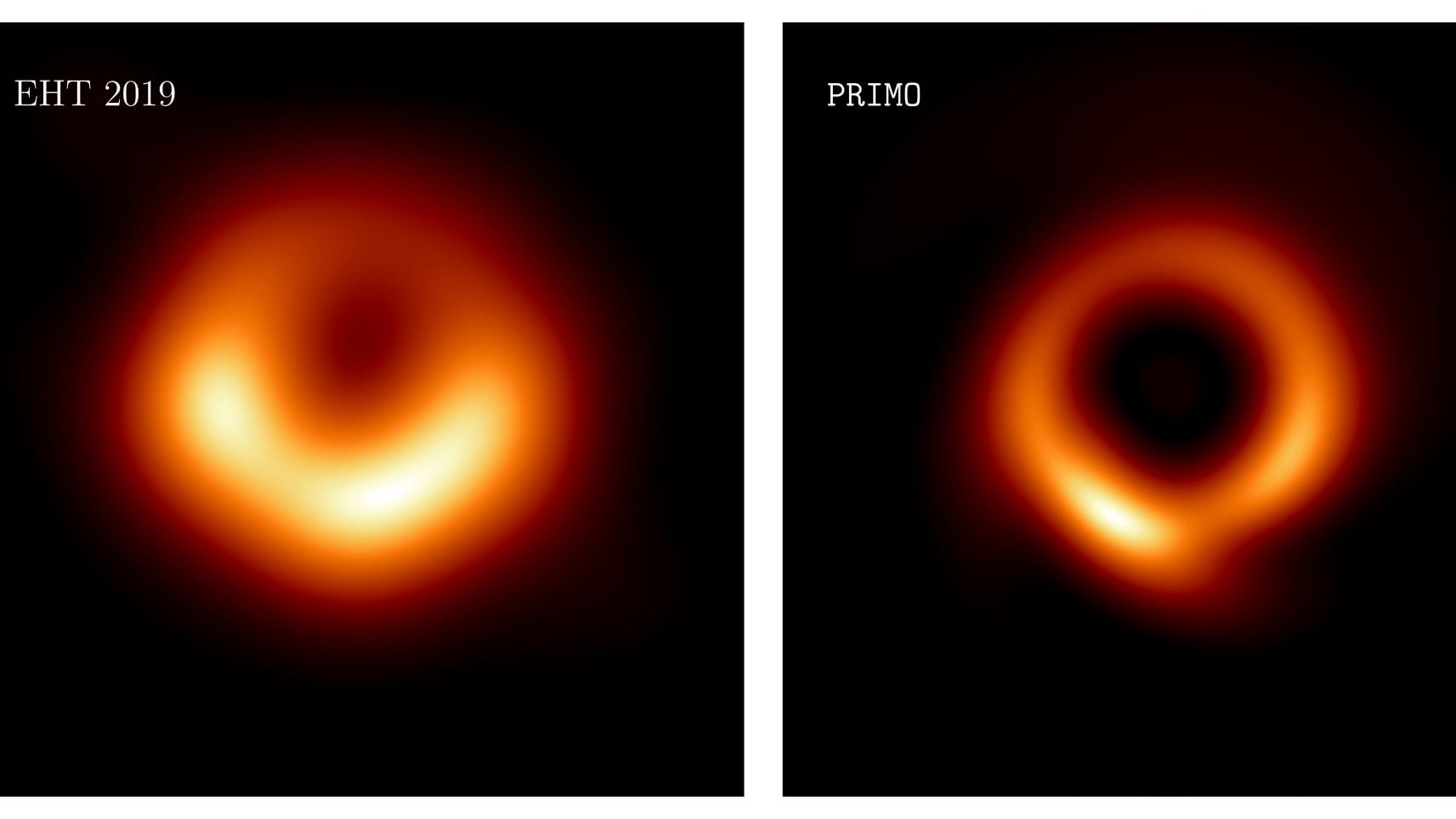
This combination of images provided by researcher Lia Medeiros shows images of the M87 black hole released in 2019, left, and an updated one for 2023. The new version, published Thursday, April 13, 2023, in the Astrophysical Journal Letters — keeps the original shape, but with a skinnier ring and a sharper resolution. Even with many telescopes working together, gaps remained in the data. In the latest study, scientists relied on the same data and used machine learning to fill in the missing pieces. (Lia Medeiros via AP)
By Maddie Burakoff
The first image of a black hole captured four years ago revealed a fuzzy, fiery doughnut-shaped object. Now, researchers have used artificial intelligence to give that cosmic beauty shot a touch-up.
The updated picture, published Thursday in the Astrophysical Journal Letters, keeps the original shape, but with a skinnier ring and a sharper resolution.
The image released in 2019 gave a peek at the enormous black hole at the center of the M87 galaxy, 53 million light-years from Earth. A light-year is 5.8 trillion miles. It was made using data gathered by a network of radio telescopes around the world, showing swirling light and gas.
But even with many telescopes working together, gaps remained in the data. In the latest study, scientists relied on the same data and used machine learning to fill in the missing pieces.
The resulting picture looks similar to the original, but with a thinner “doughnut” and a darker center, researchers said.
“For me, it feels like we’re really seeing it for the first time,” said lead author Lia Medeiros, an astrophysicist at the Institute for Advanced Study in New Jersey.
By having a clearer picture, researchers hope to learn more about the black hole’s properties and gravity in future studies. And Medeiros said the team plans to use machine learning on other images of celestial objects, including possibly the black hole at the center of our Milky Way galaxy.
___
The Associated Press Health and Science Department receives support from the Howard Hughes Medical Institute’s Science and Educational Media Group. The AP is solely responsible for all content.
Sanchali Pal, Founder and CEO of Joro, joins ChedHER to discuss how her app can help users track, reduce, and automatically offset the carbon footprint of their purchases, and gives advice for other women seeking careers in climate.
Connected cars software development platform Smartcar announced this week it has raised $24 million in a Series B round led by Energize Ventures. Smartcar's software can be integrated into mobile and web apps from mobility businesses. It allows users to do things like locate and unlock a vehicle, as well as check its mileage, fuel level, and battery if the vehicle is electric. Smartcar's technology is compatible with 22 different vehicle brands in 31 different countries. Smartcar co-founder and CEO Sahas Katta joined Cheddar News' Closing Bell to discuss.
If some members of Congress have their way, there might finally be a 'TLDR' on sites' terms of service, introduced by the terms-of-service labeling, design, and readability act – or TLDR for short. With this act, users will actually understand what they're agreeing to or the many ways in which their data is being used before pressing 'accept.' J.D. sat down with co-sponsor of the bill and Senator Bill Cassidy, to discuss.
On this episode of Cheddar Innovates: Vrai CEO discusses the process of creating lab grown diamonds, Entrupy CEO breaks down how the app uses artificial intelligence to analyze authenticity for luxury goods and sneakers; A look at Curiosity Stream's 'Red Elvis.'
Vidyuth Srinivasan, CEO and Co-Founder of Entrupy, joins Cheddar Innovates to discuss how this app uses artificial intelligence to analyze authenticity for luxury goods and sneakers, and why this is so critical as the secondary and resale retail markets are on the rise.