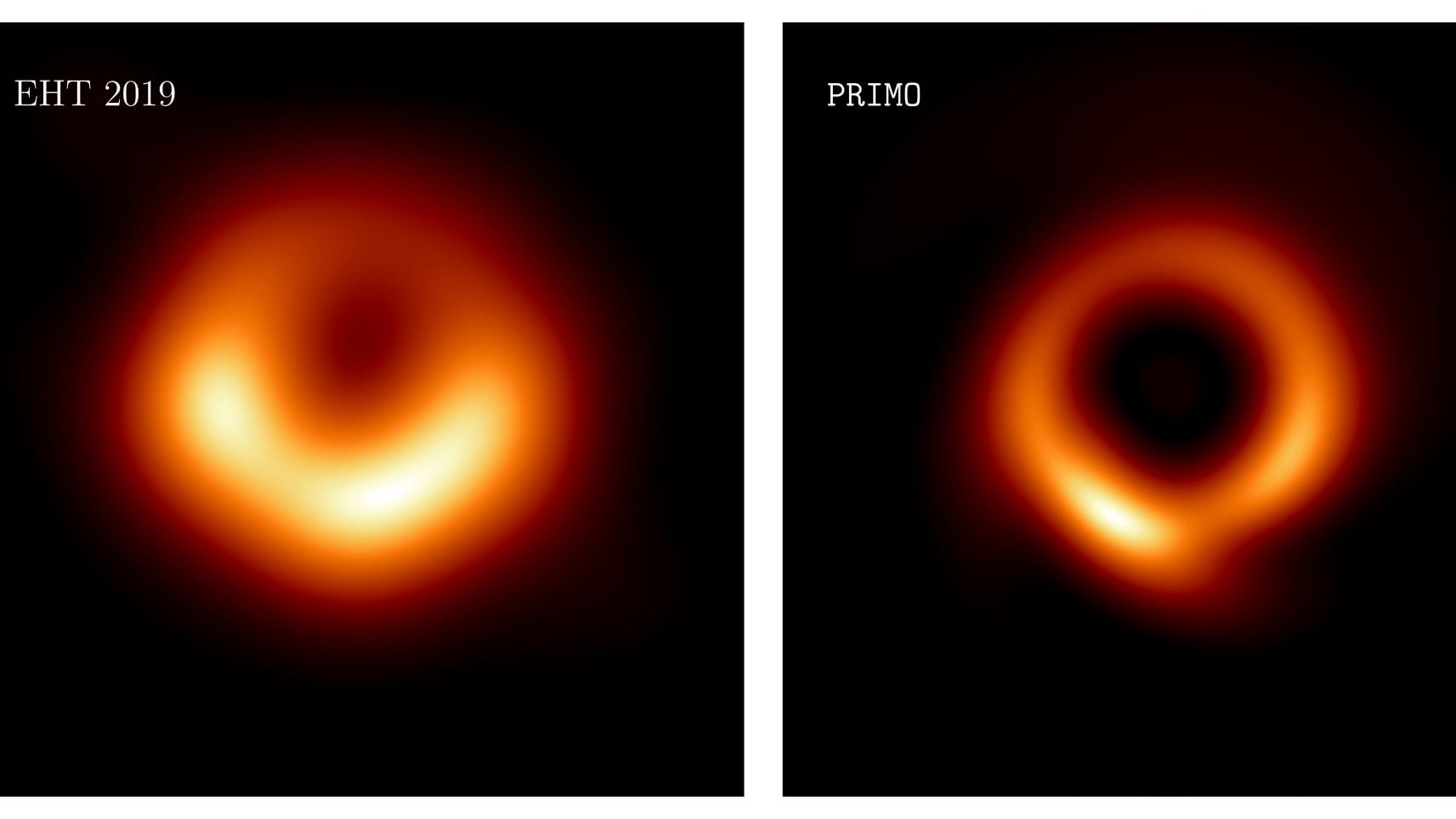
This combination of images provided by researcher Lia Medeiros shows images of the M87 black hole released in 2019, left, and an updated one for 2023. The new version, published Thursday, April 13, 2023, in the Astrophysical Journal Letters — keeps the original shape, but with a skinnier ring and a sharper resolution. Even with many telescopes working together, gaps remained in the data. In the latest study, scientists relied on the same data and used machine learning to fill in the missing pieces. (Lia Medeiros via AP)
By Maddie Burakoff
The first image of a black hole captured four years ago revealed a fuzzy, fiery doughnut-shaped object. Now, researchers have used artificial intelligence to give that cosmic beauty shot a touch-up.
The updated picture, published Thursday in the Astrophysical Journal Letters, keeps the original shape, but with a skinnier ring and a sharper resolution.
The image released in 2019 gave a peek at the enormous black hole at the center of the M87 galaxy, 53 million light-years from Earth. A light-year is 5.8 trillion miles. It was made using data gathered by a network of radio telescopes around the world, showing swirling light and gas.
But even with many telescopes working together, gaps remained in the data. In the latest study, scientists relied on the same data and used machine learning to fill in the missing pieces.
The resulting picture looks similar to the original, but with a thinner “doughnut” and a darker center, researchers said.
“For me, it feels like we’re really seeing it for the first time,” said lead author Lia Medeiros, an astrophysicist at the Institute for Advanced Study in New Jersey.
By having a clearer picture, researchers hope to learn more about the black hole’s properties and gravity in future studies. And Medeiros said the team plans to use machine learning on other images of celestial objects, including possibly the black hole at the center of our Milky Way galaxy.
___
The Associated Press Health and Science Department receives support from the Howard Hughes Medical Institute’s Science and Educational Media Group. The AP is solely responsible for all content.
Members of Congress have voted to advance a bill meant to address antitrust concerns related to tech giants including Amazon, Apple, Google, and Meta. The 'American Innovation and Choice Online Act' is largely seen as one of the best chances for the government to reign in Big Tech's dominance
Seth Schachner, Managing Director StratAmericas; Digital Business Executive joined Cheddar's Opening Bell to discuss.
The Federal Reserve released its highly-anticipated research weighing the pros and cons of a digital dollar in the U.S. The report comes as economic rivals like china have already piloted their own central bank digital currencies. Edward Moya, Senior Market Analyst, The Americas, Oanda, joined Cheddar's Opening Bell to discuss.
Verizon and AT&T officially launched their 5G wireless services Wednesday across the U.S. Despite pushback from U.S. airlines and the FAA over safety concerns, the telecom giants rolled out the next generation of wireless cellular technology, with speeds up to 20 times faster than 4G LTE. John Biggs, Editor, Tech Crunch joined Cheddar's Opening Bell to discuss.
Earnings season kicks into high gear this week as big players are on tap to report their Q4 numbers, including Microsoft, Apple, and Tesla. Investors will be watching for key indicators on how the companies are dealing with inflation, Omicron and interest rates. Christine Short, VP of Research, Wall Street Horizon joined Cheddar's Opening Bell to discuss.
Stan Farnsworth, chief marketing officer at PulseForge, joined Cheddar to talk about his company's debut at CES 2022 and how it plans to innovate the sustainable tech manufacturing space. PulseForge is bringing a new approach to industrial thermal processing, which contributes to 30 percent of global greenhouse gas emissions, according to Farnsworth. "By using 85 percent less energy in the processing of materials through a variety of manufacturing processes, we can make a direct impact in reducing carbon output and reducing carbon footprint associated with manufacturing," he said.