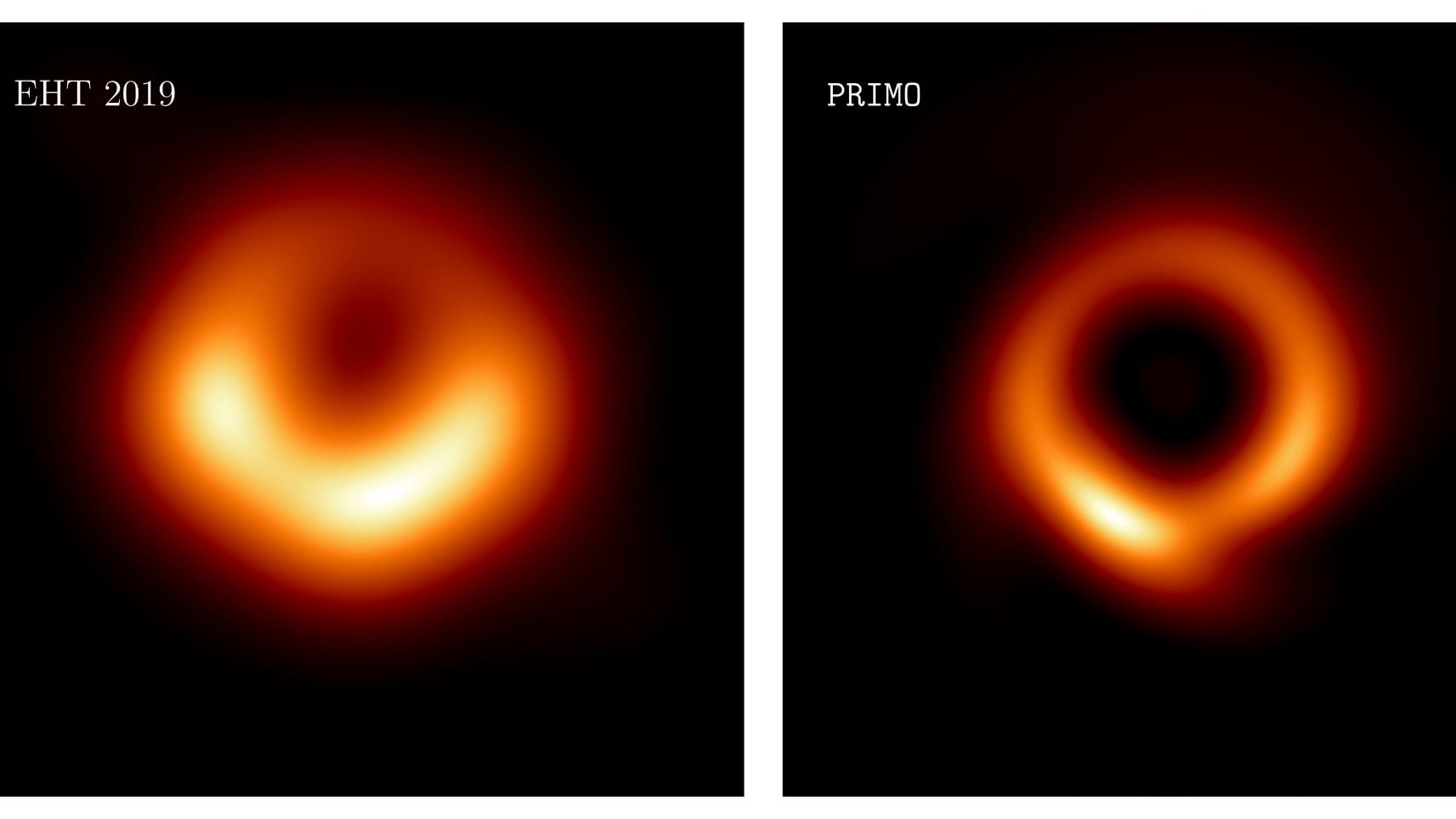
This combination of images provided by researcher Lia Medeiros shows images of the M87 black hole released in 2019, left, and an updated one for 2023. The new version, published Thursday, April 13, 2023, in the Astrophysical Journal Letters — keeps the original shape, but with a skinnier ring and a sharper resolution. Even with many telescopes working together, gaps remained in the data. In the latest study, scientists relied on the same data and used machine learning to fill in the missing pieces. (Lia Medeiros via AP)
By Maddie Burakoff
The first image of a black hole captured four years ago revealed a fuzzy, fiery doughnut-shaped object. Now, researchers have used artificial intelligence to give that cosmic beauty shot a touch-up.
The updated picture, published Thursday in the Astrophysical Journal Letters, keeps the original shape, but with a skinnier ring and a sharper resolution.
The image released in 2019 gave a peek at the enormous black hole at the center of the M87 galaxy, 53 million light-years from Earth. A light-year is 5.8 trillion miles. It was made using data gathered by a network of radio telescopes around the world, showing swirling light and gas.
But even with many telescopes working together, gaps remained in the data. In the latest study, scientists relied on the same data and used machine learning to fill in the missing pieces.
The resulting picture looks similar to the original, but with a thinner “doughnut” and a darker center, researchers said.
“For me, it feels like we’re really seeing it for the first time,” said lead author Lia Medeiros, an astrophysicist at the Institute for Advanced Study in New Jersey.
By having a clearer picture, researchers hope to learn more about the black hole’s properties and gravity in future studies. And Medeiros said the team plans to use machine learning on other images of celestial objects, including possibly the black hole at the center of our Milky Way galaxy.
___
The Associated Press Health and Science Department receives support from the Howard Hughes Medical Institute’s Science and Educational Media Group. The AP is solely responsible for all content.
As Russia intensifies its war on Ukraine, President Biden announced a ban on oil imported from the aggressor nation. Critics of Russia have said this would be the best way to force Putin to pull back, but curbs on Russian oil exports are expected to send already skyrocketing oil and gas prices even higher, further impacting consumers, businesses, financial markets, and the global economy. Leslie Beyer, CEO of the Energy Workforce and Technology Council, joined Cheddar News' Closing Bell to discuss. "It's certainly going to increase pricing, but it is the right thing to do," she said. "The industry itself has already pulled out of the significant portion of its operations in Russia."
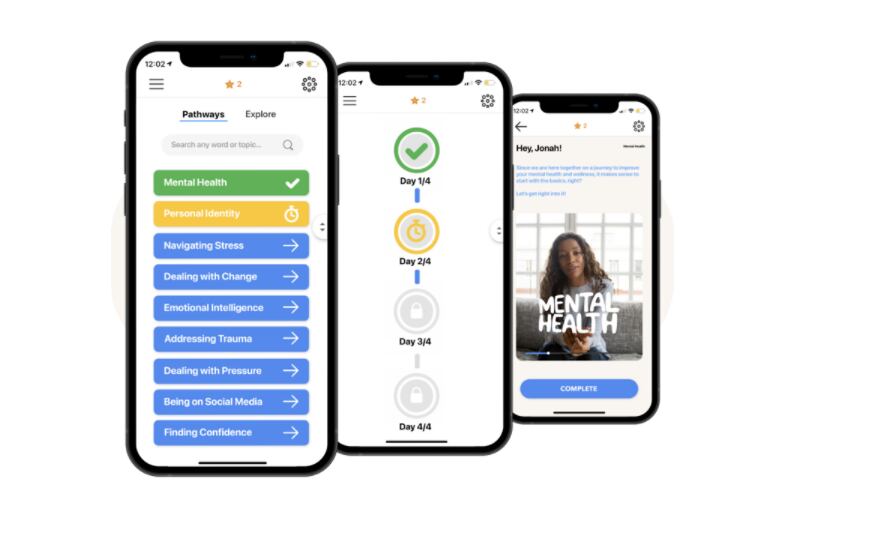
Two friends have joined forces to come up with an app dedicated to making mental health more approachable and to provide users with the tools needed to improve their mental health and overall well-being. Co-Founders of the Dial App Jonah Salita and Marcel Johnson, joined Cheddar to discuss more.
On this International Women’s Day, Deb Cupp, president of Microsoft U.S., joined Cheddar News to talk about the implementation of her pillars to extend the company's culture, such as acting with care and putting the team first. "What I like about the pillars is they're very simple, so it's easy for us to think about how they show up every day in our lives," Cupp said.
The growth of the metaverse is bringing new challenges to managing safe, diverse communities. Helping Cheddar kick off Women's History Month, Tiffany Xingyu Wang, chief marketing officer for AI-powered content moderation company Spectrum Labs, joined Cheddar's Opening Bell to discuss how platforms can help create safer, more inclusive online communities in the metaverse and about her own experience as a woman in technology. "Trust is really the new digital transformation, and it should not be a siloed task solely belonging to chief security officers, to privacy officers, or the people who were given the task of trust and safety," she said. "It should be a priority for all the C suite and a whole company to rally around."