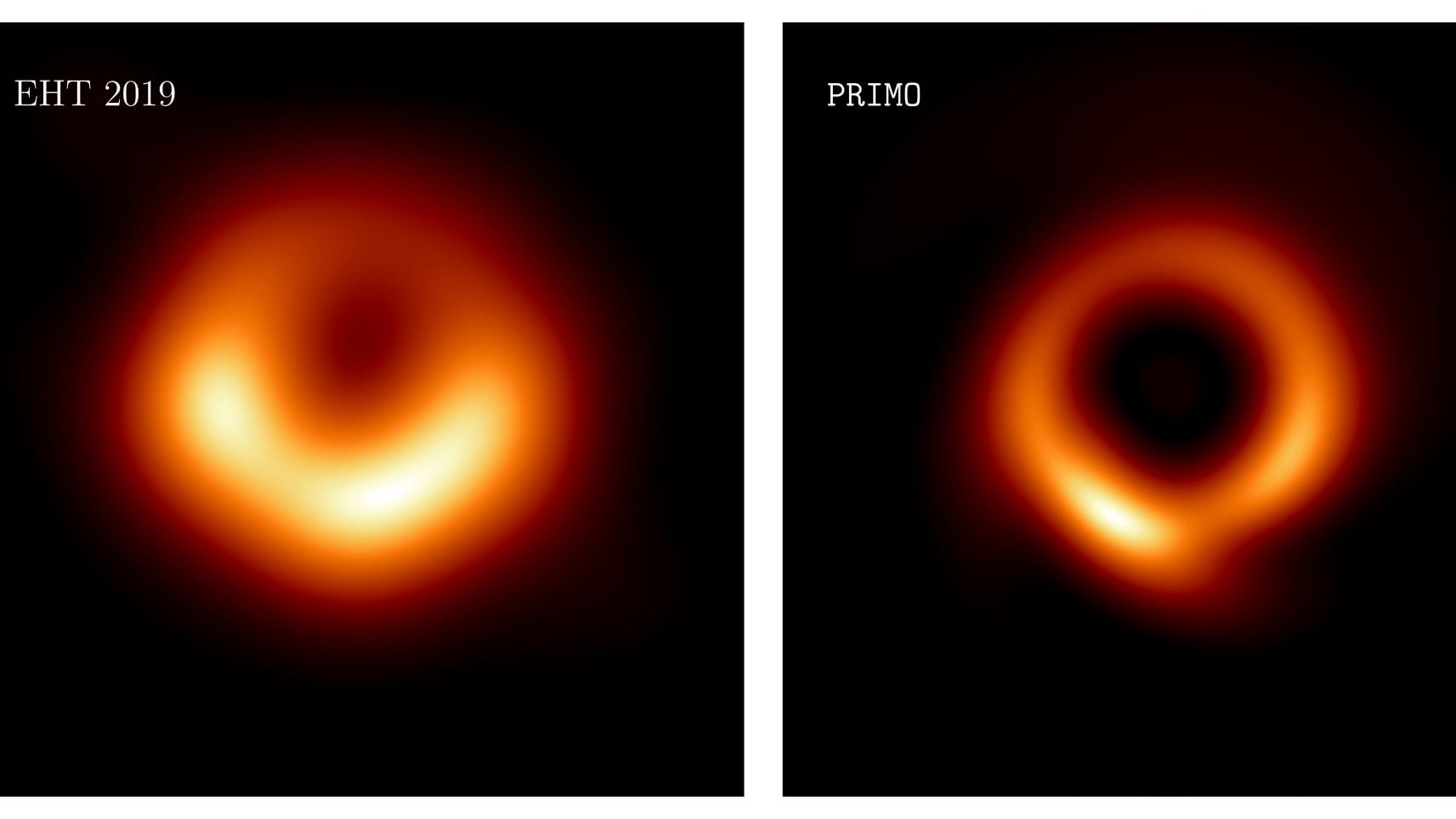
This combination of images provided by researcher Lia Medeiros shows images of the M87 black hole released in 2019, left, and an updated one for 2023. The new version, published Thursday, April 13, 2023, in the Astrophysical Journal Letters — keeps the original shape, but with a skinnier ring and a sharper resolution. Even with many telescopes working together, gaps remained in the data. In the latest study, scientists relied on the same data and used machine learning to fill in the missing pieces. (Lia Medeiros via AP)
By Maddie Burakoff
The first image of a black hole captured four years ago revealed a fuzzy, fiery doughnut-shaped object. Now, researchers have used artificial intelligence to give that cosmic beauty shot a touch-up.
The updated picture, published Thursday in the Astrophysical Journal Letters, keeps the original shape, but with a skinnier ring and a sharper resolution.
The image released in 2019 gave a peek at the enormous black hole at the center of the M87 galaxy, 53 million light-years from Earth. A light-year is 5.8 trillion miles. It was made using data gathered by a network of radio telescopes around the world, showing swirling light and gas.
But even with many telescopes working together, gaps remained in the data. In the latest study, scientists relied on the same data and used machine learning to fill in the missing pieces.
The resulting picture looks similar to the original, but with a thinner “doughnut” and a darker center, researchers said.
“For me, it feels like we’re really seeing it for the first time,” said lead author Lia Medeiros, an astrophysicist at the Institute for Advanced Study in New Jersey.
By having a clearer picture, researchers hope to learn more about the black hole’s properties and gravity in future studies. And Medeiros said the team plans to use machine learning on other images of celestial objects, including possibly the black hole at the center of our Milky Way galaxy.
___
The Associated Press Health and Science Department receives support from the Howard Hughes Medical Institute’s Science and Educational Media Group. The AP is solely responsible for all content.
Tech apprenticeship platform Multiverse became a unicorn with a $1.7 billion valuation, after raising $220 million in a Series D round. As companies across the country face challenges in hiring and retaining tech talent, Multiverse says it's trying to offer a solution with a new way to train and hire workers that can serve as an alternative to college and corporate training. Sophie Ruddock, VP and GM North America of Multiverse, joins Cheddar News' Closing Bell to discuss.
Bitcoin's price has fallen below $24,000, its lowest level since December 2020. Matt Hougan, CIO at Bitwise Asset Management, joined Cheddar News to discuss the future of crypto amid the latest high-profile point of concern, the halting of withdrawals at Celsius Network. "Last month we saw Luna collapse. This month we're seeing Celsius possibly collapsing," he said. "So this stress test is finding weaknesses in the crypto ecosystem and it will continue until we get to a strong foundation from which crypto can recover."
An analyst at JP Morgan is predicting massive future growth for Apple in its music and gaming divisions — to the tune of more than $8 billion in revenue by 2025. Cheddar News anchors Kristen Scholer and Hena Doba discuss the glowing forecast for the tech giant.
U.S. stocks closed Thursday at their lowest levels of the trading day, as investors continue to eye inflation ahead of the May CPI report out Friday. Art Hogan, Chief Market Strategist for National Holdings, joins Cheddar News' Closing Bell to discuss.
U.S. markets opened sharply lower on Friday on hotter-than-expected inflation data. The May CPI showed an 8.6% jump in consumer prices year-over-year, higher the expected 8.3%. Mark Howard, Senior Multi-Asset Specialist at BNP Paribas joined Cheddar's Opening Bell to discuss.