By Garance Burke
President Donald Trump’s 2020 reelection campaign was powered by a cell phone app that allowed staff to monitor the movements of his millions of supporters, and offered intimate access to their social networks.
While the campaign may be winding down, the data strategy is very much alive, and the digital details the app collected can be put to multiple other uses — to fundraise for the president’s future political ventures, stoke Trump’s base, or even build an audience for a new media empire.
The app lets Trump’s team communicate directly with the 2.8 million people who downloaded it — more than any other app in a U.S. presidential campaign — and if they gave permission, with their entire contact list as well.
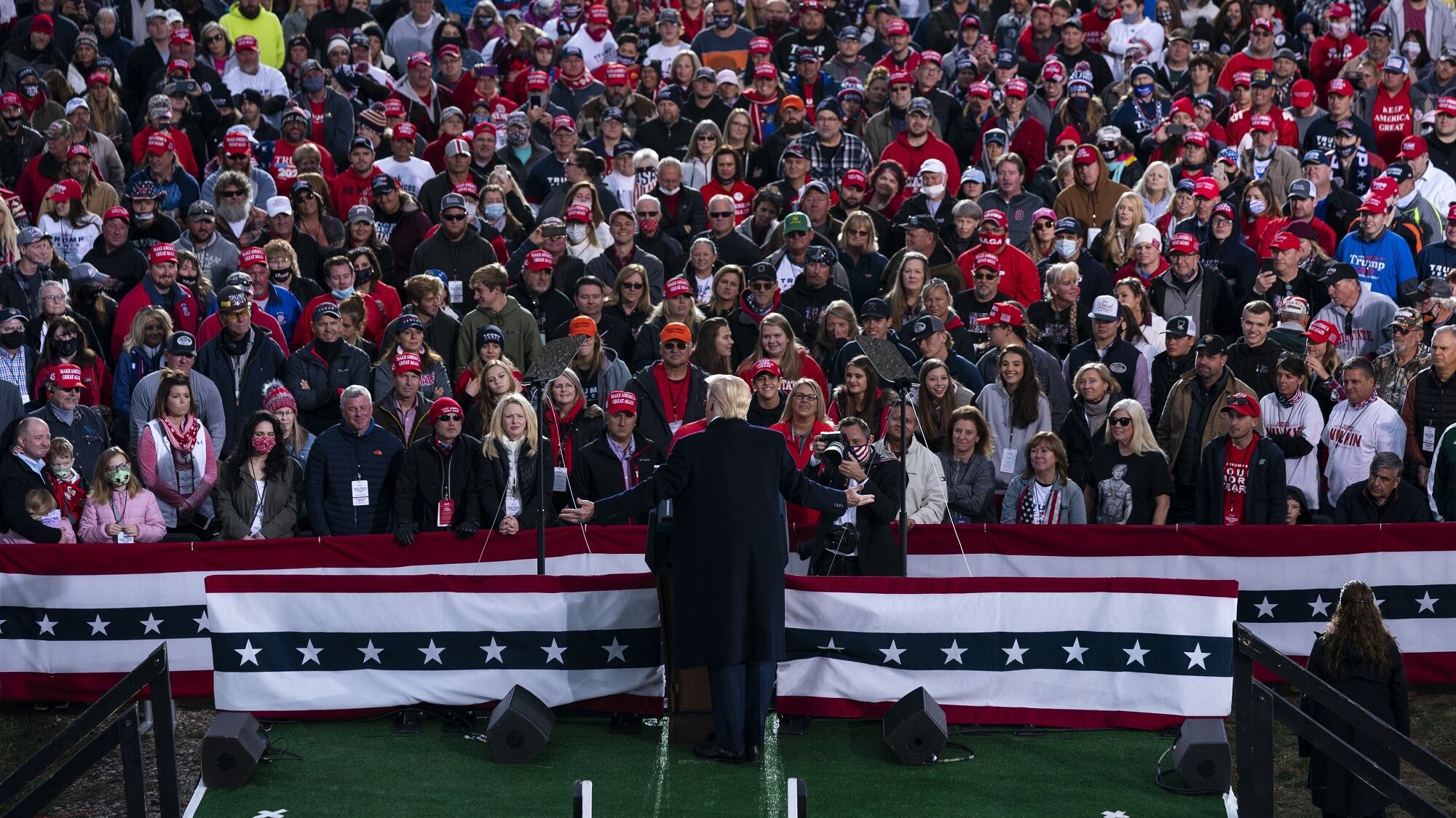
Once installed, it can track their behavior on the app and in the physical world, push out headlines, sync with mass texting operations, sell MAGA merchandise, fundraise and log attendance at the president’s rallies, according to the app’s privacy policy and user interface.
Yet the enterprise software company that built a tool to propel Trump’s mass movement is in financial distress and has been sustained at key points by the administration and the president’s campaign, according to interviews with former employees, financial filings and court documents.
Austin-based Phunware Inc., whose stock is trading for pennies, recently agreed to pay Uber $4.5 million as part of a settlement over claims of fraudulent advertising and earlier this year risked being delisted from the Nasdaq. In April, the company got a $2.9 million loan under the Coronavirus Aid, Relief and Economic Security Act as it was building the Trump campaign app.
Campaign watchdogs and former employees alike marvel at how a struggling startup known more for building apps for hospitals and a Manhattan-based astrologer became a juggernaut in Trump’s reelection bid, facilitating an ongoing data and fundraising effort that threw the company a financial lifeline.
Even after major media outlets called the election for his Democratic opponent Joe Biden, the app kept pushing out content supporting Trump’s bid.
“We all know why Joe Biden is rushing to falsely pose as the winner, and why his media allies are trying so hard to help him: they don’t want the truth to be exposed,” read a statement attributed to Trump posted earlier this month. “I will not rest until the American People have the honest vote count they deserve.”
On Monday, the app pushed out fresh content defending the campaign’s vote-counting litigation in Pennsylvania. Last week, the app posted a fundraising appeal asking for donations to Trump’s newly formed Election Defense Fund, which will send most of the money raised to a new political action committee Trump formed called Save America. That PAC has few spending restrictions and could pay for lavish personal expenses or give money to other candidates.
Enriched User Data
While activity on the app has slowed recently, the enriched data it gathered on the president’s supporters — which can include everything from their contacts to their IP address to their location data — can serve many purposes going forward, said Adav Noti, a former Federal Election Commission attorney who works for the nonpartisan Campaign Legal Center.
Congress and the FEC have not set rules governing how campaigns can use people’s personal data and or limits on the number of entities to whom the campaign can sell its list, he added.
“I’m assuming that what he is going to do is transfer the assets of the campaign,” Noti said. “You can definitely buy the data and the campaign can sell it to you, the trickier question is how much do you have to pay for it.”
Phunware declined to respond to questions about the app, the company’s financial status, its internal culture and its relationship to the campaign.
“Phunware has absolutely no role in the constitutional processes tied to US elections at any level ... and also has no role in the content created or used by our customers specific to our mobile software or enterprise cloud platform for mobile,” CEO Alan Knitowski said in an email.
A senior Trump campaign official declined to answer questions about possible future uses for the rich supporter data the campaign collected via digital platforms, including the Phunware app.
“The data is owned by the campaign and limited whatever hit their servers,” said the official who spoke on condition of anonymity to discuss campaign specifics.
Introducing Phunware to the Trump Campaign
As Phunware has hit challenging financial times in recent years, it has shed employees, clients and investors, 10 of whom agreed to speak with The Associated Press, some on condition of anonymity because they signed non-disclosure agreements or feared retaliation.
Phunware sued its client Uber in 2017, accusing the ride-sharing company of failing to pay its invoices, according to court records.
But after Uber filed suit against Phunware, alleging the software company committed fraud by among other things, allowing ads for the ride-sharing app to show up on porn sites, former employees said the startup looked for new ways to diversify its revenue stream.
Into the picture stepped Karl Rove, former advisor and Republican strategist for President George W. Bush.
Long before reaching the White House, Rove made his name in Texas politics as a specialist in direct mail, a form of political advertising he once said was effective because it was largely “immune from press coverage,” or near invisible to the public.
In an interview with the AP, Rove said a lobbyist who was friendly with his wife introduced him to Phunware executives, who told him the company had built apps for sports teams and Fortune 100 companies that integrated geofencing technology, which can track people’s movements through their cell phones.
Ex-Phunware employees and the lobbyist’s staff gave Rove a presentation, showing off how the company could use cell phone data to send out customized political ads that also were hard to trace.
“His mind was blown. He was like ‘this is extremely powerful data,’” a former employee recalled.
Rove said he brokered a relationship for Phunware with Trump’s 2016 campaign digital director Brad Parscale.
“I thought it had lots of implications for politics so in a subsequent conversation I mentioned it to Brad Parscale,” Rove. “He said ‘interesting’ and that was it, he never told me he had hired them.”
Knitowski said in an email that he built the relationship with the Trump campaign.
“Phunware met the Trump Campaign through me directly after a 1:1 introduction from a Silicon Valley CEO who requested our consideration and participation in an RFP that also had Salesforce as a finalist,” Knitowski said.
Stung by the Cambridge Analytica controversy -- the company was accused of using data improperly obtained from Facebook to predict voter behavior in the 2016 election -- and perceived bias from social media platforms, Parscale wanted to bypass Big Tech and reorient the reelection campaign to connect directly with supporters.
After Trump’s 2016 victory, Parscale worked with consultants and an ex-Cambridge Analytica data scientist to build out a data storehouse that could better microtarget audiences with specialized ads, former collaborators said.
Phunware, meanwhile, started marketing its tools to campaigns, saying it could reach likely voters through geofencing, by drawing virtual boundaries around areas of interest “such as event appearances, polling centers, sporting events – even an opponent’s campaign rally,” a blog post said.
Two former employees said Knitowski told engineers to embed invisible tracking software to follow users’ behavior inside each app they built to boost Phunware’s offerings to campaigns.
“We were told they needed to be in every app to collect information for whatever we did, and the political vertical was one of those reasons,” an ex-employee said. “It would still go in even if the customer said they didn’t want it.”
Knitowski declined to comment on the allegation. A former manager said he worked to keep the software out of apps whose clients didn’t want it.
Phunware's Financials
At monthly meetings, Knitowski would brief staff on the startup’s prospects for getting bought by another company or attracting angel investors, another former manager recalled.
The Republican National Committee, in turn, had hired a private company to build a centralized hub for voter data for right-leaning campaigns called Data Trust, and Parscale joined its board. All the while, his team kept amassing mobile phone numbers, and offering Trump supporters MAGA swag in exchange for their digits.
“This is how Donald Trump stays president for four more years,” Parscale said, holding up his iPhone on stage at a 2018 rally supporting Texas Sen. Ted Cruz’s reelection. “Now this phone is how we connect with you. It’s how we turn you into the army of Trump.”
By early 2019, after Phunware had gone public, former colleagues said Knitowski started talking about his efforts to court the Trump campaign. In April, 15 percent of the staff was laid off due to “organizational restructuring and cost reductions,” according to a Securities and Exchange Commission filing.
In July of that year, Knitowski rang the bell at the Nasdaq. But by then revenue was dropping and major clients were threatening to leave.
New York-based astrologer Susan Miller, whose glittery horoscope app had been one of Phunware’s most successful, said she would ask for features to be updated, and no one would call back.
“Have you ever talked to someone at a party who is always looking at the door and not at you because they want to talk to someone else more? It felt like that,” Miller said. “They just treated me like an old shoe.”
An investor said Knitowski stopped returning his calls, too.
“The guy seems very shady. He is all your best friend when he’s looking to raise money and once you have questions he is nowhere to be seen,” said Scott Walker, who said he lost more than $200,000 after Phunware’s stock tanked.
In August, there was something new to announce: work with American Made Media Consultants, “otherwise known as the ‘Trump-Pence 2020’ and ‘Keep America Great’ Campaign,” Knitowski said in an earnings call.
According to a document filed with Federal Communications Commission two months later, the company's directors included campaign operations director Sean Dollman and campaign counsel Alex Cannon.
Phunware would later reveal more details about its work on the Trump app, which would include location-based tools and other features to help the campaign crowdsource new users. Plus, there would be a gamified loyalty system, where supporters could accumulate points to spend on signed MAGA hats or pose for a picture with Trump.
By September 2019, 18 percent of the remaining staff was laid off after client Fox Networks Group left, taking a large percentage of Phunware’s sales with them, according to filings.
Managers asked engineers in Phunware’s Newport Beach office if they wanted to work on the Trump app, and some engineers who were opposed resigned, a former employee said.
Then in April, as coronavirus cases surged and stay-at-home orders shut down business, Phunware received a $2.9 million loan from the U.S. Small Business Administration’s Paycheck Protection Program, a relief fund that Congress created to help small businesses keep workers employed through the pandemic.
Phunware COO Randall Crowder denied political favoritism helped Phunware get the loan.
“We got no help from the Trump campaign — boy I wish we could have, what a great way to have friends in high places — but that didn’t have any implication on what we did,” Crowder said in a recorded interview.
Phunware declined to return the money after the administration demanded that public companies that received more than $2 million give it back.
The next month, Nasdaq notified the company it could be delisted over its finances. To stay listed, companies must meet a set of standards to reassure investors that since the initial public offering, they remain a credible company.
SEC records revealed that by July, American Made Media Consultants accounted for one-third of Phunware’s sales, paying Phunware more than $1.6 million in the first half of the year. The Campaign Legal Center filed an FEC complaint alleging that the Trump campaign and a major PAC supporting it had shielded their spending on Phunware and other subcontractors through American Made Media Consultants.
As the pandemic kept many supporters at home, Trump’s campaign used the app to acquire new users remotely, and Parscale touted how the app was retooled to support virtual events. According to online data provider Apptopia, nearly 860,000 people downloaded the Trump app in July, the same month Biden’s campaign abandoned its first app, Team Joe, and asked followers to download an entirely new app, Vote Joe (only 11,075 did).
By mid-November, 2.8 million people had downloaded the Trump app, which Apptopia CEO Eliran Sapir estimated could give the campaign hundreds of millions of phone numbers, enabling it to reach people whose numbers were stored in their friends’ contact lists but never consented to being contacted. A Carnegie Mellon University researcher, however, estimated the total would be closer to 27 million due to duplicate phone numbers.
By then, the app had already laid the groundwork for a coordinated final months, allowing campaign officials to model supporters’ behavior under quarantine and incentivize them to appear at rallies.
“Why is that app so valuable? Because people like sharing messages with their friends from the campaign and getting news and updates,” said Republican consultant Eric Wilson. “But it’s not just an extractive resource. It’s also generating contacts and mindshare on behalf of the campaign.”
Phunware’s financial troubles hadn’t abated, however.
In a Thursday SEC filing, Phunware suddenly stopped disclosing its top customers by name. But by matching the accounting figures to past filings, AP derived that American Made Media Consultants is Phunware’s single biggest customer, and paid Phunware $2.4 million over the first 9 months of this year, accounting for nearly one-third of Phunware’s revenue. Two former employees concurred. The app developer also disclosed sizable debt and expressed “substantial doubt about its ability to continue as a going concern.”
On an earnings call with analysts last week, the company never mentioned its work for the Trump campaign, instead focusing on its future growth potential. Despite the company's uncertainties, some analysts say it has a positive long-term outlook due to the growth in mobile usage.
Last month, its stock rose slightly after the company announced it had finished two contracts for Honeywell. Honeywell fired back on Twitter, saying it had asked Phunware to retract its release, and that the industrial conglomerate “does not have an ongoing relationship with Phunware and does not plan to work with Phunware in the future.”
A second company, Hewlett Packard Enterprise, told AP Phunware had publicized a partnership between the companies where none existed. Knitowski declined to comment on either instance.
“We never had a relationship with Phunware, we don’t have any formalized partnership with them,” said spokesman Adam Bauer. “We didn’t authorize them to issue that press release and we asked them to take it down.”
Associated Press writer Bernard Condon in New York contributed to this story.