By Hope Yen and Lisa Mascaro
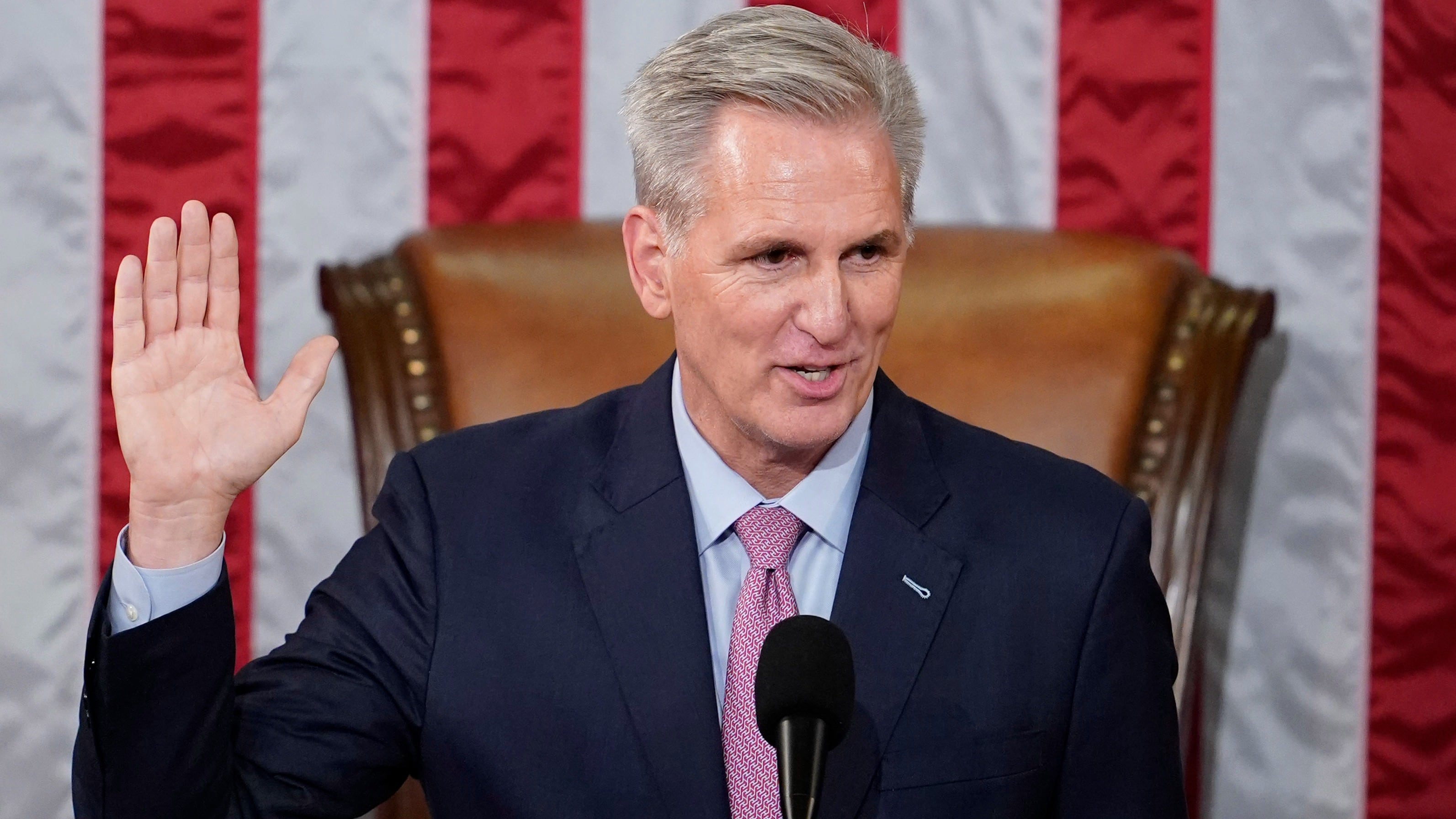
After an epic 15-ballot election to become House speaker, Republican Kevin McCarthy faces his next big test in governing a fractious, slim majority: passing a rules package to govern the House.
The drafting and approval of a set of rules is normally a fairly routine legislative affair, but in these times, it's the next showdown for the embattled McCarthy.
To become speaker and win over skeptics, McCarthy had to make concessions to a small group of hard-liners who refused to support his ascension until he yielded to their demands.
Now those promises — or at least some of them — are being put into writing to be voted on when lawmakers return this week for their first votes as the majority party.
On Sunday, at least two moderate Republicans expressed their reservations about supporting the rules package, citing what they described as secret deals and the disproportionate power potentially being handed out to a group of 20 conservatives.
The concessions included limits on McCarthy's power, such as by allowing a single lawmaker to initiate a vote to remove him as speaker and curtailing government spending, which could include defense cuts. They also give the conservative Freedom Caucus more seats on the committee that decides which legislation reaches the House floor.
They also raise questions about whether McCarthy can garner enough support from Republicans, who hold a 222-212 edge, on a critical vote in the coming months to raise the debt limit, given conservatives' demand that there also be significant spending cuts, over opposition from the White House and a Democratic-controlled Senate.
Rep. Nancy Mace, R-S.C., a strong McCarthy supporter, said she currently is “on the fence” about the proposed rules.
“I like the rules package,” Mace said, in reference to what has been released publicly. “What I don’t support is a small number of people trying to get a deal done or deals done for themselves in private, in secret.”
She said it will be hard to get anything done in the House if a small band is given a stronger hand compared with the larger number of moderates. “I am concerned that commonsense legislation will not get through to get a vote on the floor," she said.
Rep. Tony Gonzales, R-Texas, was an outright “no” against the rules package, decrying an “insurgency caucus” that he said would cut defense spending and push extremist legislation, such as on immigration.
Democrats are expected to be united against the package.
Rep. Jim Jordan, R-Ohio, a member of the Freedom Caucus who is expected to lead the House Judiciary Committee, defended the concessions McCarthy made and said he believes the rules package will get enough Republican support to pass. He insisted that the agreements will help ensure broader representation on committees and will curtail unfettered government spending.
“We'll see tomorrow,” he said Sunday, but “I think we’ll get the 218 votes needed to pass the rules package."
In the coming months, Congress will have to work to raise the debt limit before the government reaches its borrowing cap or face a devastating default on payments, including those for Social Security, military troops and federal benefits such as food assistance. Lawmakers will also have to fund federal agencies and programs for the next budget year, which begins Oct. 1.
“Our general concern is that the dysfunction — that was historic — that we saw this week is not at an end, it’s just the beginning,” said House Democratic leader Hakeem Jeffries of New York.
The White House has rejected Republican calls to slash spending in return for an increase in the federal government’s borrowing authority. White House press secretary Karine Jean-Pierre went so far on Sunday as to call House Republicans’ likely demands “hostage taking” that would risk default, an event that could trigger an economic crisis.
“Congress is going to need to raise the debt limit without — without — conditions and it’s just that simple,” Jean-Pierre told reporters aboard Air Force One as President Joe Biden flew to Texas. “Attempts to exploit the debt ceiling as leverage will not work. There will be no hostage taking.”
Yet the White House also said it had no plans to sidestep the needed congressional approval through possible budget gimmicks such as the minting of a coin to help cover a deficit that could be roughly $1 trillion this fiscal year.
“We’re not considering any measures that would go around Congress,” Jean-Pierre said. “That’s not what we’re doing. This is a fundamental congressional responsibility, and Congress must act.”
Jordan argued that “everything has to be on the table” when it comes to spending cuts, including in defense, in light of the government's $32 trillion debt. “Frankly we better look at the money we send to Ukraine as well and say, how can we best spend the money to protect America?” he said.
Rep. Chip Roy, R-Texas, one of the 20 who initially voted against McCarthy before throwing his support behind the Californian, said he and other conservatives will be holding their position that there should be spending cuts in a debt ceiling bill. Asked whether he would exercise members' new authority and unilaterally initiate a vote to remove the speaker if McCarthy doesn't ultimately agree, Roy offered a warning.
“I’m not going to play the ‘what if’ games on how we’re going to use the tools of the House to make sure that we enforce the terms of the agreement, but we will use the tools of the House to enforce the terms of the agreement,” Roy said.
Mace and Gonzales appeared on CBS' “Face the Nation,” Jordan spoke on “Fox News Sunday,” Jeffries was on NBC's “Meet the Press,” and Roy was on CNN's “State of the Union.”
Associated Press writer Josh Boak contributed to this report.