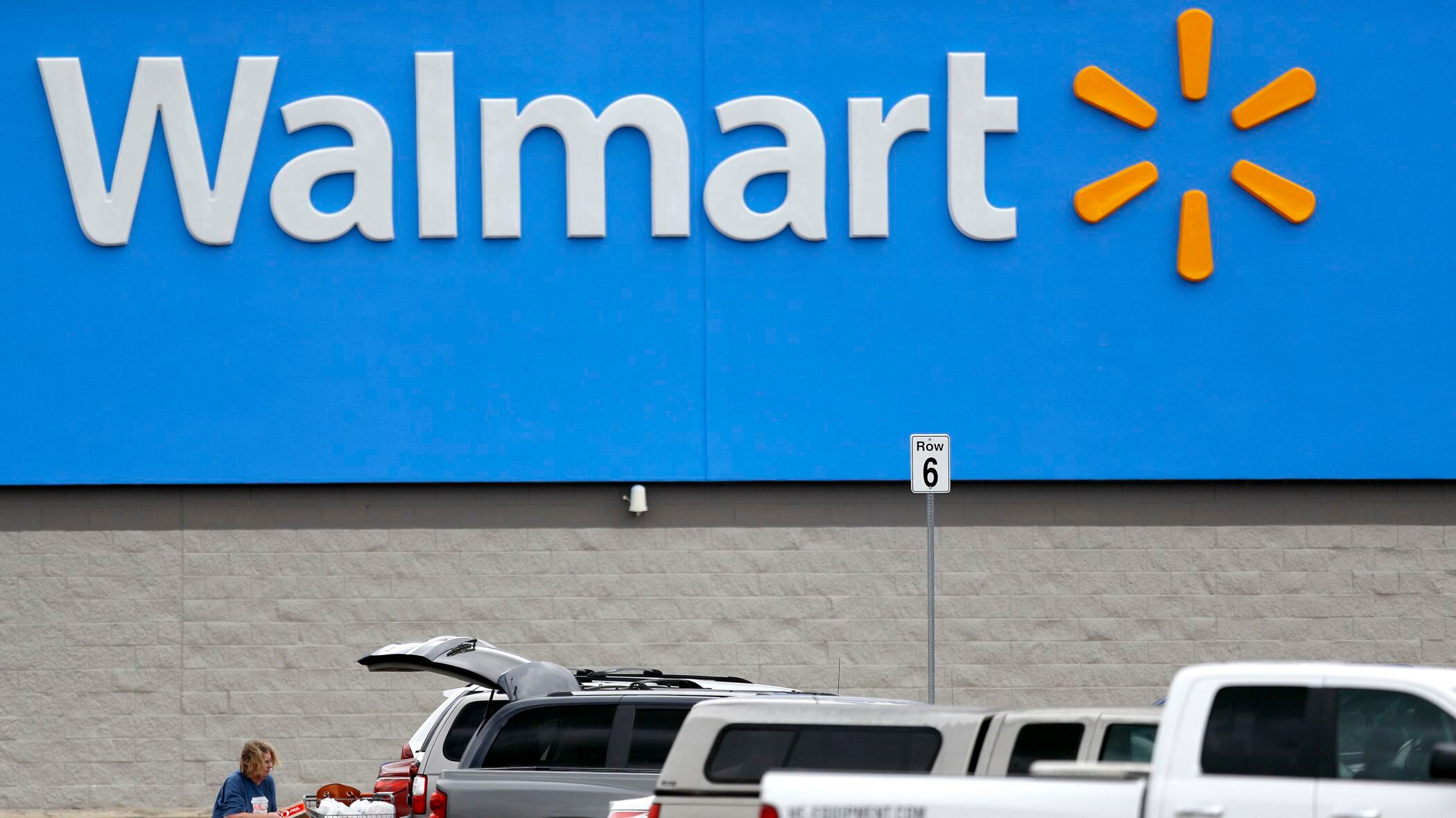
In this March 31, 2020 file photo, a woman pulls groceries from a cart to her vehicle outside of a Walmart store in Pearl, Miss. Walmart is teaming with the General Motors' Cruise autonomous vehicle unit to test automated package delivery in Arizona. (AP Photo/Julio Cortez, File)
By Michael Balsamo and Ann D'Innocenzio
The Justice Department is suing Walmart, alleging the company unlawfully dispensed controlled substances through its pharmacies, helping to fuel the opioid crisis in America.
The civil complaint being filed Tuesday points to the role Walmart’s pharmacies may have played in the crisis by filling opioid prescriptions and by unlawfully distributing controlled substances to the pharmacies during the height of the opioid crisis. Walmart operates more than 5,000 pharmacies in its stores around the country.
The Justice Department alleges Walmart violated federal law by selling thousands of prescriptions for controlled substances that its pharmacists “knew were invalid,” said Jeffrey Clark, the acting assistant attorney general in charge of the Justice Department’s civil division.
Federal law required Walmart to spot suspicious orders for controlled substances and report those to the Drug Enforcement Administration, but prosecutors charge the company didn’t do that. Walmart couldn’t immediately be reached for comment.
“Walmart knew that its distribution centers were using an inadequate system for detecting and reporting suspicious orders,” said Jason Dunn, the U.S. attorney in Colorado. “As a result of this inadequate system, for years Walmart reported virtually no suspicious orders at all. In other words, Walmart’s pharmacies ordered opioids in a way that went essentially unmonitored and unregulated.”
The suit alleges that Walmart made it difficult for its pharmacists to follow the rules, putting “enormous pressure" on them to fill a high volume of prescriptions as fast as possible, while at the same time denying them the authority to categorically refuse to fill prescriptions issued by prescribers the pharmacists knew were continually issuing invalid prescriptions.
AP reported the news of the lawsuit ahead of the Justice Department's public announcement, citing a person who could not discuss the matter publicly before the announced move. The person spoke to the AP on condition of anonymity.
The Justice Department’s lawsuit comes nearly two months after Walmart filed its own preemptive suit against the Justice Department, Attorney General William Barr, and the Drug Enforcement Administration.
In its lawsuit, Walmart said the Justice Department’s investigation — launched in 2016 — had identified hundreds of doctors who wrote problematic prescriptions that Walmart’s pharmacists should not have filled. But the lawsuit charged that nearly 70% of the doctors still have active registrations with the DEA.
Walmart’s lawsuit alleged the government was blaming it for the lack of regulatory and enforcement policies to stem the crisis. The company is asking a federal judge to declare the suit has no basis to seek civil damages. That suit remains ongoing.
The initial investigation was the subject of a ProPublica story published in March. ProPublica reported that Joe Brown, then U.S. attorney for the Eastern District of Texas office, spent years pursuing a criminal case against Walmart for its opioid prescription practices, only to have it stymied after the retail giant’s lawyers appealed to senior officials in the Justice Department.
Two months later, Brown resigned. He didn’t give a reason for his departure except to say he would be “pursuing opportunities in the private and public sectors." Brown went into private practice in the Dallas area.
Updated on December 22, 2020, at 3:44 p.m. ET with additional details.
Cloud data management company Informatica made its market debut on the New York Stock Exchange today under the ticker symbol INFA. Shares ending the day even after opening at $27.55. with shares priced at $29 apiece.
This is the second time the company has gone public after being founded back in 1993. Informatica then went private in a $5 billion deal in 2015. Now, the company is reentering public markets as a subscription business with a push to the cloud. Cheddar News welcomes CEO of Informatica, Amit Walia, to discuss.
If you plan on hosting family and friends this holiday season, you may want to start stocking up on gifts right now. That's because major retailers don't anticipate the national supply chain crisis to end anytime soon. President Biden even says he's considering deploying the National Guard to ease the supply chain crisis. Melissa Gonzalez, CEO and founder of The Lionesque Group, joins Cheddar News to breakdown what consumers should expect.
It's no doubt that the pandemic has been tough on the job market. According to the Labor Department, a record four million people quit their jobs in April. Now, a new survey from Oracle is touching on mental health and how employees are demanding more from their work lives. Juergen Lindner, SVP of global software for SaaS at Oracle, joins Cheddar Wellness to talk about the findings.
The new 2023 C8 Corvette Z06 is finally here. GM's Chevrolet is holding a livestream feature film to debut the car. A panel discussion will also take place to break down everything you need to know about the vehicle. Tadge Juechter, Corvette's executive chief engineer, joins Cheddar News to talk about the new model.
Anushka Salinas, president and COO of Rent the Runway, joined Cheddar's "Closing Bell" to talk about bringing the fashion rental company to the public market after debuting on Nasdaq. Salinas also talks about the future outlook for the company after the pandemic shifted the everyday lives of working women. "As of the end of September, we're at 97 percent of our ending 2019 subscriber count, which, I think, highlights that despite the pandemic, despite delta variant still kind of lingering around, limited marketing of our business, and women not fully being back in the office, we've already brought Rent the Runway back to pre-pandemic levels," she said.
The Roots' Questlove joined Cheddar's 'Between Bells' to talk about partnering with The Balvenie Scotch whisky on a new web series called 'Quest for Craft,' where he interviews big-name guests about their creative processes. He noted that he hopes the series can act as a guide for recent college grads who might be confused about their personal path to take toward success.
GM CFO Paul Jacobson joined Cheddar to talk about the automaker's Q3 earnings beat. Despite COVID concerns at some of its plants overseas as well as the ongoing global chip shortage, Jacobson said he expects the average sale price of GM's vehicles — around $50,000 — to remain the same going into 2022, even as inventory remains low. He also talked about plans to open more battery plants in coordination with the efforts to transform GM's fleet fully into electric vehicles.
Kevin Cohee, chairman and CEO of OneUnited Bank, joined Cheddar's "Opening Bell" to talk about the launch of its Greenwood debit card keeping alive the legacy of Tulsa, Oklahoma's historic Black Wall Street. Cohee also discussed the importance of shopping with Black businesses and investing in Black-led and owned financial institutions. "Our leaders have understood, since the end of slavery, the importance of us being organized in order to be effective in a capitalist society," he said.
Alex Wilhelm, a senior editor at TechCrunch, joined Cheddar to talk about the ups and downs of fashion rental company Rent the Runway as it went public on the Nasdaq. "In the case of Rent the Runway, the economics of its core business are a little bit suspect, I think, and the company's high debt load puts a pretty serious drag on its operations," he said. "And so when you consider it's going to spend a lot of its IPO paying down debt, you wonder what's going to be left over to fund future growth."