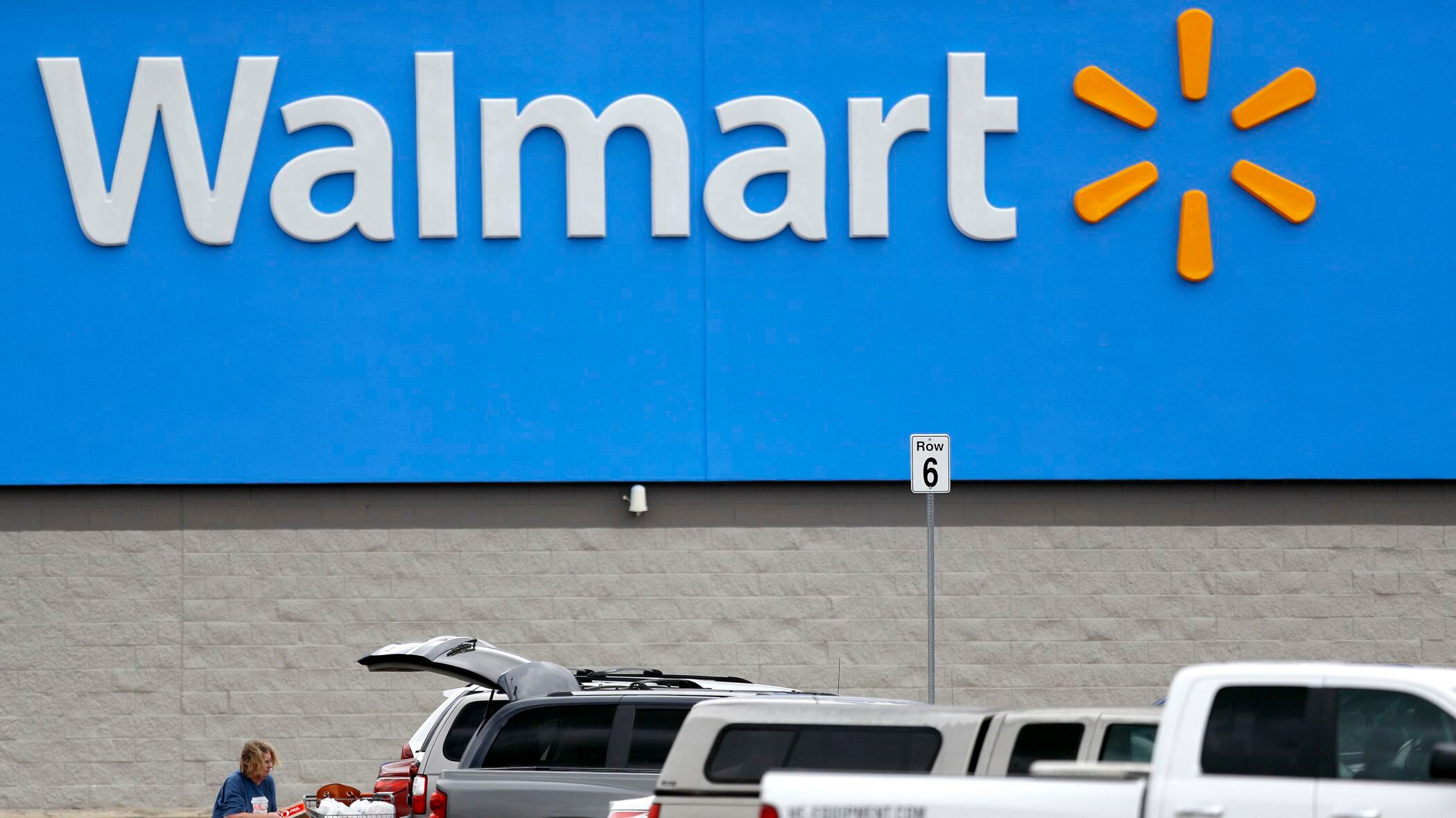
In this March 31, 2020 file photo, a woman pulls groceries from a cart to her vehicle outside of a Walmart store in Pearl, Miss. Walmart is teaming with the General Motors' Cruise autonomous vehicle unit to test automated package delivery in Arizona. (AP Photo/Julio Cortez, File)
By Michael Balsamo and Ann D'Innocenzio
The Justice Department is suing Walmart, alleging the company unlawfully dispensed controlled substances through its pharmacies, helping to fuel the opioid crisis in America.
The civil complaint being filed Tuesday points to the role Walmart’s pharmacies may have played in the crisis by filling opioid prescriptions and by unlawfully distributing controlled substances to the pharmacies during the height of the opioid crisis. Walmart operates more than 5,000 pharmacies in its stores around the country.
The Justice Department alleges Walmart violated federal law by selling thousands of prescriptions for controlled substances that its pharmacists “knew were invalid,” said Jeffrey Clark, the acting assistant attorney general in charge of the Justice Department’s civil division.
Federal law required Walmart to spot suspicious orders for controlled substances and report those to the Drug Enforcement Administration, but prosecutors charge the company didn’t do that. Walmart couldn’t immediately be reached for comment.
“Walmart knew that its distribution centers were using an inadequate system for detecting and reporting suspicious orders,” said Jason Dunn, the U.S. attorney in Colorado. “As a result of this inadequate system, for years Walmart reported virtually no suspicious orders at all. In other words, Walmart’s pharmacies ordered opioids in a way that went essentially unmonitored and unregulated.”
The suit alleges that Walmart made it difficult for its pharmacists to follow the rules, putting “enormous pressure" on them to fill a high volume of prescriptions as fast as possible, while at the same time denying them the authority to categorically refuse to fill prescriptions issued by prescribers the pharmacists knew were continually issuing invalid prescriptions.
AP reported the news of the lawsuit ahead of the Justice Department's public announcement, citing a person who could not discuss the matter publicly before the announced move. The person spoke to the AP on condition of anonymity.
The Justice Department’s lawsuit comes nearly two months after Walmart filed its own preemptive suit against the Justice Department, Attorney General William Barr, and the Drug Enforcement Administration.
In its lawsuit, Walmart said the Justice Department’s investigation — launched in 2016 — had identified hundreds of doctors who wrote problematic prescriptions that Walmart’s pharmacists should not have filled. But the lawsuit charged that nearly 70% of the doctors still have active registrations with the DEA.
Walmart’s lawsuit alleged the government was blaming it for the lack of regulatory and enforcement policies to stem the crisis. The company is asking a federal judge to declare the suit has no basis to seek civil damages. That suit remains ongoing.
The initial investigation was the subject of a ProPublica story published in March. ProPublica reported that Joe Brown, then U.S. attorney for the Eastern District of Texas office, spent years pursuing a criminal case against Walmart for its opioid prescription practices, only to have it stymied after the retail giant’s lawyers appealed to senior officials in the Justice Department.
Two months later, Brown resigned. He didn’t give a reason for his departure except to say he would be “pursuing opportunities in the private and public sectors." Brown went into private practice in the Dallas area.
Updated on December 22, 2020, at 3:44 p.m. ET with additional details.
Stocks fell into the red on Wednesday after new data heightened fears over inflation. Vince Lorusso, Co-Founder and portfolio manager at Changebridge Capital, joins Cheddar News' Closing Bell where he says recent history suggests investors to buy the dips.
Food delivery giant DoorDash is acquiring European food delivery company Wolt. The all-stock deal is valued at $8.1 billion and is expected to close in the first half of 2022. The companies say they share a mission to build a global delivery platform. Gerber Kawasaki investment advisor Eva Agi joins Cheddar News' Closing Bell to discuss what the deal means for Doordash, as well as its customers and investors.
Identity verification startup Socure recently raised $450 million dollars in a series E round, bringing the company's valuation to $4.5 billion. Socure says it is now the highest-valued private company in the identity verification space, and that the funds will be used to accelerate its mission to verify 100% of good identities and eliminate identity fraud across all industries. Socure Founder and CEO Johnny Ayers joins Cheddar News' Closing Bell to discuss.
On Tuesday, an Oklahoma court overturned a ruling in a case against Johnson & Johnson for liability in the opioid crisis, and on Wednesday a North Carolina judge put a pause on the thousands of lawsuits accusing the company's baby powder product of containing cancer-causing asbestos. Elizabeth Burch, a professor at the University of Georgia school of law, joined Cheddar to break down the legal results that the pharmaceutical giant had long been hoping to get.
3D printing company Velo3D released its first earnings report since going public in September. CEO and co-founder Benny Buller joined Cheddar to discuss the company's bottom line miss while noting he expects revenue for the year will hit $26 million. Buller also expressed optimism about the company achieving $89 million in revenue in 2022.
Wheels Up CEO Kenny Dichter talked to Cheddar about the aviation company's Q3 earnings report, the increase in memberships, and rising fuel costs. He attributed some of the increase in the number of members and rising revenue to lingering concerns about commercial flying amid the pandemic and noted that legacy members have used the service more frequently than in previous years. Dichter also explained that a rise in pricing is planned for December.
With more companies offering employees flexibility in work schedules, Airbnb is looking to accommodate flexible travel plans. Chief Strategy Officer Nathan Blecharczyk joined Cheddar to discuss the growing trend of people staying in Airbnbs for longer periods of time. "In December over the holidays, in North America, we are seeing a 68 percent increase in the demand for month-long stays relative to years past," he said.
Asad Hussain, lead mobility analyst at data company PitchBook, joined Cheddar to discuss the blockbuster Rivian IPO. The electric truck maker's valuation jumped to more than $90 billion, signaling progress in the "multi-decade transformation in mobility," according to Hussain. He noted that electric automakers like Rivian, Tesla, and Lucid, will continue to lead electrification in being free to innovate and lacking the legacy issues facing traditional, combustion engine carmakers.
Coinbase reported third quarter earnings yesterday and revenue did not at all meet estimates, with the company saying that it also saw a staggering decrease of about 1.4 million customers in comparison to the previous quarter. This comes in the same week where bitcoin and ethereum, two of its most important digital assets hit record highs. Martin Gaspar, research analyst at CrossTower explains how a soft crypto trading quarter contributed to the less-than-ideal revenue outcome.