By Michael R. Sisak
Donald Trump’s civil fraud trial will roll ahead next week after the former president lost a bid Friday to halt the proceedings while he fights a pretrial ruling that could strip him of Trump Tower and other marquee properties.
An appeals court judge rebuffed Trump’s push to pause the New York trial, but agreed to leave him in control of his holdings for now. The decision, after an emergency hearing Friday afternoon, came five days into the closely watched trial.
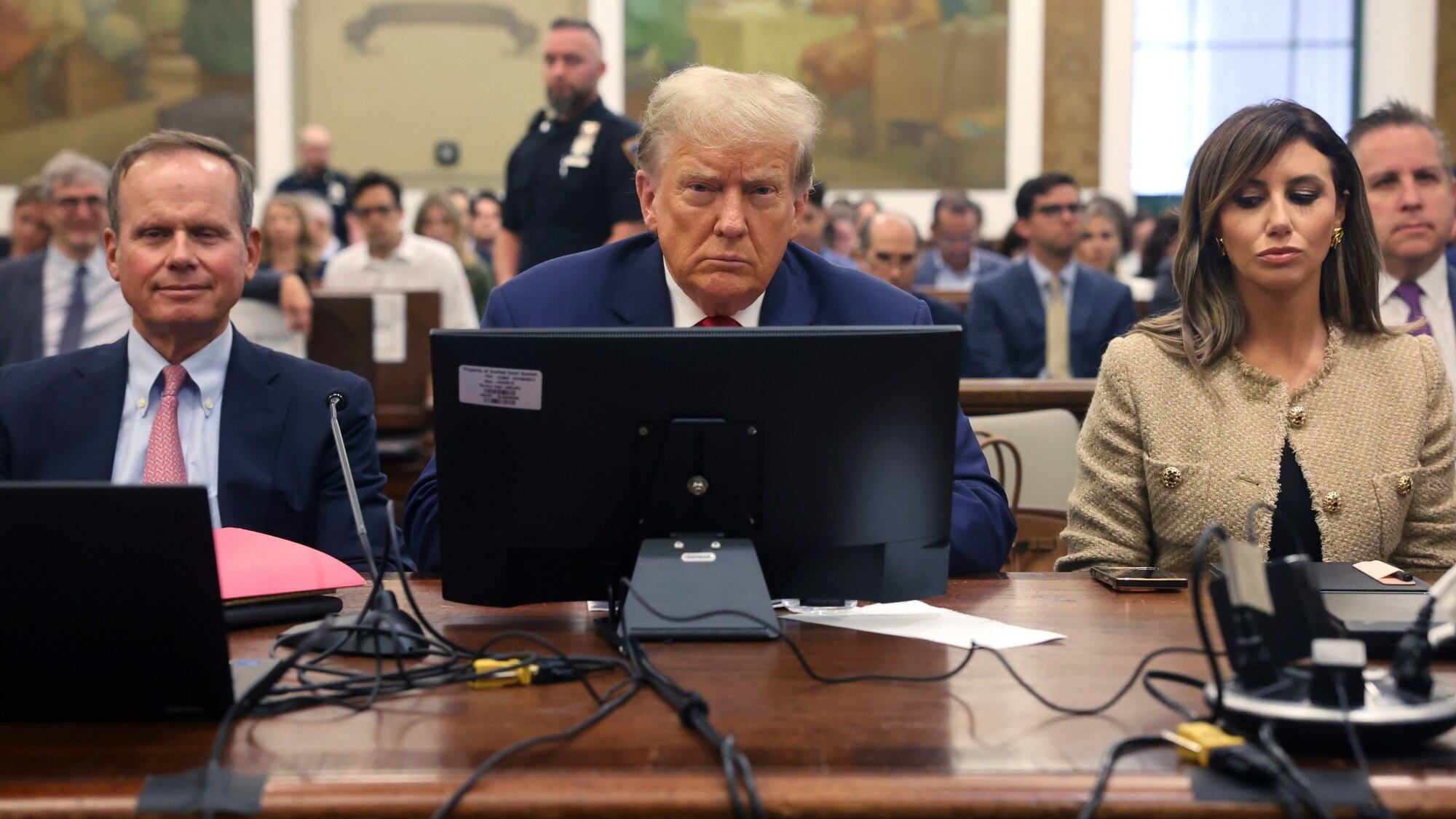
Trump went to the courthouse for the first three days of the trial in New York Attorney General Letitia James’ lawsuit, observing testimony — and fulminating to TV cameras outside about a case he deemed a “a witch hunt and a disgrace.”
Trump's lawyers had asked the state’s intermediate appellate court to suspend the trial and prevent Judge Arthur Engoron from enforcing a ruling he made last week. Engoron's decision revoked the Republican presidential frontrunner's business licenses and puts a court-appointed receiver in charge of his companies.
“This is a massive error. It is irreparable," Trump lawyer Christopher Kise told the appellate judge, Associate Justice Peter H. Moulton. Kise argued that the ruling will make defendants in other cases fear that their companies and properties will be seized without recourse.
“We’re not seeking a delay. We’re seeking a fair trial," Kise said.
Trump's lawyers said Engoron’s ruling could harm not only the ex-president and other defendants but as many as 1,000 employees.
State Deputy Solicitor General Judy Vale told the appeals judge that James’ office had already offered to keep the business licenses as-is until after the trial. Kise acknowledged the offer, but said he was worried Engoron wouldn't allow it.
“We could have resolved some of this, and we’re still happy to do so,” Vale said.
She called the defense arguments for a delay “completely meritless” and noted that mounting the trial has been ”an enormous endeavor." It has entailed extensive court planning, security resources for Trump's attendance and special arrangements for press and public access.
Ahead of the hearing, James said Trump and the other defendants “can continue to try to delay and stall, but the evidence is clear, and our case is strong."
She declined to comment as she left the emergency hearing, at the state’s Appellate Division, First Department in Manhattan.
In a statement, Kise said: “We are very pleased the First Department upheld New York law and put a halt to any cancellation of business certificates, receivers or dissolution. The trial court’s attempt to reach issues, entities and assets beyond the scope of this case has been suspended.”
The appellate court last week rejected the defense’s last-minute effort to delay the trial just days before it began. On Thursday, Trump’s lawyers dropped a lawsuit they filed against Engoron as part of that challenge.
Engoron ruled last week that Trump committed years of fraud as he built the real estate empire that vaulted him to fame and the White House.
The judge, ruling on the top claim in James' lawsuit, found that Trump routinely deceived banks, insurers and others by exaggerating the value of assets on his annual financial statements, which were used in making deals and securing loans.
Trump has denied wrongdoing, arguing that some of his assets are worth far more than what’s listed on the statements.
Before the appellate action, former Trump Organization controller Jeffrey McConney testified at the trial Friday that values he assigned to Trump’s Mar-a-Lago resort in Florida — as much as $739 million in 2018 — were based on the false premise that it could be sold as a private residence. Such use is prohibited by Trump’s 2002 agreement with the National Trust for Historic Preservation.
“Were you aware that Mr. Trump had deeded away his right to use the property for any other purpose than a social club?" state lawyer Andrew Amer asked.
“I was not aware,” said McConney, who's also a defendant in this case.
The trial will resume Tuesday with Trump's longtime finance chief Allen Weisselberg on the witness stand. Weisselberg, a defendant, oversaw Trump’s dealmaking, was involved in securing loans and supervised McConney's work on the financial statements. He left jail in April after serving about 100 days for dodging taxes on $1.7 million in job perks.
As the trial was unfolding this week, Engoron issued an order Thursday setting procedures for enforcing his ruling. He gave both sides until Oct. 26 to submit names of potential receivers and gave Trump and other defendants seven days to provide a court-appointed monitor, retired federal judge Barbara Jones, with a list of all entities covered by the ruling.
He also ordered the defendants to give Jones advance notice of any application for new business licenses in any jurisdiction and any attempts to create new entities to “hold or acquire the assets” of a company that’s being dissolved under the ruling.
Trump's lawyers argued in court papers that Engoron had “no rationale or legal authority” to impose what they described as “the corporate death penalty." They also rapped the judge for not being clear in explaining the real-world effects of his decision.
At a pretrial hearing on Sept. 26, Trump lawyer Christopher Kise pressed Engoron to clarify whether his ruling meant Trump would be required simply to close up some corporate entities or if he’d be forced to relinquish some of his most prized assets.
Engoron then said he wasn't “prepared to issue a ruling right now."
Associated Press writer Jennifer Peltz contributed.
Updated October 6, 2023 at 5:06 p.m. ET with latest updates.