By John Raby and Leah Willingham
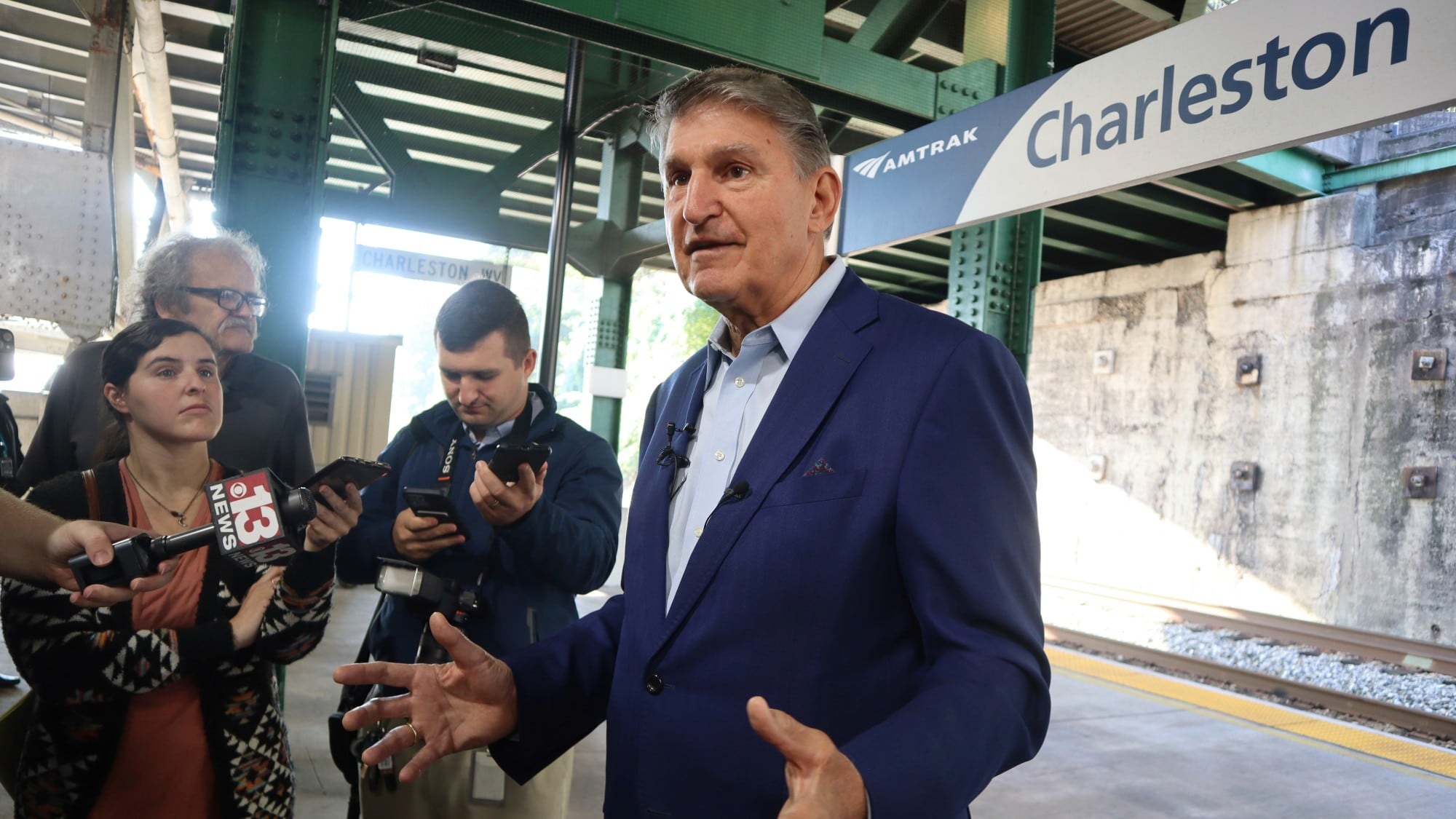
Democratic Sen. Joe Manchin of West Virginia announced Thursday that he won’t seek reelection in 2024, giving Republicans a prime opportunity to pick up a seat in the heavily GOP state.
Manchin, 76, said in a statement that he had made the decision “after months of deliberation and long conversations” with his family.
“I believe in my heart of hearts that I have accomplished what I set out to do for West Virginia," he said. “I have made one of the toughest decisions of my life and decided that I will not be running for re-election to the United States Senate, but what I will be doing is traveling the country and speaking out to see if there is an interest in creating a movement to mobilize the middle and bring Americans together.”
His decision to retire severely hampers Democratic hopes of holding on to the coal country seat and marks the end of an era for West Virginia, which voted reliably blue for decades before flipping red and becoming one of former President Donald Trump’s most loyal states. For the last few years, Manchin has been the only Democrat elected to statewide office in West Virginia, a longtime politician who has served as governor, secretary of state and state legislator.
Republican challengers began clamoring for the Senate seat long before Manchin’s announcement, with GOP Rep. Alex Mooney jumping in the race less than two weeks after winning his fifth term in the House in November 2022. Hugely popular two-term Republican Gov. Jim Justice joined the Senate race earlier this year and was endorsed by Trump, who easily won the state both previous times he ran for the White House.
After Manchin's announcement Thursday, Justice said he and the senator “have not always agreed on policy and politics.”
"But we’re both lifelong West Virginians who love this state beyond belief, and I respect and thank him for his many years of public service,” the governor said in a statement.
Already, 2024 was shaping up to be a tough election cycle for Senate Democrats. The party will be forced to defend 23 seats, including three held by independents, compared to just 10 seats for Republicans. Manchin is one of just three Democratic senators up for reelection in 2024 who represent a state won by Trump, a Republican, in the 2020 election.
In recent months, Manchin teased possible retirement, a run for reelection to the Senate or even a presidential campaign in 2024 — possibly as an independent candidate, although it's unclear what his voter base would be. Alluding to potential national aspirations for Manchin, Republican Sen. Dan Sullivan of Alaska told reporters moments after the announcement that Manchin’s message sounded like someone who would be running for higher office.
No Labels, a group laying the groundwork for a possible third-party presidential ticket, praised Manchin as a “tireless voice for America's commonsense majority" Thursday.
“We will make a decision by early 2024 about whether we will nominate a Unity presidential ticket, and who will be on it,” the organization said in a statement.
In a statement Thursday, Manchin's West Virginia colleague Republican U.S. Sen. Shelley Moore Capito thanked him for his years of service.
“I’ve enjoyed serving alongside you — our senior senator,” she said. "And as you said, we still have much work ahead of us. Thank you for your friendship, Joe. I look forward to that continuing.”
West Virginia Democratic Party Chair Mike Pushkin called Manchin "a larger-than-life figure in the United States Senate” and said his “name has been synonymous with West Virginia politics and government” for 41 years.
Manchin, a conservative Democrat, was both a critical vote and a constant headache for his party in the first two years of President Joe Biden’s term. When the Senate was split 50-50 and Democrats controlled it by virtue of Vice President Kamala Harris’ tiebreaking vote, Manchin leveraged his political power to shape legislation to his liking.
Along with Sen. Kyrsten Sinema of Arizona, a Democrat who switched to an independent after last year’s midterms, he helped water down much of Biden’s social spending agenda. He has frequently clashed with members of his own party over his strong support for coal and other fossil fuels.
Days before last year’s midterms, he blasted Biden for being “cavalier” and “divorced from reality” after vowing to shutter coal-fired power plants and rely more heavily on wind and solar energy in the future. He demanded a public apology from Biden, and the White House acquiesced by issuing a statement saying the president “regrets it if anyone hearing these remarks took offense.”
Manchin’s announcement comes just a year after Democrats increased their Senate majority to 51-49 by flipping a Republican-held seat in Pennsylvania. The practical effect of that victory was giving Democrats the ability to pass bills while losing one vote within their caucus — zapping Manchin’s power to singlehandedly thwart some of his party’s priorities.
Manchin regained some of that influence after Sinema switched parties, though she made clear that she would not caucus with Republicans. Sinema is also up for reelection in 2024 but has not yet announced her plans.
Manchin entered the Senate after winning a special election in 2010 following the death of Robert C. Byrd. He won reelection in both 2012 and 2018, with the latter campaign his toughest in his three-plus decades in West Virginia politics. He defeated Republican state Attorney General Patrick Morrisey by just over 3 percentage points.
Registered Democrats outnumbered Republicans during Manchin’s first two Senate campaigns, but things have changed since then. Now, about 40% of registered voters are Republicans, compared with 31% for Democrats and about 24% with no party affiliation.
Both chambers of the Legislature have Republican supermajorities, and Trump overwhelmingly won the state in 2016 and 2020.
Manchin’s penchant for not following fellow Democrats on some key votes was a cause of angst and bruised relationships within his own party. It even prompted independent Sen. Bernie Sanders to suggest that he would support a 2024 primary challenger to Manchin.
Manchin’s split with the White House prompted Senate Republican leader Mitch McConnell of Kentucky to publicly invite him to join the GOP. Manchin held firm there, too, insisting that he saw himself as a Democrat.
During Manchin’s first two terms in the Senate, West Virginia lost thousands of coal jobs as companies and utilities explored using other energy sources such as natural gas, solar and wind. Manchin later promoted the Biden administration’s plans to involve the state in the development of clean energy. But his push to speed permits for natural gas pipelines and other energy projects — including a planned pipeline in his home state — failed.
Under Trump, Manchin was the only Democrat to vote for the confirmation of Supreme Court Justice Brett Kavanaugh in 2018 and among three Democrats to support nominee Neil Gorsuch in 2017. But he voted with Democrats on other key issues, including a failed 2017 effort by Republicans to repeal the Affordable Care Act passed under President Barack Obama.
Associated Press writer Farnoush Amiri in Washington contributed to this report.
Updated November 9, 2023 at 4:43 p.m. ET with additional details.