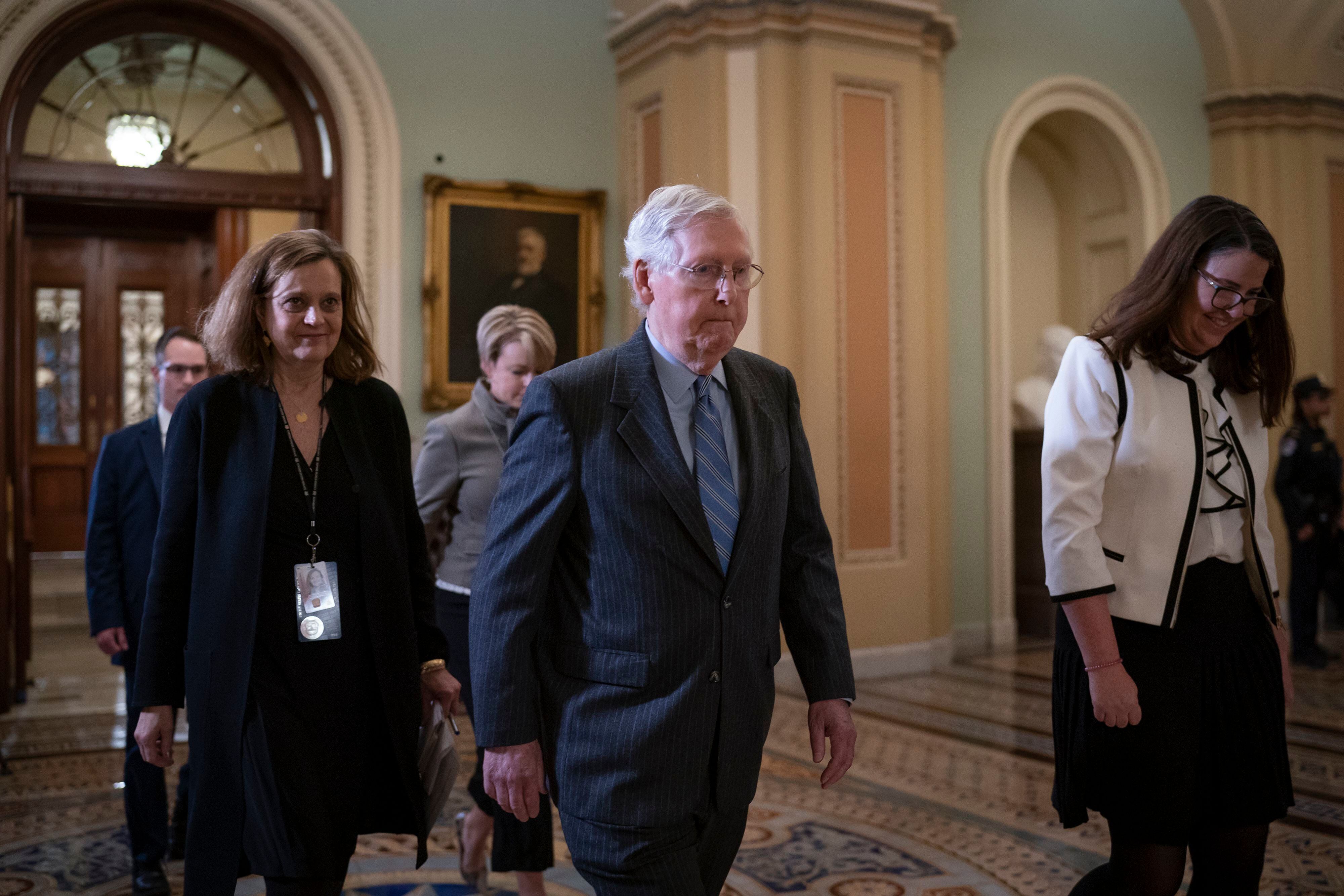
After voting to block witnesses, the Senate voted Friday to approve a resolution setting the final day of the president’s impeachment trial — and his likely acquittal — for Wednesday, after both the Iowa Caucuses and President Donald Trump's State of the Union address.
Senators debated on how to move forward during a recess after the witness vote’s conclusion. After nearly 90 minutes, it appeared that Senate leaders Mitch McConnell and Chuck Schumer had reached a deal that would pause the trial until Monday and provide each senator with 10 minutes to explain his or her decision on the president’s conviction or acquittal. The Senate voted on the organizing resolution and Democrats brought four amendments to the floor — all of which were defeated.
Chief Justice John Roberts answered a question from Schumer on whether he would cast a tie-breaking vote. Roberts said it would be “inappropriate for me” to break a 50-50 tie.
One of the amendments brought to the Senate floor tonight on impeachment rules would have required Roberts to rule on motions for evidence.
Sen. Roy Blunt (R-Mo.) had previously told reporters the expectation moving forward would not include closed deliberations. "I'm opposed to it and I believe we will not have any closed sessions," he said. The plan voted on did not include such a provision.
The new resolution provided a timetable for the end of the third impeachment trial of a sitting U.S. president. The Senate will recess for the weekend until Monday at 11 a.m. Then House Managers and the defense counsel will each have two hours to make closing arguments. Senators will be allowed to give floor speeches for parts of Monday, Tuesday, and Wednesday. The vote would be scheduled for 4 pm Wednesday.
Sen. Tim Scott (R-S.C.) said, upon leaving the GOP meeting, that "the process is important, so having the Democrats buy into this final arrangement, I think is more important than just shoving it down their throats because sooner or later the shoe will be on this foot."
Senators will vote on two articles of impeachment: abuse of power and obstruction of Congress related to allegations President Trump pressured Ukraine to announce investigations into his political rival, former Vice President Joe Biden, and his son Hunter by withholding nearly $400 million in security aid.
Democrats had been pushing to hear from new witnesses since the trial began nearly two weeks ago, especially after John Bolton, the former national security advisor, said he would testify and new evidence was reported by the New York Times indicated Bolton's unpublished manuscript contained details in which the president told advisors to withhold aid to Ukraine as early as last spring. Only two Republicans — Senators Mitt Romney (R-Utah) and Susan Collins (R-Maine) — voted with the Democrats.
President Biden is looking at unlikely partners to buy oil, after banning all Russian energy imports. Among them is Venezuela, a regime that has been sanctioned by the U.S. since 2019. Ariel Cohen of the Atlantic Council explains to Cheddar News why that might not be a bad choice.
Stock trading app Robinhood already has been offering cryptocurrency investments but seems further excited about the asset class following President Biden's recent announcement of an executive order. Dan Gallagher, the chief legal and corporate affairs officer for Robinhood, joined Cheddar News to talk about the White House's tentative vision for digital currency. "I think this executive order firmly states that, yes, crypto is here to stay, which it talks about the important competitive issues around crypto and how the United States needs to be a leader, a global leader, in innovation and technology regarding crypto," he said. Gallagher also discussed having clarity around meme stocks going forward but worried about overregulation slowing down innovation.
As Russia’s attack on Ukraine, the latest inflation report showed the consumer price index rose 7.9 percent — a 40-year high. Heather Boushey, a member of the White House Council of Economic Advisers, joined Cheddar News to discuss what American consumers might be in store for as prices keep rising. "Forecasters at this point believe that the American economy will be resilient," she said. "They’re still predicting that the unemployment rate will continue to be lower at the end of the year than it is today, and we are still seeing folks believe that over time prices will come back down." Boushey did note that it would be dependent on how long the current situation lasts.
Simon Shuster, TIME's Moscow correspondent joins Cheddar to discuss how Ukraine could become part of the EU and what it would mean for politics in Europe.
President Biden has banned imports of Russian oil to the U.S. in retaliation for its invasion of Ukraine. The president warned of higher prices at the gas pump, leading some analysts to think it could propel the transition to clean, renewable energy. Michael Jones, chairman and CEO of investment solutions company Caravel Concepts, discussed how the ban is hitting green energy stocks as gas prices continue to surge. "I think the 10-year prospects for renewables just got a whole lot better because ultimately this is going to force a transition into renewables," he said.
Amid ongoing tensions in the Russia-Ukraine region, many American travelers are nervous about traveling to Europe.
It comes at a time when international travel was set to make a comeback, but uncertainty surrounding the conflict may delay the overall recovery. Francesca Page, Travel Expert, joined Cheddar's Opening Bell to discuss.
Russia's invasion of Ukraine is coming for the global food supply. Ongoing tensions in the region are threatening the supply of various agricultural products including wheat, barley and corn. Vladik Rikhter, CEO & Cofounder of Zenput joined Cheddar's Opening Bell to discuss how this could impact food prices overseas.
Chris Natividad, CIO of EquBot, joins Cheddar News' Closing Bell, where he elaborates on what ultimately dragged the Dow, S&P, and Nasdaq lower on Tuesday and discusses how investors are reacting to rising oil prices and February CPI data coming out later this week.