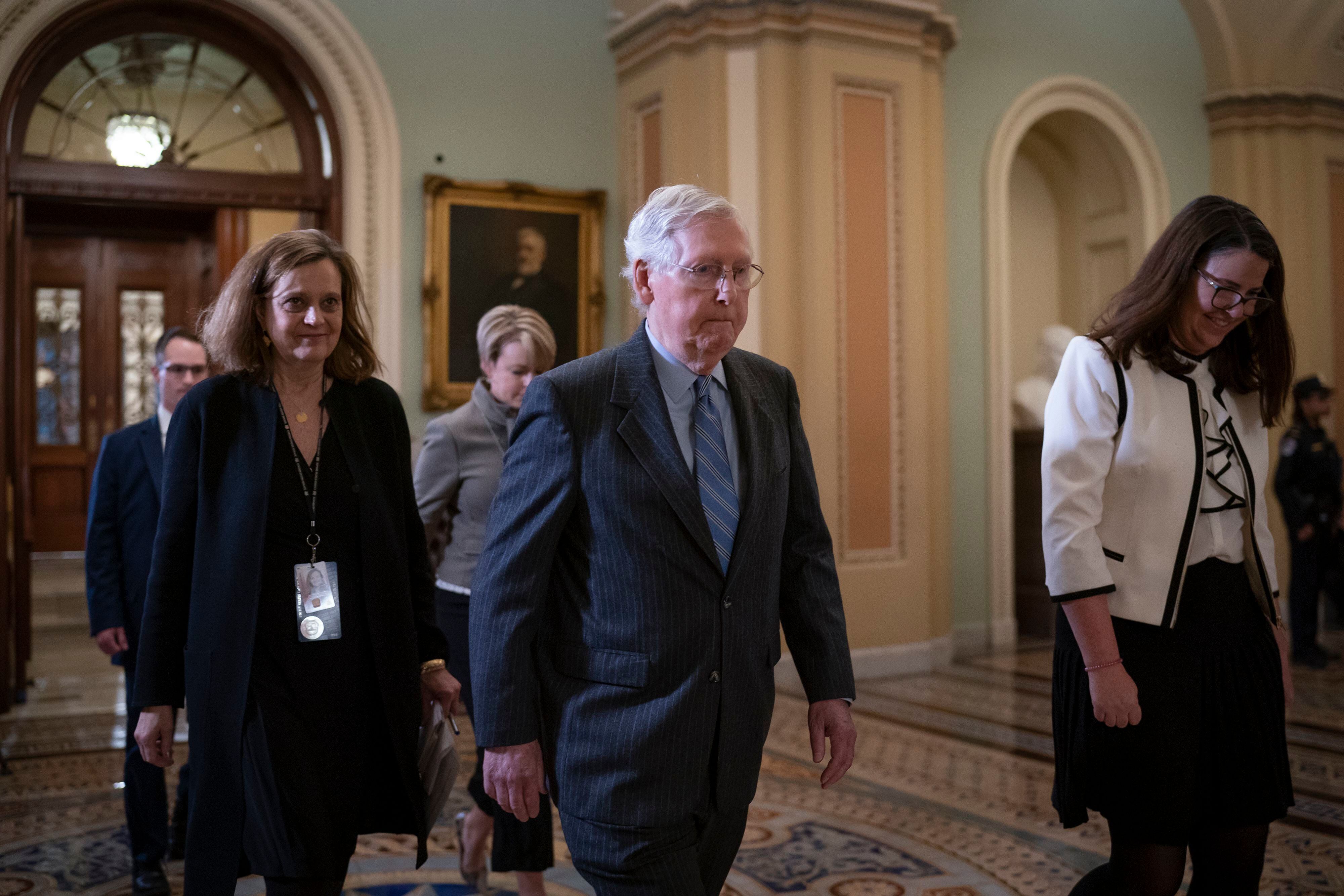
After voting to block witnesses, the Senate voted Friday to approve a resolution setting the final day of the president’s impeachment trial — and his likely acquittal — for Wednesday, after both the Iowa Caucuses and President Donald Trump's State of the Union address.
Senators debated on how to move forward during a recess after the witness vote’s conclusion. After nearly 90 minutes, it appeared that Senate leaders Mitch McConnell and Chuck Schumer had reached a deal that would pause the trial until Monday and provide each senator with 10 minutes to explain his or her decision on the president’s conviction or acquittal. The Senate voted on the organizing resolution and Democrats brought four amendments to the floor — all of which were defeated.
Chief Justice John Roberts answered a question from Schumer on whether he would cast a tie-breaking vote. Roberts said it would be “inappropriate for me” to break a 50-50 tie.
One of the amendments brought to the Senate floor tonight on impeachment rules would have required Roberts to rule on motions for evidence.
Sen. Roy Blunt (R-Mo.) had previously told reporters the expectation moving forward would not include closed deliberations. "I'm opposed to it and I believe we will not have any closed sessions," he said. The plan voted on did not include such a provision.
The new resolution provided a timetable for the end of the third impeachment trial of a sitting U.S. president. The Senate will recess for the weekend until Monday at 11 a.m. Then House Managers and the defense counsel will each have two hours to make closing arguments. Senators will be allowed to give floor speeches for parts of Monday, Tuesday, and Wednesday. The vote would be scheduled for 4 pm Wednesday.
Sen. Tim Scott (R-S.C.) said, upon leaving the GOP meeting, that "the process is important, so having the Democrats buy into this final arrangement, I think is more important than just shoving it down their throats because sooner or later the shoe will be on this foot."
Senators will vote on two articles of impeachment: abuse of power and obstruction of Congress related to allegations President Trump pressured Ukraine to announce investigations into his political rival, former Vice President Joe Biden, and his son Hunter by withholding nearly $400 million in security aid.
Democrats had been pushing to hear from new witnesses since the trial began nearly two weeks ago, especially after John Bolton, the former national security advisor, said he would testify and new evidence was reported by the New York Times indicated Bolton's unpublished manuscript contained details in which the president told advisors to withhold aid to Ukraine as early as last spring. Only two Republicans — Senators Mitt Romney (R-Utah) and Susan Collins (R-Maine) — voted with the Democrats.
Reshma Saujani, the founder of Girls Who Code and author of "Pay Up: The Future of Women and Work (and Why It's Different Than You Think), joined Cheddar to discuss the many challenges for women in the workplace after the upheaval caused by the pandemic and the solutions she presents.
Hate crimes from the start of 2022 against Asians reportedly more than doubled compared to 2021, according to the NYPD. Amid the surge of attacks, Amber Reed, the president and co-founder of the grassroots organization AAPI Montclair, joined Cheddar News to talk about how it's looking to help Asian Americans with classes and techniques to defend themselves. “We're seeing racism literally killing people who look like us, and these self defense classes are a chance for us to rewrite a narrative of victimhood into one of empowerment," she said. "We learn first how to be aware of our surroundings because we know that being distracted, appearing weak can make you a target, and then that we focus on disengagement."
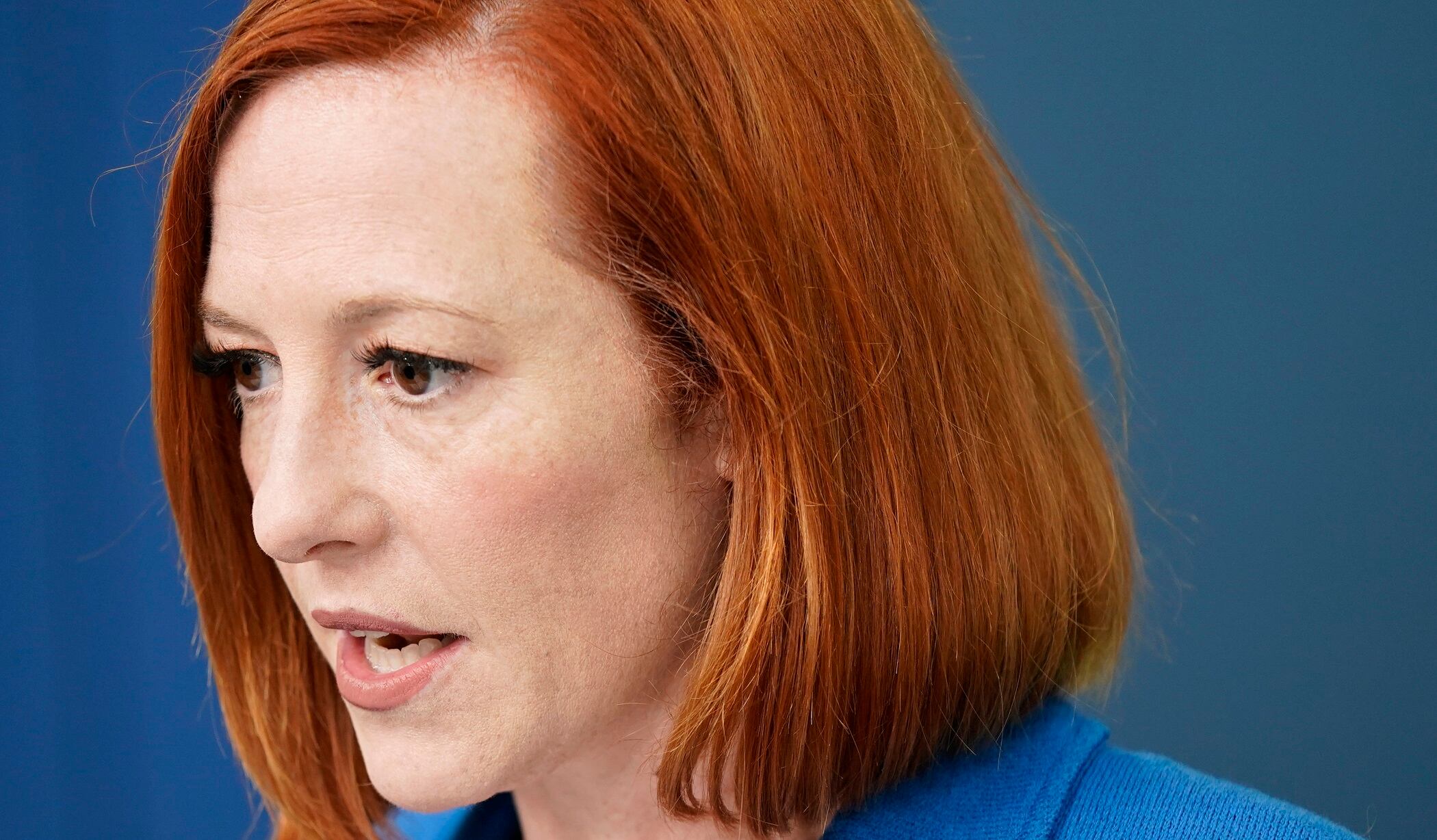
White House press secretary Jen Psaki said Tuesday that she has tested positive again for COVID-19 and will not accompany President Joe Biden to Europe for meetings on Russia’s invasion of Ukraine.
Reshma Saujani, the founder of the nonprofit Girls Who Code, discusses the workplace inequities further exposed by the pandemic and her latest book, "Pay Up: The Future of Women and Work (and Why It's Different Than You Think).
Since Russia invaded Ukraine, the United States, along with much of the Western world, has imposed economic sanctions on Russia’s economy and its oligarchs. And these measures are costing these oligarchs — billions. So what exactly is an oligarch and what are their ties to Putin and the ongoing invasion? And will sanctioning them work?
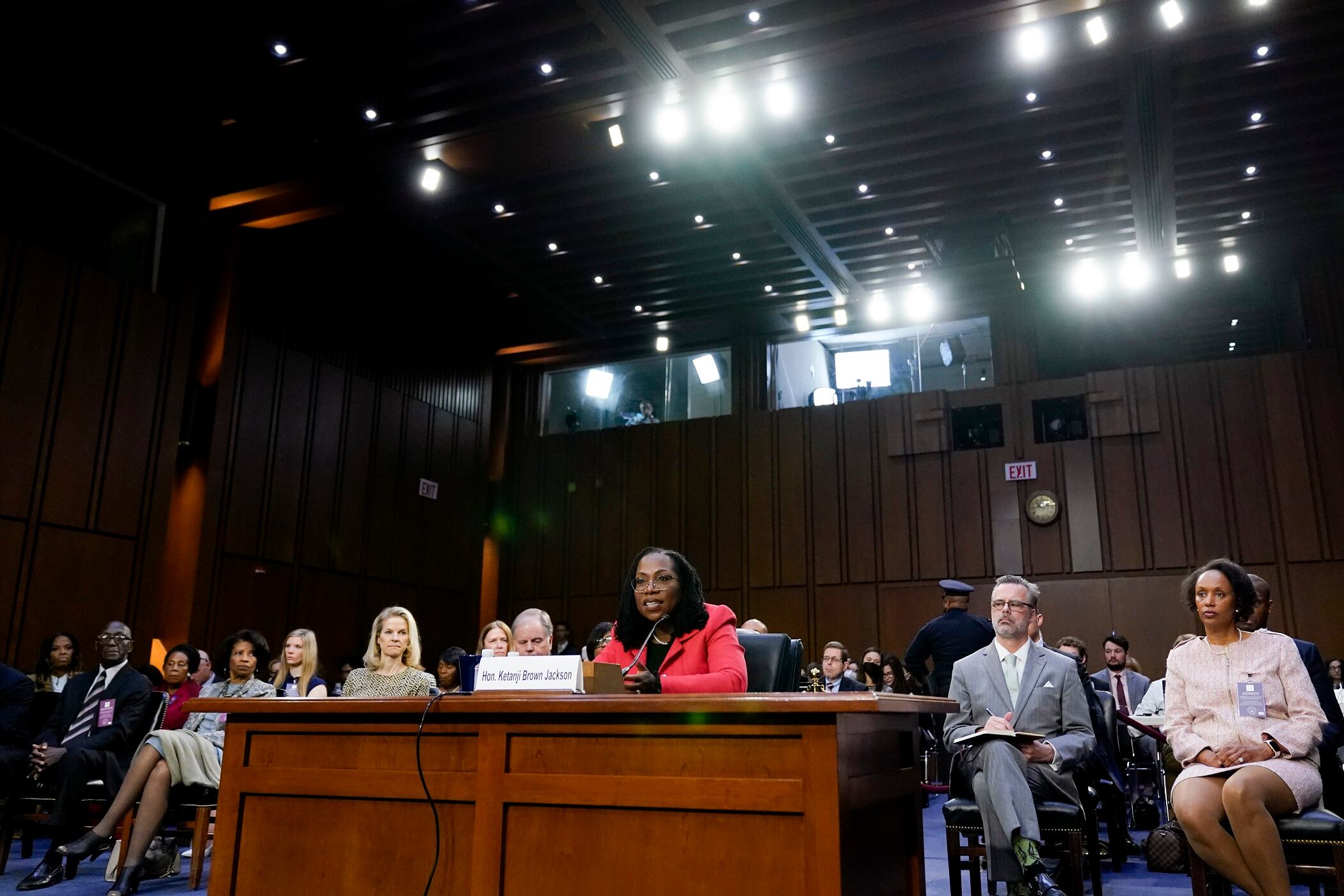
Ketanji Brown Jackson is forcefully defending her record as a federal judge, telling senators she will rule “from a position of neutrality” if she is confirmed as the first Black woman on the high court.
Ukraine remains defiant as the Russian invasion is approaching its fourth week. Cheddar News speaks with Former Obama Campaign Foreign Policy Advisor David Tafuri, on Russia’s war efforts so far and how it might shift tactics moving forward.
While investors soured on Fed Chair Jerome Powell's remarks on interest rates Monday, Anthony Saccaro, Founder and President at Providence Financial explains why he is supportive of the Fed's approach on Cheddar News' Closing Bell.
As Russia continues to wage war in Ukraine, 10 million of its citizens have fled their homes according to the UN, with more and more refugees flooding into other European countries. Nancy Dent, senior global communications officer for Europe and Asia at the aid group International Rescue Committee, joined Cheddar News to discuss the deteriorating conditions. “What's really clear from my time at the border today, in particular, is that people really are fleeing for their lives now," she said. "Two million people, 60 percent of the refugee population from Ukraine is now in Poland, and people are arriving with smaller bags really unprepared."