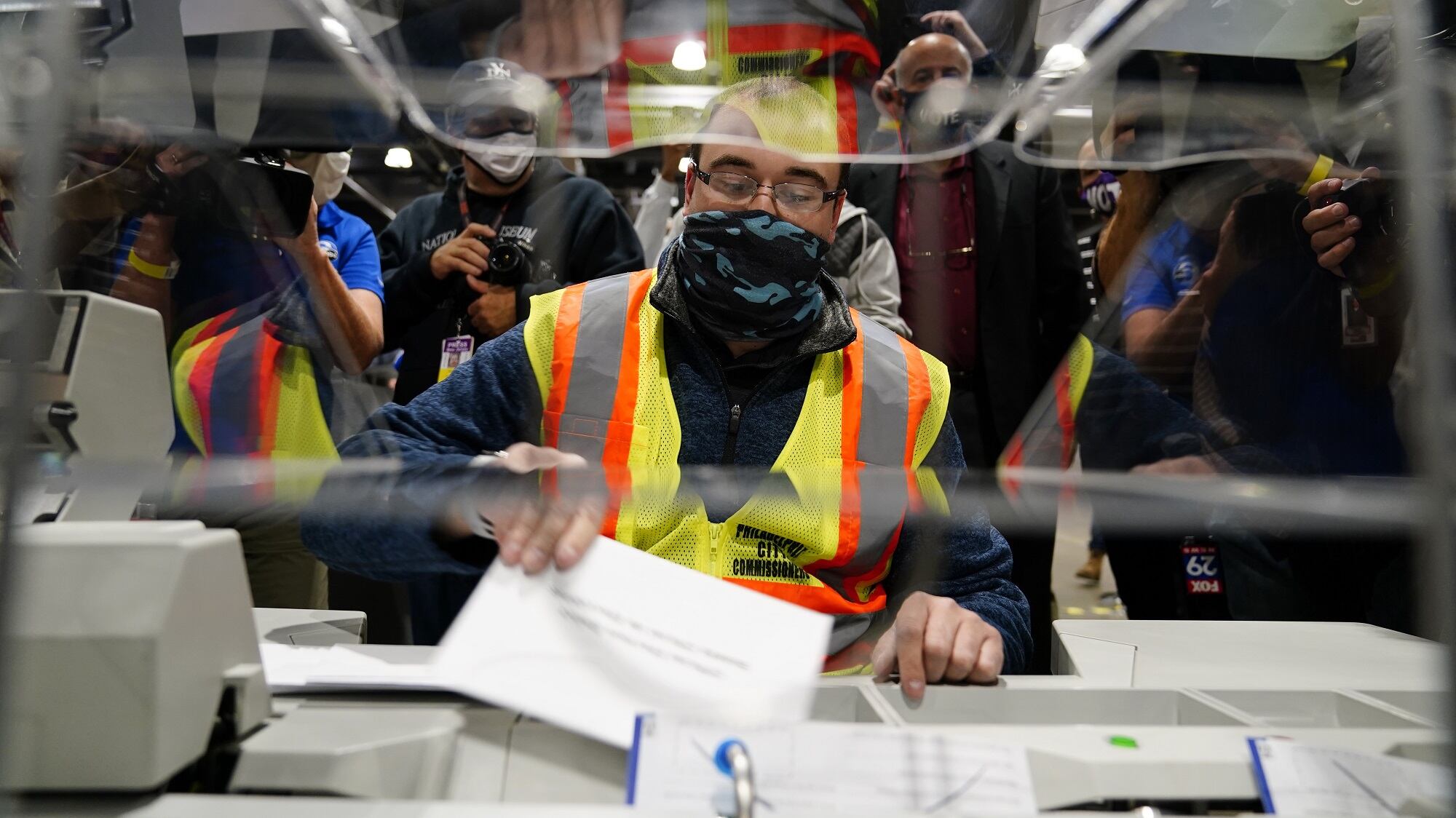
John Hansberry, with the Philadelphia City Commissioners office, demonstrates an extraction machine at the city's mail-in ballot sorting and counting center in preparation for the 2020 General Election in the United States, Monday, Oct. 26, 2020, in Philadelphia. (AP Photo/Matt Slocum)
HOW WILL VARIOUS BALLOTS BE COUNTED, AND WHAT RESULTS WILL BE KNOWN ON ELECTION NIGHT?
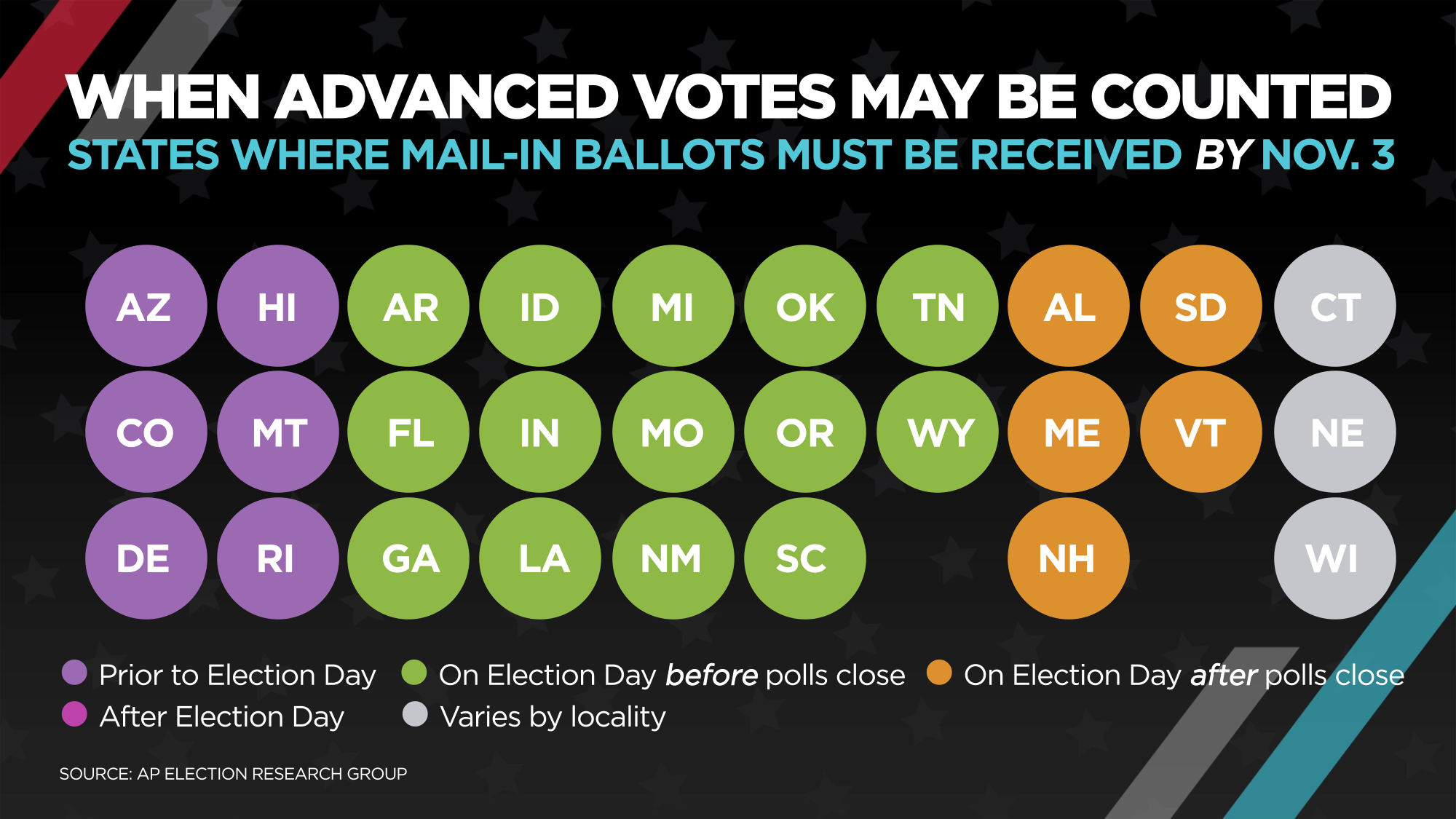
Millions of Americans have already voted, but each state has different rules on when it's allowed to actually start counting those ballots. That is going to produce results coming in at very different times — perhaps days or even weeks after Election Day.
In some places, election officials can begin processing ballots weeks before Election Day. That means workers can start verifying voter information while also removing ballots from their envelopes to physically get them ready for tabulation. Doing so readies ballots for counting on Election Day and will speed up the release of results.
But it's not that simple.
In some of the most critical battleground states, laws prevent the early processing of ballots. So on Nov. 3, Election Day, officials will have to run an in-person election while also working through the unprecedented number of mail-in votes. This dynamic is likely to delay results and heighten the potential for big shifts if in-person vote tallies are upended by the counting of mail-in ballots.
President Donald Trump has repeatedly warned of voting fraud without offering any evidence. Because of that, there are concerns that he will use delays in vote-counting to declare results illegitimate. While results might come in later than usual this year, that's because of a change in how people are voting, not malfeasance or fraud.
Here is another wrinkle: Nationwide delivery delays at the U.S. Postal Service are sparking fears that ballots might not arrive in time to be counted. Republicans, including Trump's campaign, have been filing lawsuits to stop election officials from counting ballots that are delivered after Election Day.
For example: As of right now in Pennsylvania, votes that arrive by mail three days after Nov. 3 will be counted, after an intense legal battle that went all the way to the U.S. Supreme Court last week. Republicans have filed another suit against the extension. Also, Pennsylvania doesn’t allow early processing of mail-in ballots, further complicating matters.
In Michigan, another hotly contested state, an appeals court has struck down a 14-day ballot-counting extension, leading the state's top election official to urge voters to drop off their ballots in person rather than use the Postal Service. Courts have also nixed similar extensions in Wisconsin and Indiana.
This story is part of a series dedicated to answering commonly asked questions from AP's audience about the 2020 U.S. presidential election.
The average city in California has a 38% higher cost of living than the average American city, according to a cost of living index. For many, the general minimum wage of $15/hour just doesn't cut it. Anti-poverty activist Joe Sanberg wants to get the minimum wage changed to $18/hour. He joins Cheddar News to discuss the Living Wage Act of 2022.
Liana Guzmán, CEO of FOLX Health, joins Cheddar News to discuss the company launching billboards across the country in response to anti-LGBTQ+ legislation.
President Biden has announced an additional $800 million in military assistance to Ukraine, including artillery, armored personnel carriers, and helicopters. It comes as Russian forces appear to be preparing for a new, aggressive offensive in the eastern part of Ukraine. Paul McLeary, defense reporter for Politico, joined Cheddar to discuss this new round of aid and what it means for the U.S. commitment to arming the embattled country.
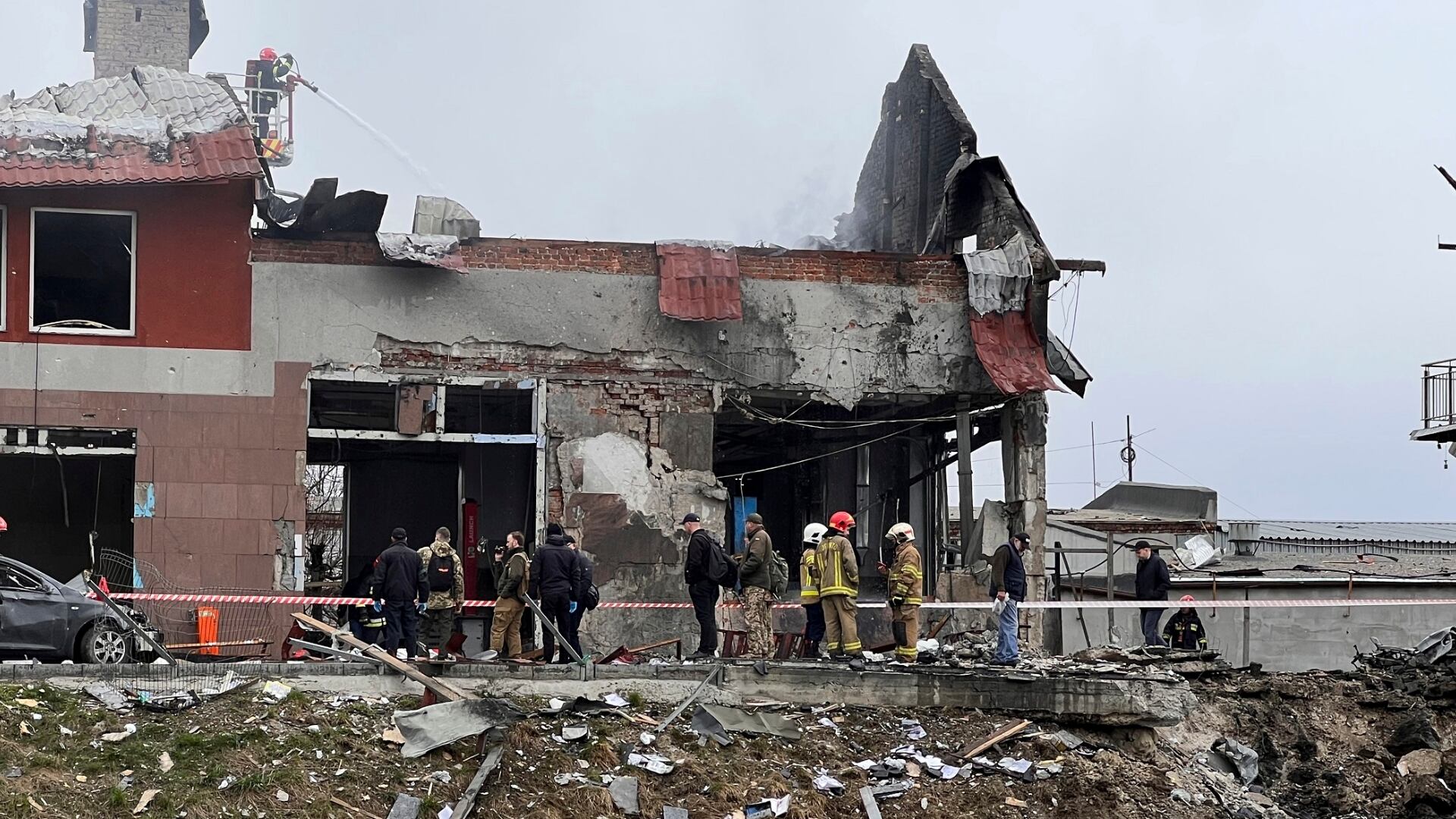
Catching you up on what you need to know on April 18, 2022, with Russian missile attacks on the Ukrainian city of Lviv killing seven, mass shootings in South Carolina and Pittsburgh, Lucky Charms cereal under official investigation by the FDA, and more.
Activism is growing around the country in response to school boards banning books from shelves that focus on sexuality, gender, identity, or race. Jen Cousins, co-founder of The Florida Freedom to Read Project, joins Cheddar News to discuss.
As the Russian invasion of Ukraine intensifies, President Biden has announced a ban on importing Russian oil, gas, and energy. To discuss how this ban will impact the war and Americans, Amir Handjani, non-resident fellow at Quincy Institute, joins Cheddar News.
Thousands of protesters around the world are expressing their solidarity with Ukraine against Russia's invasion.
Jason Beardsley, national executive director of the Association of the U.S. Navy and national security expert, joins Cheddar News to discuss.
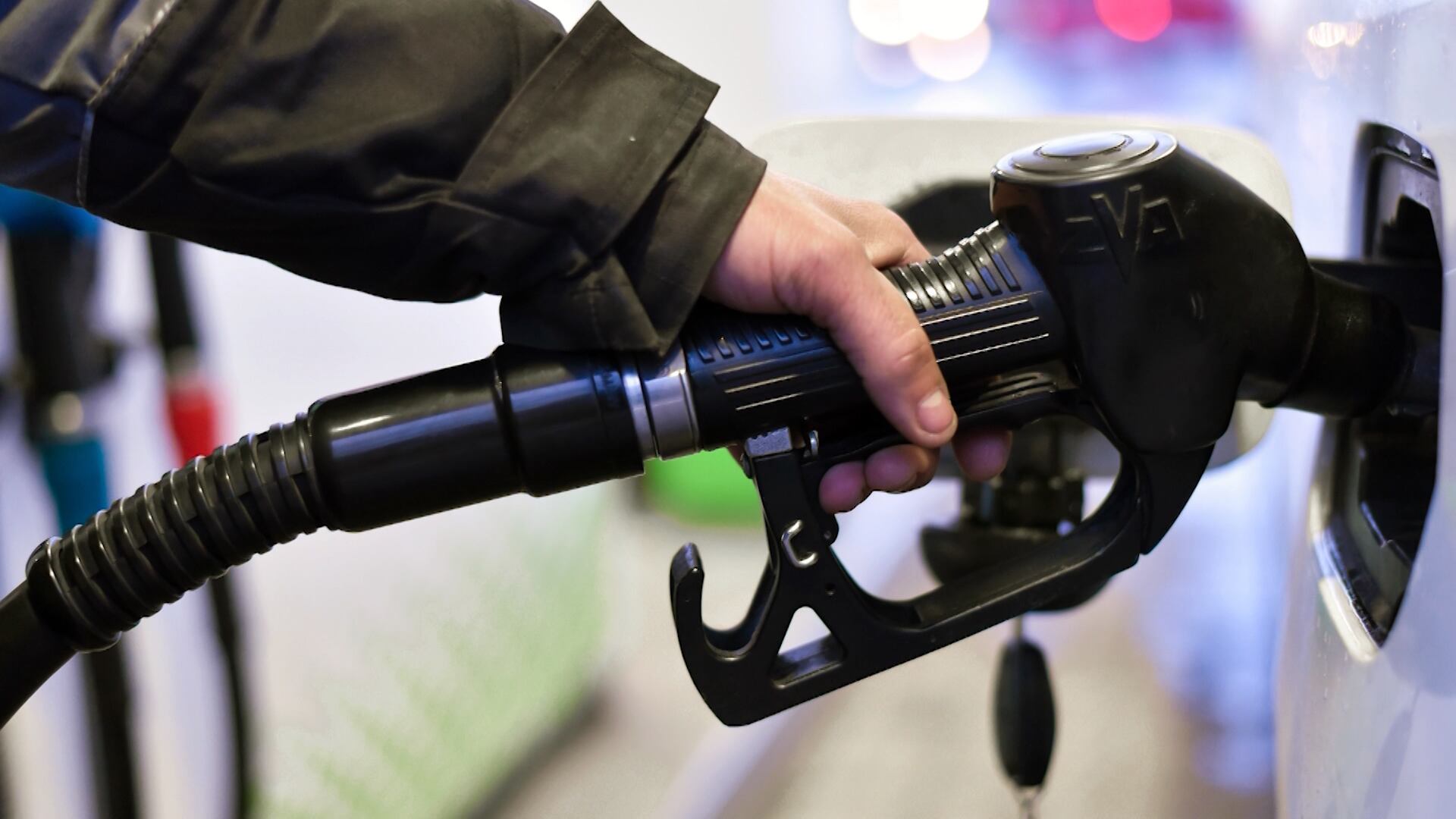
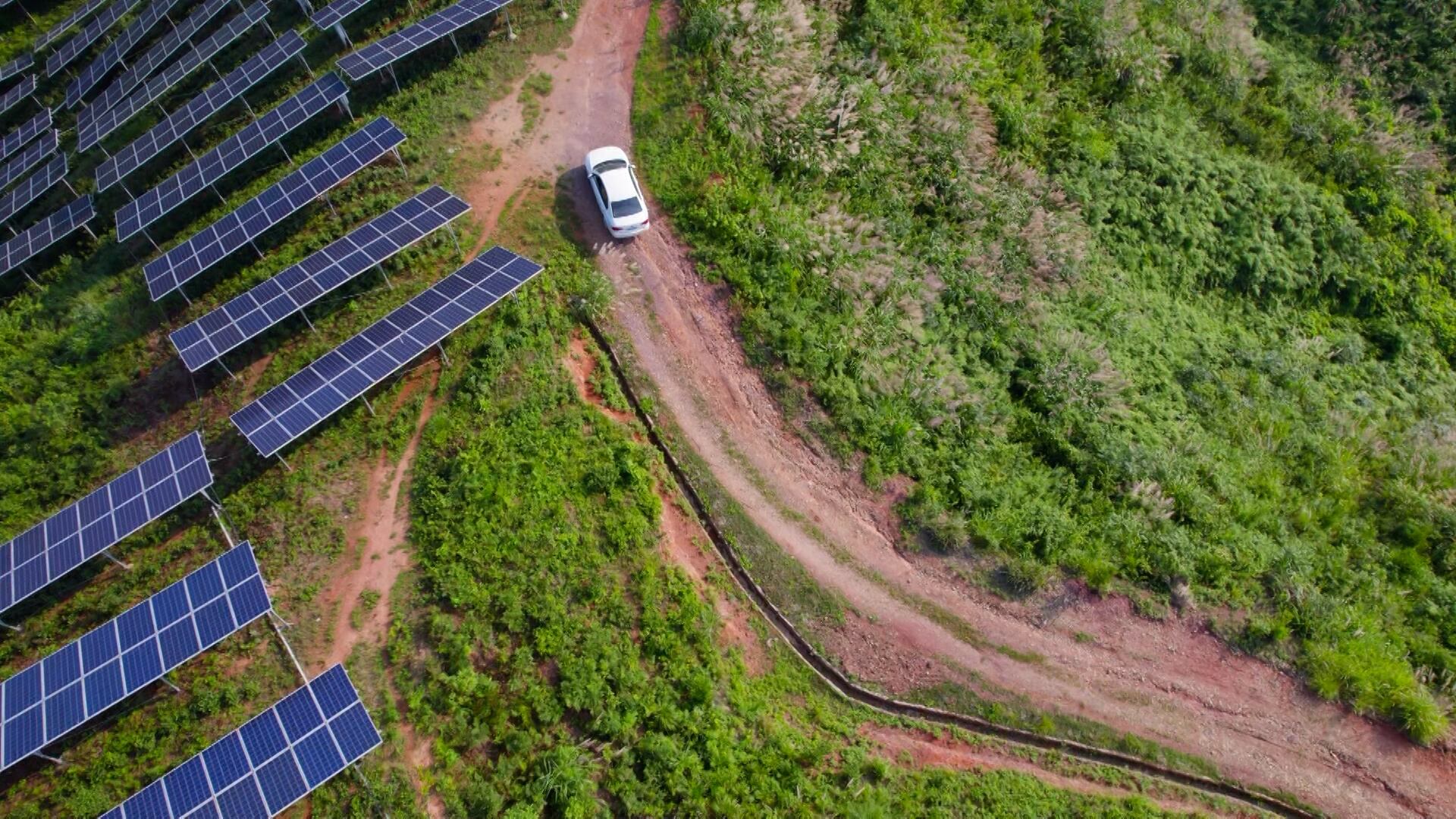
As gas prices surge amid the Russian invasion of Ukraine, other nations could potentially transition faster to using clean energy than previously expected. Philip K. Verleger, a senior fellow at the Niskanen Center, joined Cheddar News to explain how this could be a possibility in the near future. "Part of the reason I think we have this invasion and the tantrum that's being thrown by Russia, terrible tantrum, is because the Russians were trying to slow down the transition," he said. "Ironically they speeded it up."