By Stephen Groves and Mary Clare Jalonick
After months of struggling to find agreement on just about anything in a divided Congress, lawmakers are returning to Capitol Hill to try to avert a government shutdown, even as House Republicans consider whether to press forward with an impeachment inquiry into President Joe Biden.
A short-term funding measure to keep government offices fully functioning will dominate the September agenda, along with emergency funding for Ukraine, federal disaster funds and the Republican-driven probe into Hunter Biden’s overseas business dealings.
Time is running short for Congress to act. The House is scheduled to meet for just 11 days before the government's fiscal year ends on Sept. 30, leaving little room to maneuver. And the dealmaking will play out as two top Republicans, Sen. Mitch McConnell of Kentucky and Rep. Steve Scalise of Louisiana, deal with health issues.
The president and congressional leaders, including Republican House Speaker Kevin McCarthy, are focused on passage of a months-long funding measure, known as a continuing resolution, to keep government offices running while lawmakers iron out a budget. It's a step Congress routinely takes to avoid stoppages, but McCarthy faces resistance from within his own Republican ranks, including from some hardline conservatives who openly embrace the idea of a government shutdown.
“Honestly, it's a pretty big mess,” McConnell said at an event in Kentucky last week.
Here are the top issues as lawmakers return from the August break:
KEEPING THE GOVERNMENT OPEN
When Biden and McCarthy struck a deal to suspend the nation's debt ceiling in June, it included provisions for topline spending numbers. But under pressure from the House Freedom Caucus, House Republicans have advanced spending bills that cut below that agreement.
Republicans have also tried to load their spending packages with conservative policy wins. For example, House Republicans added provisions blocking abortion coverage, transgender care and diversity initiatives to a July defense package, turning what has traditionally been a bipartisan effort into a sharply contested bill.
But Democrats control the Senate and are certain to reject most of the conservative proposals. Senators are crafting their spending bills on a bipartisan basis with an eye toward avoiding unrelated policy fights.
Top lawmakers in both chambers are now turning to a stopgap funding package, a typical strategy to give the lawmakers time to iron out a long-term agreement.
The House Freedom Caucus has already released a list of demands it wants included in the continuing resolution. But they amount to a right-wing wish list that would never fly in the Senate.
The conservative opposition means McCarthy will almost certainly have to win significant Democratic support to pass a funding bill — but such an approach risks a new round of conflict with the same conservatives who in the past have threatened to oust him from the speakership.
Democrats are already readying blame for the House GOP.
“The last thing the American people deserve is for extreme House members to trigger a government shutdown that hurts our economy, undermines our disaster preparedness, and forces our troops to work without guaranteed pay," said White House spokesman Andrew Bates.
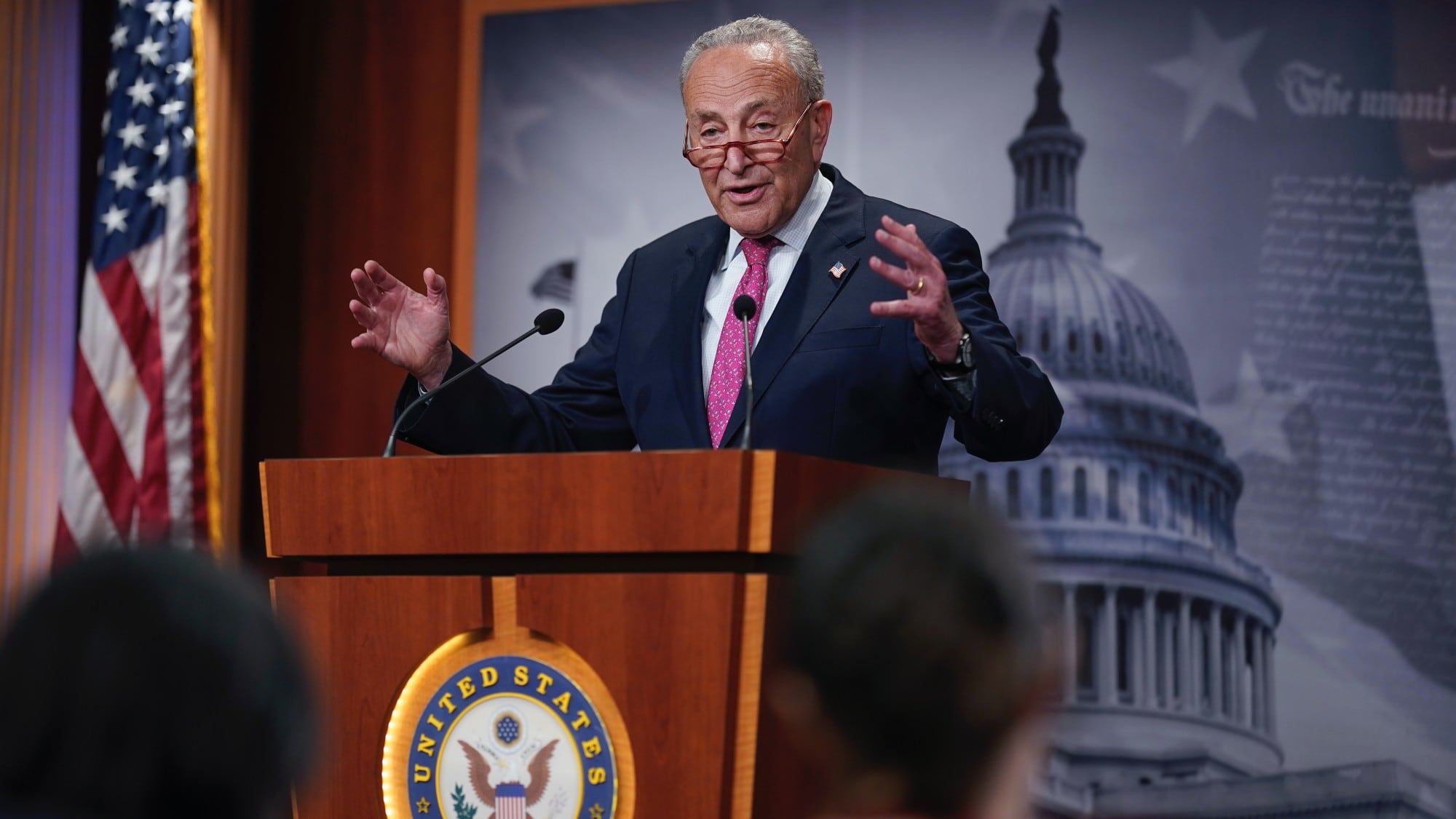
In a letter to his colleagues Friday, Senate Majority Leader Chuck Schumer wrote that the focus when the Senate returns Tuesday will be “funding the government and preventing House Republican extremists from forcing a government shutdown.”
It leaves McCarthy desperate to get the votes to keep government offices running and avoid the political blowback. As he tries to persuade Republicans to go along with a temporary fix, McCarthy has been arguing that a government shutdown would also halt Republican investigations into the Biden administration.
“If we shut down, all of government shuts it down — investigations and everything else — it hurts the American public,” the speaker said on Fox News last week.
IMPEACHMENT INQUIRY
Since they gained the House majority, Republicans have launched a series of investigations into the Biden administration, with an eye towards impeaching the president or his Cabinet officials. They have now zeroed in on the president's son, Hunter Biden, and his overseas business dealings, including with Ukrainian gas company Burisma.
The inquiries have not produced evidence that President Biden took official action on behalf of his son or business partners, but McCarthy has called impeachment a “natural step forward” for the investigations.
An impeachment inquiry by the House would be a first step toward bringing articles of impeachment. It is not yet clear what that may look like, especially because the speaker does not appear to have the GOP votes lined up to support an impeachment inquiry. Moderate Republicans have so far balked at sending the House on a full-fledged impeachment hunt.
But Donald Trump, running once again to challenge Biden, is prodding them to move ahead quickly.
“I don’t know how actually how a Republican could not do it," Trump said in an interview on Real America's Voice. “I think a Republican would be primaried and lose immediately, no matter what district you’re in.”
UKRAINE AND DISASTER FUNDING
The White House has requested more than $40 billion in emergency funding, including $13 billion in military aid for Ukraine, $8 billion in humanitarian support for the nation and $12 billion to replenish U.S. federal disaster funds at home.
The request for the massive cash infusion comes as Kyiv launches a counteroffensive against the Russian invasion. But support for Ukraine is waning among Republicans, especially as Trump has repeatedly expressed skepticism of the war.
Nearly 70 Republicans voted for an unsuccessful effort to discontinue military aid to Ukraine in July, though strong support for the war effort remains among many members.
It is also not clear whether the White House's supplemental request for U.S. disaster funding, which also includes funds to bolster enforcement and curb drug trafficking at the southern U.S. border, will be tied to the Ukraine funding or a continuing budget resolution. The disaster funding enjoys wide support in the House, but could be tripped up if packaged with other funding proposals.
LEGISLATION ON HOLD
The Senate is expected to spend most of September focused on funding the government and confirming Biden's nominees, meaning that major policy legislation will have to wait. But Schumer outlined some priorities for the remaining months of the year in the letter to his colleagues.
Schumer said the Senate would work on legislation to lower the costs of drugs, address rail safety and provide disaster relief after floods in Vermont, fires in Hawaii and a hurricane in Florida.
Senators will also continue to examine whether legislation is needed to address artificial intelligence. Schumer has convened what he is calling an “AI insight forum” on Sept. 13 in the Senate with tech industry leaders, including Meta's Mark Zuckerberg and Elon Musk, the CEO of X and Tesla, as well as former Microsoft CEO Bill Gates.
HEALTH CONCERNS
Senate Republicans will return next week to renewed questions about the health of their leader, McConnell.
McConnell, 81, faces questions about his ability to continue as the top Senate Republican after he has frozen up twice during news conferences in the last two months since falling and suffering a concussion in March. During the event in Kentucky last week, he fell silent for roughly 30 seconds as he answered a question from a reporter.
Dr. Brian Monahan, the Capitol's attending physician, said Thursday that McConnell is cleared to work. But the question of whether McConnell — the longest-serving party leader in Senate history — can continue as Republican leader has sparked intense speculation about who will eventually replace him.
Meanwhile, the health of California Democrat Sen. Dianne Feinstein, 90, has visibly wavered in recent months after she was hospitalized for shingles earlier this year. She suffered a fall at her San Francisco home in August and visited the hospital for testing.
And in the House, Rep. Steve Scalise, the No. 2 Republican, disclosed last week that he has been diagnosed with a form of blood cancer known as multiple myeloma and is undergoing treatment.
Scalise, 57, said he will continue to serve and described the cancer as “very treatable.”