By Audrey McAvoy and Claire Rush
Ira “Ike” Schab had just showered, put on a clean sailor's uniform and closed his locker aboard the USS Dobbin when he heard a call for a fire rescue party.
He went topside to see the USS Utah capsizing and Japanese planes in the air. He scurried back below deck to grab boxes of ammunition and joined a daisy chain of sailors feeding shells to an anti-aircraft gun up above. He remembers being only 140 pounds (63.50 kilograms) as a 21-year-old, but somehow finding the strength to lift boxes weighing almost twice that.
“We were pretty startled. Startled and scared to death,” Schab, now 103, said. “We didn’t know what to expect and we knew that if anything happened to us, that would be it.”
Eighty-two years later, Schab returned to Pearl Harbor Thursday on the anniversary of the attack to remember the more than 2,300 servicemen killed. He was one of five survivors at a ceremony commemorating the assault that propelled the United States into World War II. Six of the increasingly frail men had been expected, but one was not feeling well, organizers said.
The aging pool of Pearl Harbor survivors has been rapidly shrinking. There is now just one crew member of the USS Arizona still living, 102-year-old Lou Conter of California.
Schab, the oldest of those who attended this year's ceremony, arrived in a wheelchair with his son, daughter and other family.
A crowd of a few thousand invited guests and members of the public joined them in holding a moment of silence at 7:55 a.m., the same time bombs began falling decades ago.
Four F-22 jets flew overhead and broke the quiet, one splitting away from the rest in a “missing man formation” that honored the fallen.
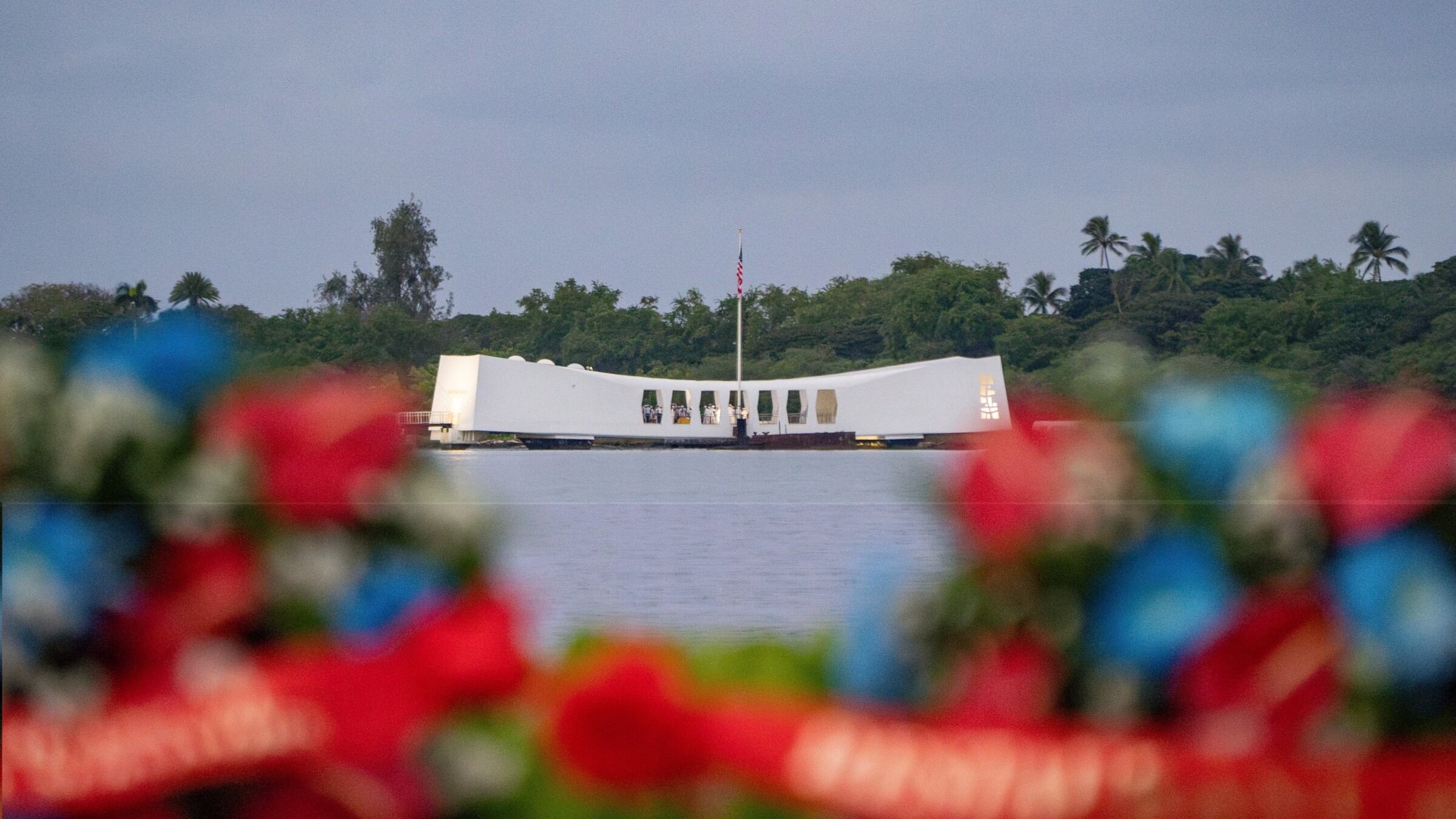
Thursday’s ceremony was held on a field across the harbor from the USS Arizona Memorial, a white structure that sits above the rusting hull of the battleship, which exploded in a fireball and sank shortly after being hit. More than 1,100 sailors and Marines from the Arizona were killed and more than 900 are entombed inside.
David Kilton, the National Park Service's interpretation, education and visitor services lead for Pearl Harbor, noted that for many years survivors frequently volunteered to share their experiences with visitors to the historic site. That's not possible anymore.
“We could be the best storytellers in the world and we can't really hold a candle to those that lived it sharing their stories firsthand,” Kilton said. “But now that we are losing that generation and won’t have them very much longer, the opportunity shifts to reflect even more so on the sacrifices that were made, the stories that they did share.”
The U.S. Department of Veterans Affairs doesn’t keep statistics for how many Pearl Harbor survivors are still living. But department data show that of the 16 million who served in World War II, only about 120,000 were alive as of October and an estimated 131 die each day.
There were about 87,000 military personnel on Oahu at the time of the attack, according to a rough estimate compiled by military historian J. Michael Wenger.
Schab never spoke much about Pearl Harbor until about a decade ago. He's since been sharing his story with his family, student groups and history buffs. And he's returned to Pearl Harbor several times since.
The reason? “To pay honor to the guys that didn’t make it,” he said.
Harry Chandler, 102, recalled raising the flag at a mobile hospital in Aiea Heights in the hills above Pearl Harbor in 1941. He was a was a Navy hospital corpsman 3rd Class at the time.
Sitting in his front-row seat on the ceremony grounds overlooking the harbor on Thursday, Chandler said the memories of the USS Arizona blowing up still come back to him today.
“I saw these planes come, and I thought they were planes coming in from the states until I saw the bombs dropping,” Chandler said. They took cover and then rode trucks down to Pearl Harbor where they attended to the injured.
He remembers sailors trapped on the capsized USS Oklahoma tapping on the hull of their ship to get rescued, and caring for those who eventually got out after teams cut holes in the ship.
“I look out there and I can still see what’s going on. I can still see what was happening,” said Chandler, who today lives in Tequesta, Florida.
Asked what he wants Americans to know about Pearl Harbor, he said: “Be prepared.”
“We should have known that was going to happen. The intelligence has to be better,” he said.
Schab's ship, the Dobbin, lost three sailors, according to Navy records. One was killed in action and two died later of wounds suffered when fragments from a bomb struck the ship's stern. All had been manning an anti-aircraft gun.
Marine Corps. Capt. Daniel Hower, the 29-year-old grand-nephew of Conter, the last remaining USS Arizona survivor, delivered the keynote address, reading from a podium as he faced the survivors seated in the front row, Pearl Harbor sitting still behind them beneath a light blue sky and scattered white clouds. Hower acknowledged the collective humility of their military service.
“Whenever my Uncle Lou or any other veteran of World War II is recognized or thanked for their service, they humbly answer: ‘We just did what we had to do,’” Hower said.
Hower then hailed their sacrifice, determination, heroism and courage.
“The legacy that you all built remains unmatched and a lesson that keeps on teaching,” Hower said.
That Sunday morning had started peacefully for Schab. He was expecting a visit from his brother, who was also in the Navy and was assigned to a naval radio station in Wahiawa, north of Pearl Harbor. The two never did get together that day.
Schab spent most of World War II in the Pacific with the Navy, going to the New Hebrides, now known as Vanuatu, and then the Mariana Islands and Okinawa.
After the war, he worked on the Apollo program sending astronauts to the moon as an electrical engineer at General Dynamics.
Schab has slowed down in recent years. But he still gets together each week for cocktails over Zoom with younger members of his fraternity, Delta Sigma Phi. He drinks cranberry-raspberry juice.
At his age, he's thankful to still be able to return to Pearl Harbor with his family and caregivers. The family has a GoFundMe account to help them raise money for the pilgrimage.
“Just grateful that I’m still here,” Schab said. “That’s really how it feels. Grateful.”
Rush reported from Beaverton, Oregon. Associated Press researcher Rhonda Shafner in New York contributed to this report.